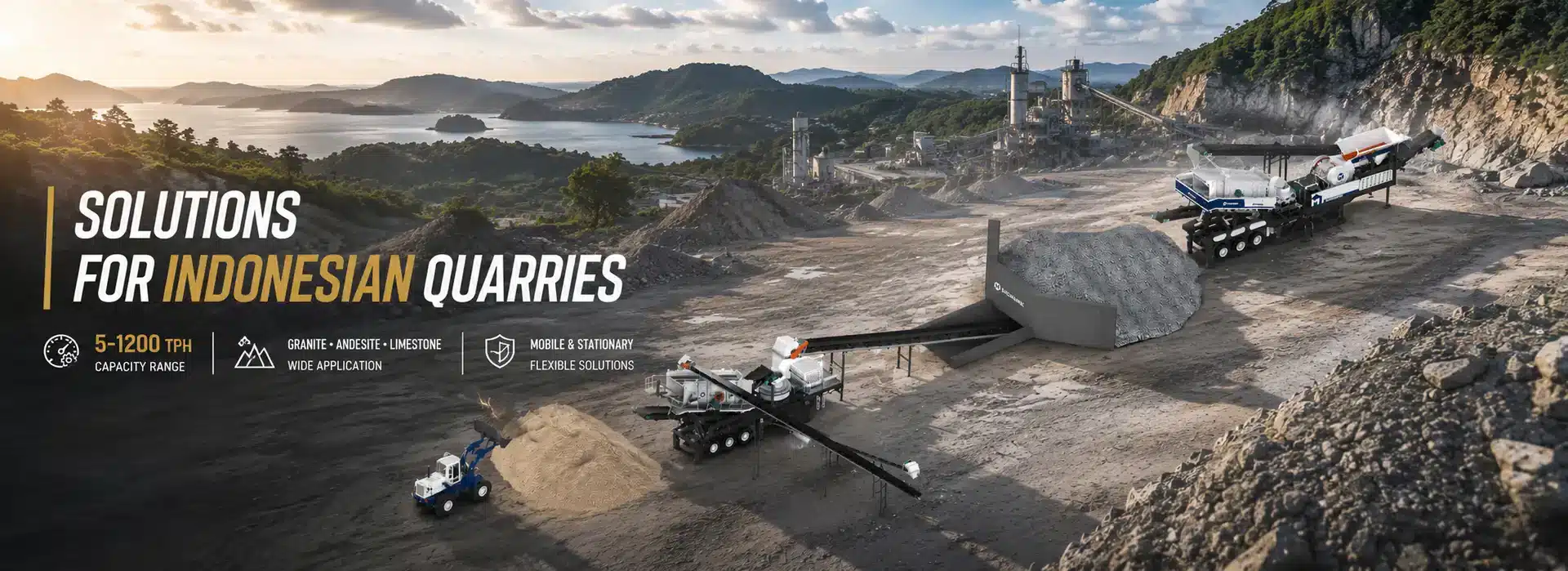
Rock crusher machines in Indonesia play an important role in converting natural rock resources into high-quality aggregates for construction, mining, and infrastructure development. With Indonesia’s aggregate demand exceeding 200 million tons annually and its 17,000+ islands creating challenges in material transportation, efficient local rock processing has become increasingly important. From rock characteristics and industry applications to crushing solutions and project selection, understanding the right processing approach helps quarry operators, mining companies, and contractors achieve stable and efficient aggregate production.
 5-1200+ TPH – Flexible production capacity.
 4+ Rock Types – Diverse material processing.
 3-Stage Crushing – Quality aggregate production.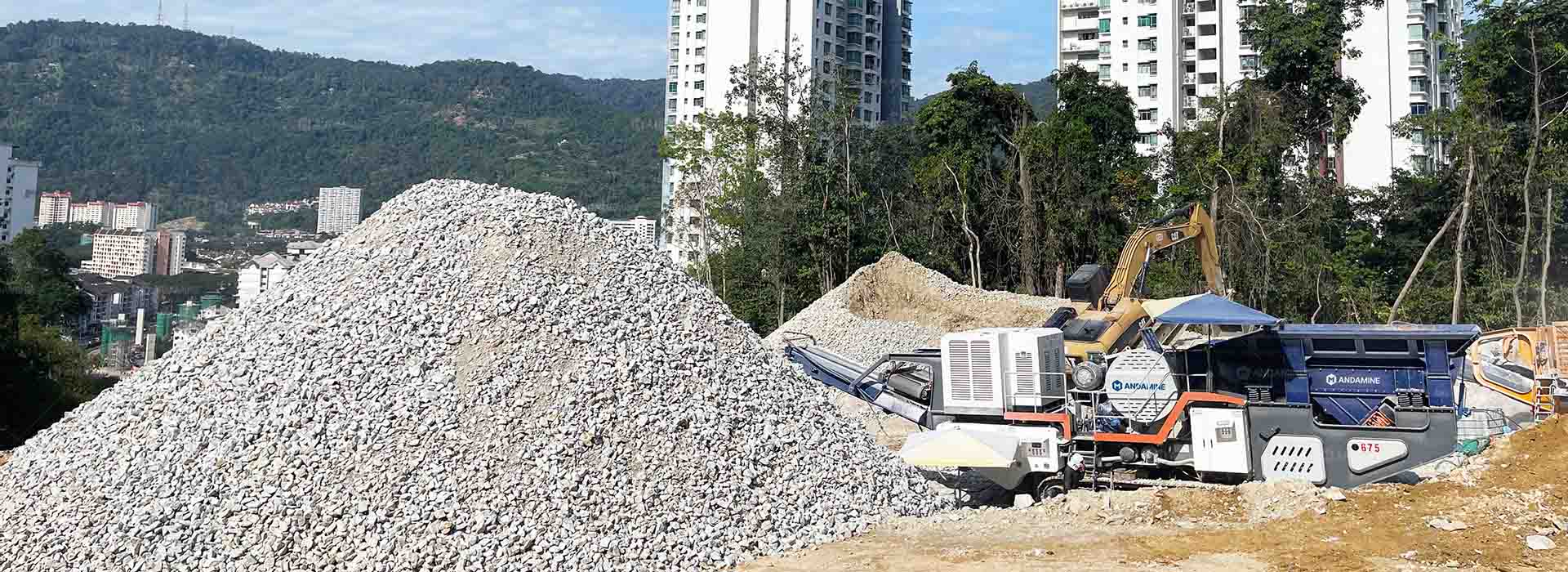
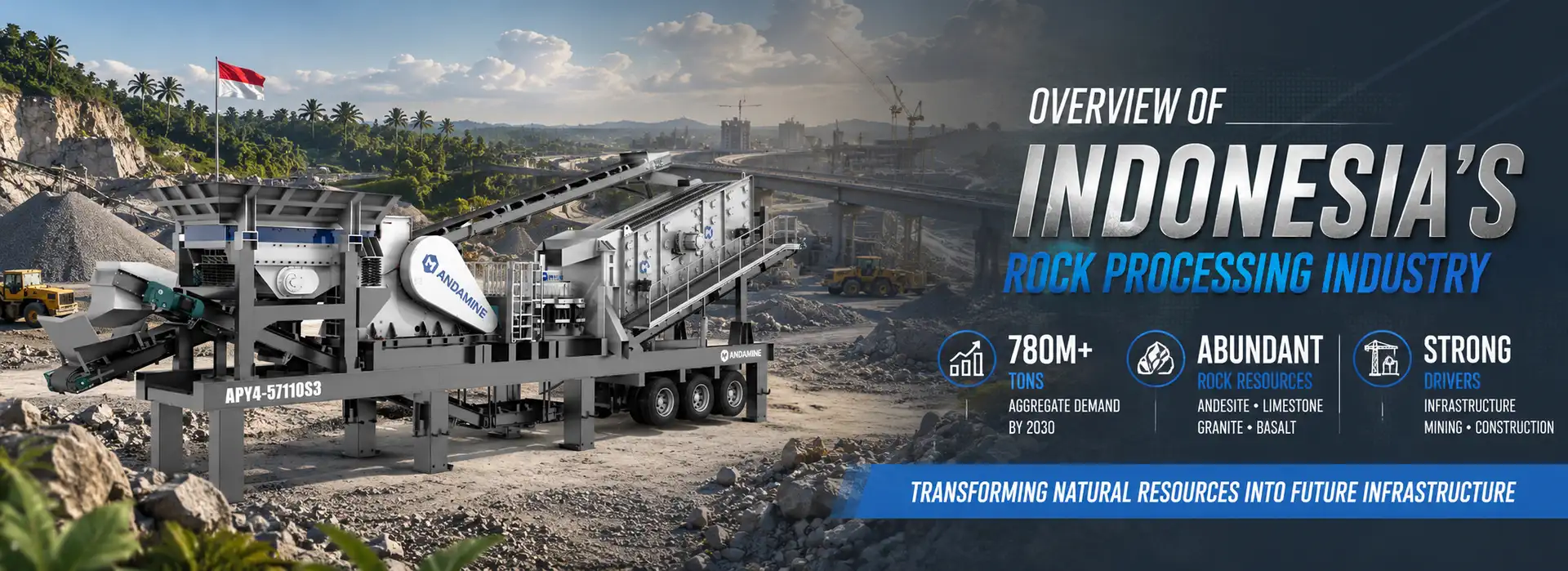
Overview of Indonesia’s Rock Processing Industry
Indonesia’s rock processing industry supports infrastructure, mining, and construction development by transforming natural resources into qualified aggregates. With abundant rocks such as andesite, limestone, granite, and basalt, Indonesia has strong potential for aggregate production. Driven by infrastructure expansion, urban development, and mining activities, Indonesia’s aggregate demand continues growing. The demand for sand and gravel aggregates is expected to exceed 780 million tons by 2030, increasing the need for efficient rock crushing machines in Indonesia.
Behind every successful rock crushing project is the right raw material. Indonesia’s abundant rock resources provide enormous opportunities, but each rock type requires a different processing approach. Let’s explore the country’s major rock resources and how they influence aggregate production and crusher selection.
What Are the Rock Resources Used for Aggregate Raw Materials?
Indonesia has abundant rock resources due to its complex geological conditions and volcanic activities. The main rocks processed for aggregates in Indonesia include andesite, limestone, granite, and basalt. Their geological characteristics and physical properties directly influence material quality, processing difficulty, and crushing project planning.
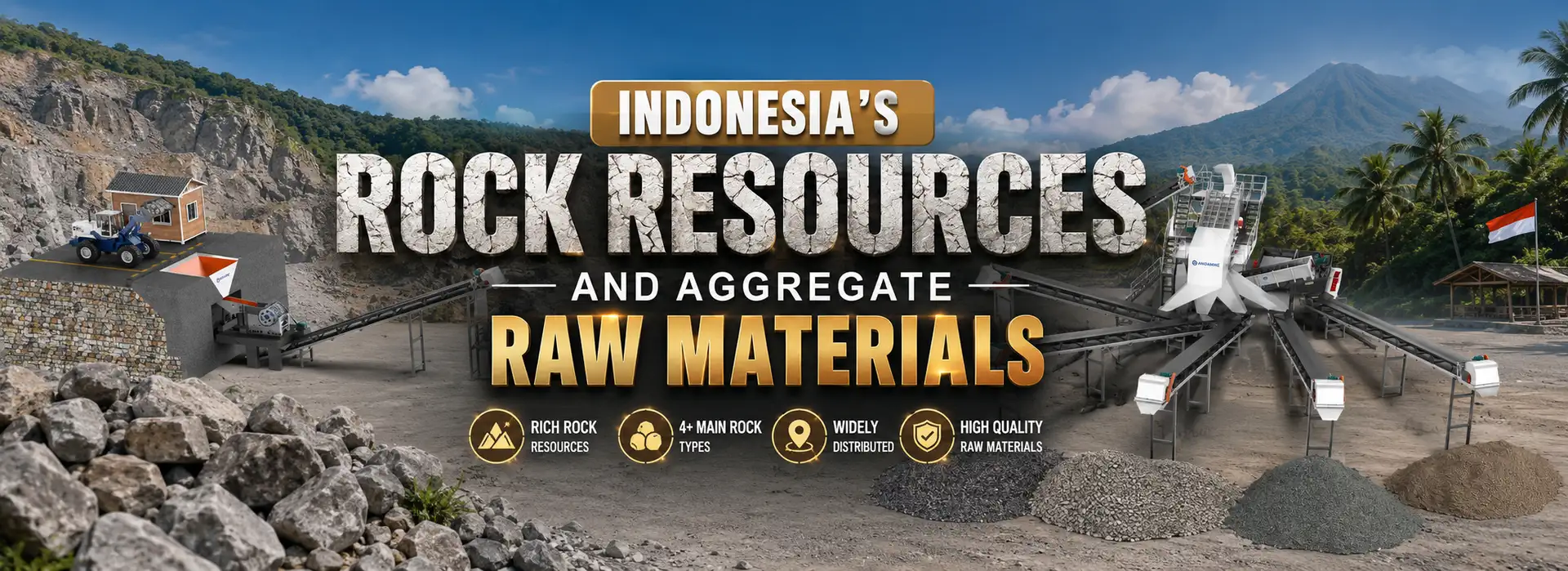
Indonesia’s aggregate industry mainly uses volcanic rocks and sedimentary rocks. The most common raw materials for rock crushing and aggregate production include the following:
| Rock Type | Geological Type | Hardness | Density | Compressive Strength | Main Distribution Areas in Indonesia | Key Characteristics |
|---|---|---|---|---|---|---|
| Andesite | Volcanic rock | 6–7 Mohs | 2.5–2.8 t/m³ | 100–250 MPa | West Java, Central Java, East Java | Dense volcanic rock with high strength, good durability, and stable quality, widely used for construction aggregates |
| Limestone | Sedimentary rock | 3–4 Mohs | 2.3–2.7 t/m³ | 30–150 MPa | East Java, South Sulawesi, West Nusa Tenggara, Aceh | Widely distributed resource with moderate hardness and good processing efficiency for large-volume production |
| Granite | Igneous rock | 6–8 Mohs | 2.6–2.8 t/m³ | 100–300 MPa | Bangka Belitung, Sumatra, Kalimantan | Hard rock with high strength, excellent durability, and strong resistance to abrasion |
| Basalt | Volcanic rock | 6–7 Mohs | 2.7–3.1 t/m³ | 150–300 MPa | Java and other volcanic regions | Dense and high-strength rock with good weather resistance and stable mechanical performance |
Key Considerations for Rock Processing
The characteristics of raw materials directly affect aggregate production performance.
- Hardness and strength influence crushing difficulty and energy requirements.
- Abrasiveness affects equipment wear and maintenance frequency.
- Material properties influence aggregate shape, size distribution, and final product quality.
Rock resources are only valuable when they are transformed into the right materials for the right projects. Across Indonesia, different industries rely on crushed aggregates with varying sizes and specifications. Let’s explore where alat pemecah batu gunung adalah making the greatest impact and why different applications require different crushing solutions.
Main Applications of Rock Crusher Machines in Indonesia
Indonesia’s growing construction, mining, and infrastructure sectors continue to increase demand for processed aggregates. Rock crusher machines play an important role in converting locally available rocks, including andesite, limestone, granite, and basalt, into different sizes of aggregates required for engineering projects, building materials, and industrial development. From commercial quarries to remote construction sites, crushing plants help improve aggregate availability, reduce transportation challenges, and support stable material supply across Indonesia.
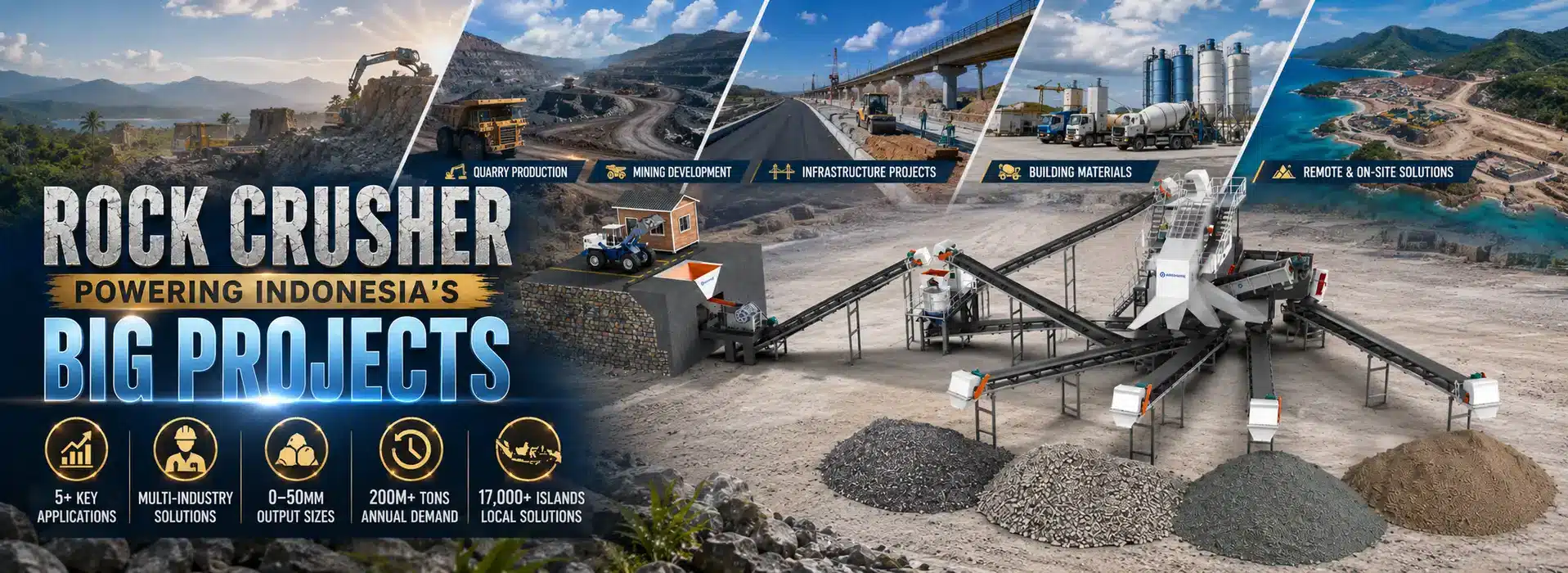
| Application Area | Main Users | Industry Demand / Data | Typical Raw Materials | Typical Output Sizes | Main Applications |
|---|---|---|---|---|---|
| Commercial Quarry Aggregate Production | Quarry operators, aggregate suppliers | Indonesia’s aggregate demand exceeds 200 million tons/year, requiring continuous crushed stone production | Andesite, basalt, limestone, granite | 0–5 mm: fine aggregate 10–20 mm: general construction aggregate 20–40 mm: coarse aggregate 0–50 mm: road base materials | Commercial aggregate supply, concrete production, buildings, and infrastructure projects |
| Mining and Mine Infrastructure Development | Mining companies, industrial developers | Major mining activities in Kalimantan and Sulawesi require supporting construction materials | Granite, limestone, basalt, waste rock | 0–50 mm: mine roads and filling materials 10–20 mm: construction aggregate 20–40 mm: foundation materials | Mine access roads, processing facilities, equipment foundations, industrial sites |
| Infrastructure Construction Projects | Contractors, EPC companies, government projects | Indonesia has more than 200,000 km of road networks, creating continuous demand for crushed aggregates | Andesite, basalt, granite | 0–50 mm: base and sub-base layers 5–15 mm: asphalt aggregate 10–25 mm: pavement aggregate | Roads, highways, bridges, ports, airports, and transportation projects |
| Construction Material Production | Ready-mix plants, asphalt producers, precast manufacturers | Indonesia’s ready-mix concrete market is estimated at approximately 115.65 million m³ in 2025 | Andesite, limestone, basalt | 0–5 mm: manufactured sand 5–10 mm: asphalt aggregate 10–20 mm: concrete aggregate | Ready-mix concrete, precast products, asphalt mixtures, and building materials |
| Remote and On-Site Aggregate Production | Regional contractors, mining projects, remote infrastructure developers | Indonesia consists of more than 17,000 islands, making long-distance material transportation challenging | Locally available rock resources | 0–50 mm: road materials 10–40 mm: construction aggregates | Remote infrastructure, mining development, and large engineering projects |
Rock crusher machines serve a wide range of industries, but producing aggregates is only the first step. Choosing the right aggregate for the right engineering application is what truly determines project quality and performance. Let’s see how different aggregate sizes match different construction needs.
Matching Rock Aggregates to Different Engineering Applications
In Indonesia, different engineering projects have different requirements for crushed rock aggregates. Road construction, concrete production, asphalt pavement, and mining infrastructure all require specific aggregate sizes, strength levels, and grading characteristics. These requirements directly affect rock selection, crushing process design, and screening configuration.
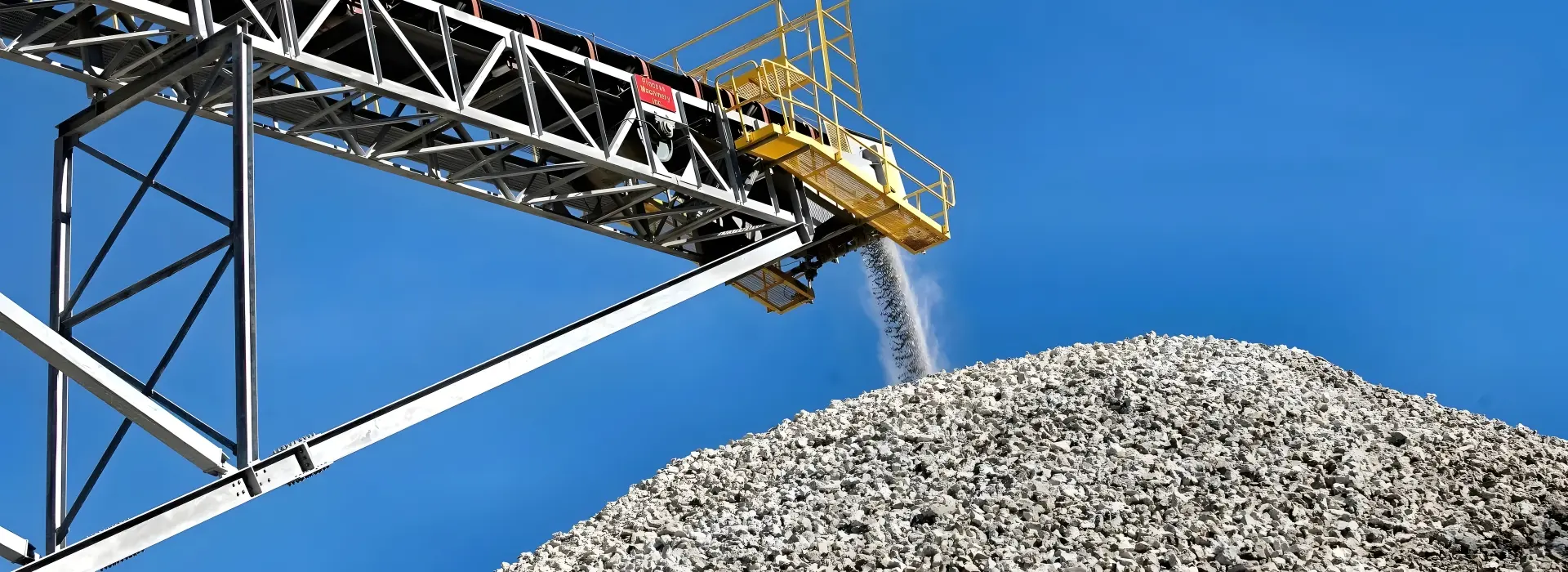
Road Construction Aggregate Requirements
- Base layer materials: Aggregates around 20–40 mm are commonly used for road foundation layers because they provide strong structural support and improve load distribution.
- Sub-base materials: Larger crushed stone materials, sometimes 40–70 mm, may be required for deeper foundation layers depending on project design.
- Surface layer materials: Smaller aggregates around 5–20 mm are preferred for better compaction and smoother pavement performance.
- Key requirements: Road aggregates need good crushing resistance, stable grading, and strong durability to withstand heavy traffic and tropical weather conditions.
- Rock crusher consideration: Crushing plants need effective size control through jaw crushers, secondary crushers, and vibrating screens to produce multiple road aggregate specifications.
Concrete Production Aggregate Requirements
- Coarse aggregate sizes: Common sizes include 10–20 mm and 20–40 mm, which are widely used for structural concrete production.
- Fine aggregate sizes: Materials below 5 mm are used to improve concrete mixture filling and workability.
- Material quality requirements: Aggregates should have sufficient strength, low impurity content, and stable grading to support concrete performance.
- Rock types commonly processed: Andesite, basalt, granite, and limestone are frequently used depending on regional availability.
- Rock crusher consideration: The crushing and screening system should maintain accurate particle size distribution and reduce excessive flaky or oversized materials.
Asphalt Mixture Aggregate Requirements
- Fine aggregate: Materials below 5 mm are used to fill gaps and improve asphalt mixture stability.
- Medium aggregate: Sizes around 5–10 mm are commonly used in asphalt mixture structures.
- Coarse aggregate: Materials around 10–20 mm provide skeleton strength and improve pavement load resistance.
- Key requirements: Aggregates need good particle shape, abrasion resistance, and stable grading to maintain asphalt pavement durability.
- Rock crusher consideration: Impact crushers, cone rock crushers, and screening systems are often selected to improve aggregate shape and achieve accurate grading.
Mining Road Aggregate Requirements
- Road foundation materials: Aggregates around 20–40 mm or larger sizes are commonly used for mine road construction.
- Strength requirements: Materials need high resistance against impact, crushing, and abrasion caused by heavy mining vehicles.
- Durability requirements: Aggregates should maintain stability under continuous traffic and changing weather conditions.
- Supply requirements: Mining projects often prefer local crushing production to reduce dependence on long-distance aggregate transportation.
- Rock crusher consideration: Mining applications require durable crushing equipment designed for continuous operation and hard rock processing.
Aggregate Size, Strength, and Grading Requirements
| Factor | Typical Range / Requirement | Influence on Crushing |
|---|---|---|
| Aggregate size | From fine materials below 5 mm to coarse aggregates above 40 mm | Determines crushing stages and screening mesh selection |
| Rock strength | Hard rocks such as granite, basalt, and andesite require stronger crushing capability | Affects crusher type and wear part selection |
| Particle shape | Cubical aggregates are preferred for asphalt and high-quality concrete | Influenced by secondary and tertiary crushing methods |
| Grading distribution | Different projects require different size combinations | Requires efficient vibrating screening systems |
Selecting the right aggregate is only part of the solution. Understanding how raw rock is transformed into high-quality construction materials helps you optimize both product quality and production efficiency. Next, let’s follow the complete rock processing journey from quarry to finished aggregates.
Rock Processing Process: From Raw Rock to Construction Materials
The rock processing process in Indonesia covers the complete journey from raw rock extraction to finished aggregates for construction projects. It includes quarrying, material transportation, crushing and screening, aggregate supply, and final applications. Understanding this process helps companies choose suitable rock crushing solutions for different project requirements. Rock Mining → Raw Material Processing → Aggregate Production → Distribution → End Application.
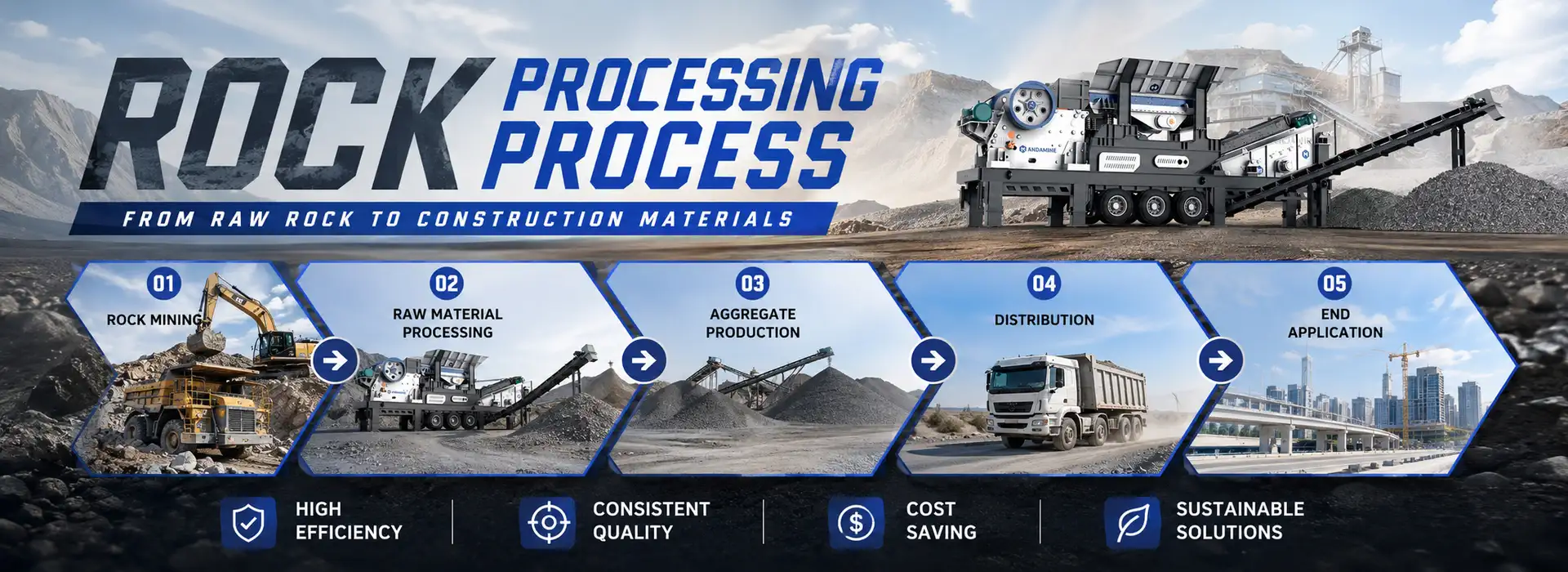
Extracting Raw Rocks from Quarries and Mining Areas
Rock resource extraction is the first step in Indonesia’s rock processing process. Natural rocks are collected from quarries and mining areas before being processed into construction aggregates.
Indonesia has abundant rock resources, including:
- Andesite for road construction and concrete aggregates.
- Limestone for cement production and general construction materials.
- Granite and basalt for high-strength infrastructure projects.
The extraction process mainly includes: Drilling → Blasting → Excavation → Loading.
After extraction, large rocks with sizes commonly ranging from 300–1,000 mm are transported to stone crushing plants for further processing into different aggregate sizes.
Transporting Raw Materials to Processing Sites
After rock extraction, raw materials need to be transported from quarries or mining areas to crushing plants for processing. Efficient transportation is important because logistics costs can directly affect aggregate production costs.
Common transportation methods include:
- Dump trucks: used for quarry operations and short-distance material movement.
- Mining trucks: suitable for large-scale mining projects.
- Conveyor systems: used in fixed crushing plants for continuous material supply.
In Indonesia, many rock resources are located far from construction areas, especially in regions such as Kalimantan, Sulawesi, and Papua. Local crushing plants help reduce long-distance transportation and provide a more stable supply of construction aggregates.
Processing Rocks into Construction Aggregates
Crushing and screening is the key stage that transforms large raw rocks into usable construction aggregates. This process controls the final material size, quality, and production efficiency. A typical rock processing flow includes: Feeding → Primary Crushing → Secondary Crushing → Screening → Stockpiling.
Main processing steps:
- Primary crushing: Jaw crushers reduce large rocks into smaller sizes.
- Secondary crushing: Cone crushers or impact crushers further process materials to meet application requirements.
- Screening: Vibrating screens separate aggregates into different sizes.
A suitable crushing and screening system helps Indonesian quarry and construction companies achieve stable production and consistent aggregate quality.
Supplying Aggregates to Different Markets
After processing, finished aggregates enter the market through different supply channels. Aggregate producers usually supply materials to construction companies, infrastructure contractors, concrete plants, and asphalt producers. The supply model depends on project location, production scale, and customer demand:
- Commercial quarry supply: Long-term production for regional construction material markets.
- Project-based supply: Producing aggregates for specific infrastructure or mining projects.
- Integrated supply: Combining quarrying, crushing, and material production to improve supply control.
In Indonesia, stable aggregate supply is important for reducing project delays and ensuring continuous material availability for growing construction and infrastructure development.
Applying Aggregates in Engineering Projects
Processed aggregates are the final products of the rock processing chain and are widely used in Indonesia’s construction and infrastructure projects. Main application areas include:
- Road construction: Providing materials for highway, rural road, and pavement projects.
- Building construction: Supporting concrete production and structural development.
- Mining infrastructure: Supplying materials for mine roads, platforms, and site preparation.
- Public infrastructure: Used in bridges, ports, airports, and other large-scale projects.
The demand for high-quality aggregates continues to grow as Indonesia expands transportation networks, industrial areas, and regional development projects. A reliable rock processing system helps ensure stable material supply throughout the project lifecycle.
As rock crusher machines are applied to more projects across Indonesia, the challenges behind efficient aggregate production become increasingly important. From raw materials and site conditions to logistics and production efficiency, understanding these challenges helps identify the right solution for long-term project success.
Main Challenges Facing Rock Processing Industry in Indonesia
Indonesia’s rock processing industry faces challenges from resource distribution, island geography, construction demand, operating costs, and environmental requirements. These challenges directly influence how companies select and operate rock crushing solutions.
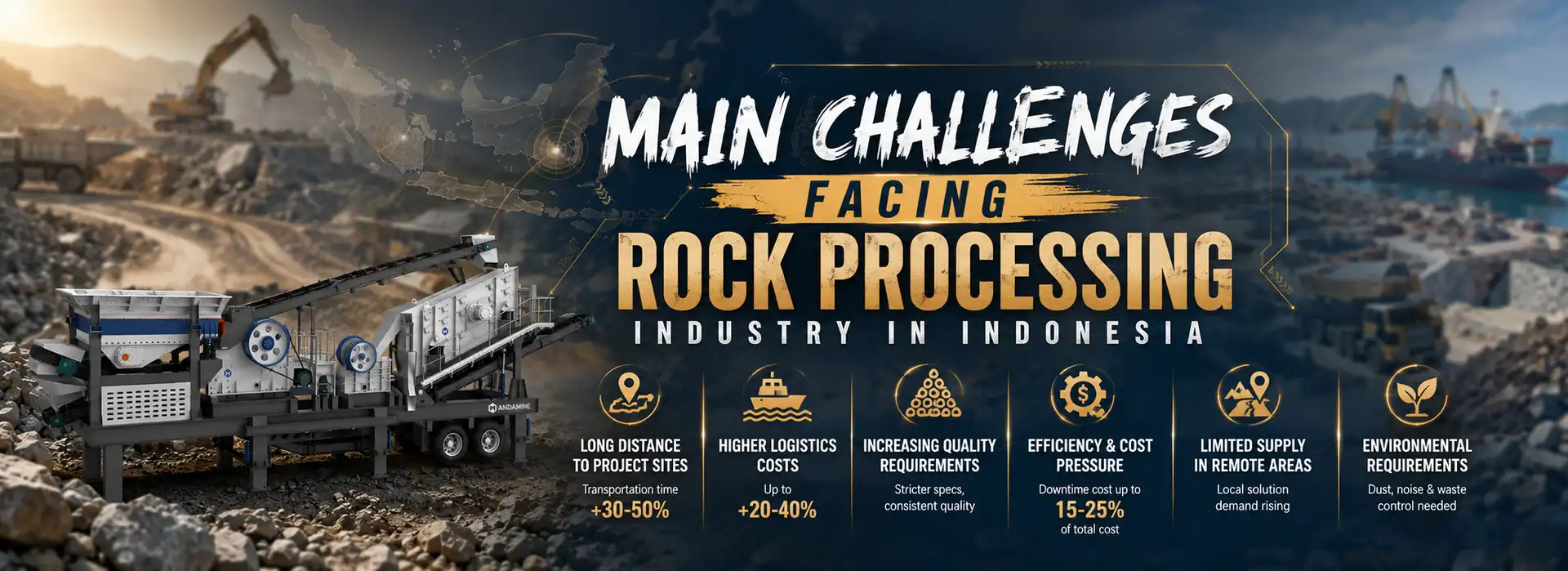
| Main Challenge | Impact on Rock Processing Business | Related Rock Crusher Requirements |
|---|---|---|
| Long distance between rock resources and project sites | Aggregate transportation over long distances increases delivery time and material costs, especially for remote construction areas. | Require local crushing solutions that can process raw rocks closer to project locations. |
| Higher logistics costs caused by island geography | Indonesia’s archipelago structure makes aggregate transportation between islands more complex and expensive. | Require regional crushing plants or mobile solutions to improve local material supply efficiency. |
| Increasing aggregate quality requirements | Infrastructure projects require more consistent aggregate sizes and better material quality. | Require efficient crushing and screening systems to produce controlled aggregate specifications. |
| Production efficiency and cost pressure | Companies need to maintain output while reducing energy consumption, downtime, and maintenance costs. | Require reliable crushers with durable components and efficient operating performance. |
| Limited material supply in remote areas | Many road, mining, and infrastructure projects are located far from existing aggregate suppliers. | Require flexible crushing solutions that can support on-site aggregate production. |
| Environmental and sustainability requirements | Crushing operations need better control of dust, noise, waste, and resource utilization. | Require modern crushing equipment with improved efficiency and environmentally friendly operation features. |
The challenges are clear, but they can be overcome with the right crushing solution. Choosing equipment that fits your material, production target, and project conditions is the key to improving efficiency and long-term performance. Next, discover how to select the right rock crusher for your project in Indonesia.
How to Choose the Right Rock Crusher for Indonesian Projects?
Selecting the right rock crusher for your Indonesia project requires more than comparing equipment models or prices. The best crushing solution should be evaluated from five key aspects: rock type, production capacity, project location, final product requirements, and project duration. Each factor affects the crusher configuration, processing method, and overall investment efficiency. By understanding these factors, you can choose a rock crushing system that better fits your project’s actual conditions and long-term production goals.
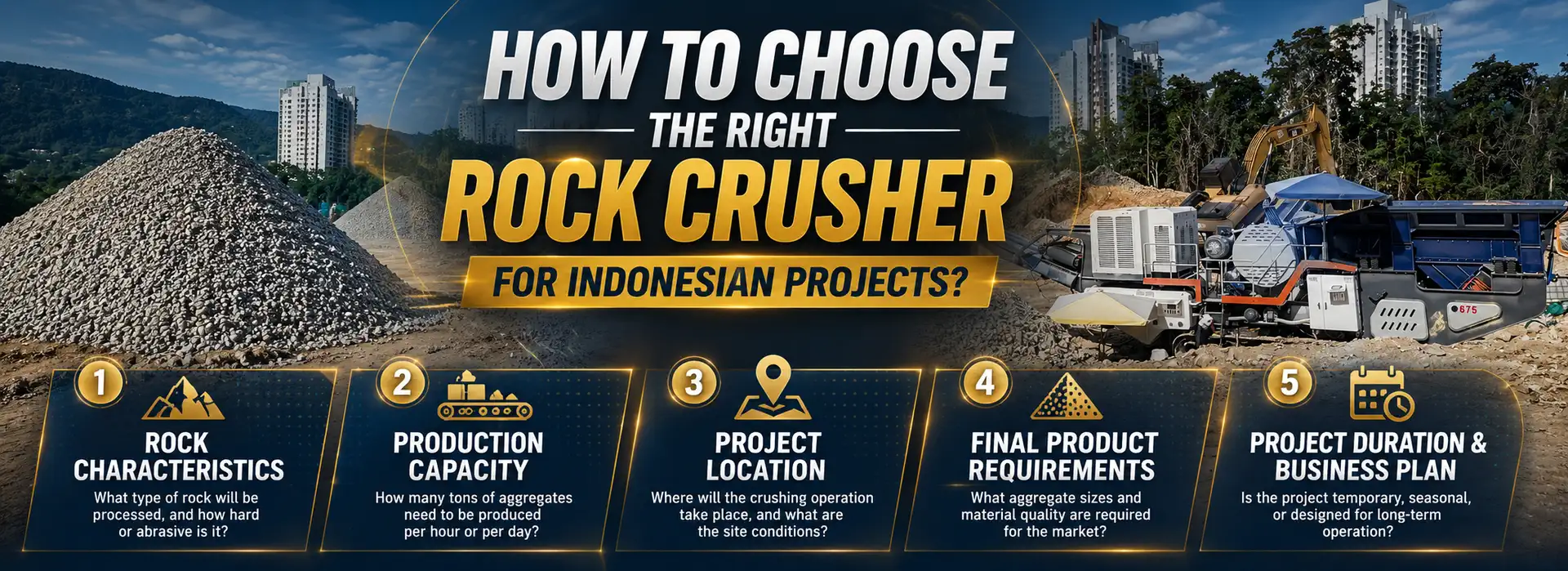
| Project Factor | Key Question to Consider | How It Affects the Crushing Solution |
|---|---|---|
| Rock Characteristics | What type of rock will be processed, and how hard or abrasive is it? | Determines the suitable crusher type, crushing stages, and wear-resistant requirements for efficient processing. |
| Production Capacity | How many tons of aggregates need to be produced per hour or per day? | Defines the required equipment size, production line configuration, and overall plant capacity. |
| Project Location | Where will the crushing operation take place, and what are the site conditions? | Influences whether a mobile, semi-mobile, or stationary crushing solution is more suitable. |
| Final Product Requirements | What aggregate sizes and material quality are required for the market? | Determines the crushing process, screening configuration, and whether additional shaping or washing is needed. |
| Project Duration & Business Plan | Is the project temporary, seasonal, or designed for long-term operation? | Affects investment strategy, equipment mobility, installation method, and expected return on investment. |
Choose Mobile or Stationary Rock Crushing Solution Based on Project Duration
The decision between mobile and stationary crushing plants depends on: Project Duration + Relocation Frequency + Transportation Cost. A mobile crusher is not always the cheapest option, and a stationary plant is not always the best choice. The right solution depends on the project’s business model.
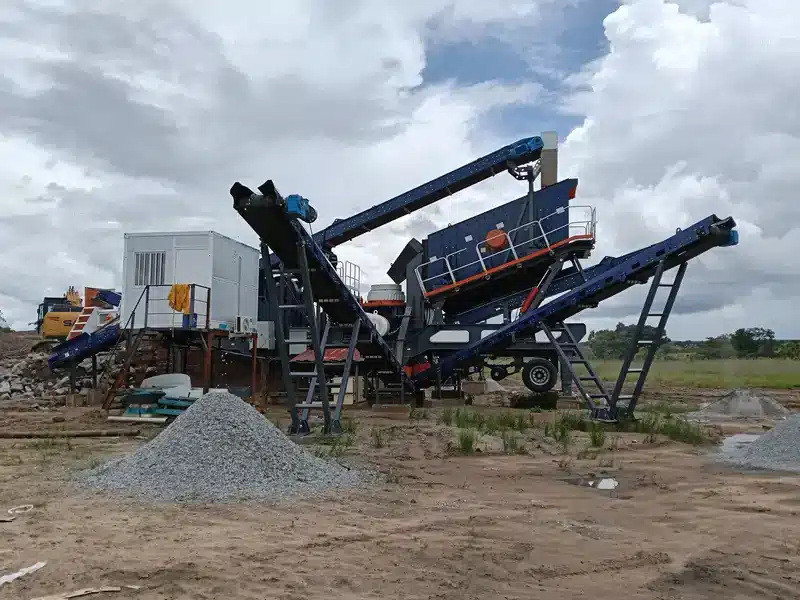
Mobile Crushing Solution
- Best For: Short-term projects, Road construction, Multiple working locations, Temporary aggregate production.
- Recommended Process: Rock Source → Mobile Crusher Installation → On-Site Crushing → Aggregate Supply → Relocation to Next Site.
- Series: APYL(Crawler Type), APY2 (2-in-1), APY3 (3-in-1), and APY4 (4-in-1) mobile crushing plants.
- Capacity: 50–400 TPH, covering small, medium, and large mobile crushing requirements.
- Materials: Suitable for granite, basalt, andesite, limestone, river stone, and construction waste commonly found in Indonesia.
- Applications: Road construction, quarry operations, mining support, remote projects, and temporary aggregate production.
- Mobility Advantages: Integrated design, fast deployment, easy relocation, and reduced site preparation requirements, suitable for Indonesia’s remote areas and multi-location projects.
- Smart Operation: Equipped with intelligent control and IoT monitoring options to support real-time operation management and improve production reliability.
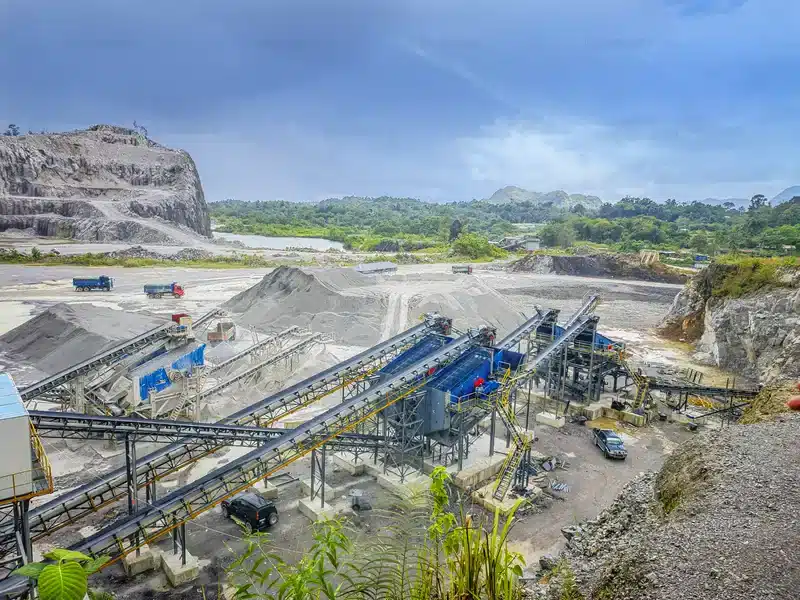
Stationary Crushing Solution
- Best For: Long-term quarry operations, Large aggregate businesses, and Mining projects
- Recommended Process: Quarry Site → Fixed Crushing Plant → Screening System → Aggregate Stockpile → Continuous Market Supply.
- Configuration: Customized crushing and screening systems designed according to Indonesian project requirements.
- Capacity: 50–1000+ TPH, suitable for medium and large-scale aggregate production.
- Materials: Designed for granite, basalt, andesite, limestone, river stone, and other construction aggregates.
- Applications: Quarry operations, mining projects, infrastructure material supply, and commercial aggregate production.
- Process Optimization: Customized crushing stages, screening systems, and conveyor layouts to improve output stability and aggregate quality.
- Long-Term Advantages: Stable continuous production, lower cost per ton, higher automation potential, and flexible expansion for future production growth.
Choose the Crushing Solution Based on Rock Type
Different rocks have different hardness, abrasiveness, and crushing characteristics. Selecting the correct crushing process can improve production efficiency, reduce equipment wear, and ensure better aggregate quality.
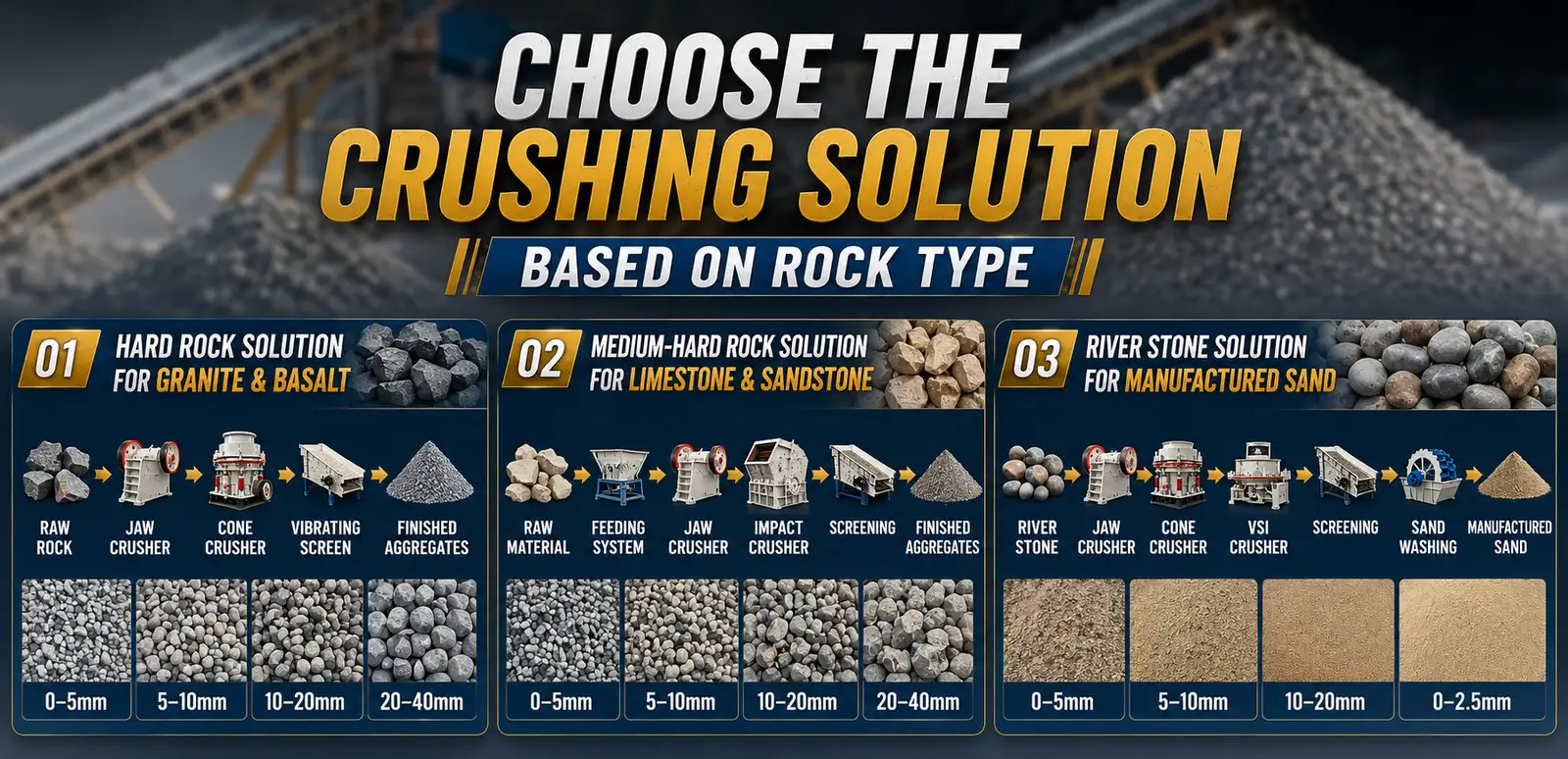
Granite and Basalt Crushing Solution for Hard Rock Projects
Granite and basalt are among the hardest rocks commonly processed in Indonesia. They are widely used for Highway construction aggregates, Concrete production, Large infrastructure projects, and Commercial quarry operations.
- Recommended Crushing Process: Granite/Basalt Raw Rock → Primary Crushing (Jaw Crusher) → Secondary Crushing (Cone Crusher) → Screening (Vibrating Screen) → Different Sizes of Finished Aggregates.
- Typical Applications: Toll road construction, Large-scale infrastructure projects, and Long-term quarry businesses.
- Recommended Solution Characteristics: High crushing strength, Wear-resistant components, Stable production capacity, and Multi-stage crushing capability.
Limestone and Sandstone Crushing Solution for Medium-Hard Rock
Limestone is one of the most commonly processed rocks in Indonesia. Compared with granite and basalt, limestone is easier to crush and usually requires less energy.
- It is widely used in: Cement production, Building materials, Road base materials, and Construction aggregates.
- Recommended Crushing Process: Limestone Raw Material → Feeding System → Primary Crushing (Jaw Crusher) → Secondary Crushing (Impact Crusher) → Screening → Finished Limestone Aggregates.
- Advantages: Lower investment requirement, Higher crushing efficiency, Good production output, and Suitable for large-volume processing.
- Suitable Projects: Limestone quarries, Cement-related industries, and Local aggregate suppliers.
River Stone Crushing and Manufactured Sand Production Solution
With increasing demand for construction materials and restrictions on natural sand extraction in some regions, manufactured sand has become an important alternative in Indonesia.
- River stones usually have: High hardness, Smooth surface, and Round particle shape.
- Recommended Crushing Process: River Stone → Primary Crushing (Jaw Crusher) → Secondary Crushing (Cone Crusher) → Sand Making (VSI Crusher) → Screening → Sand Washing → Manufactured Sand.
- Suitable Applications: Ready-mix concrete plants, Building construction, and Urban infrastructure projects.
- Key Benefits: Stable sand supply, Reduced dependence on natural sand, and Better control of particle size and quality.
Select Equipment Configuration Based on Production Capacity
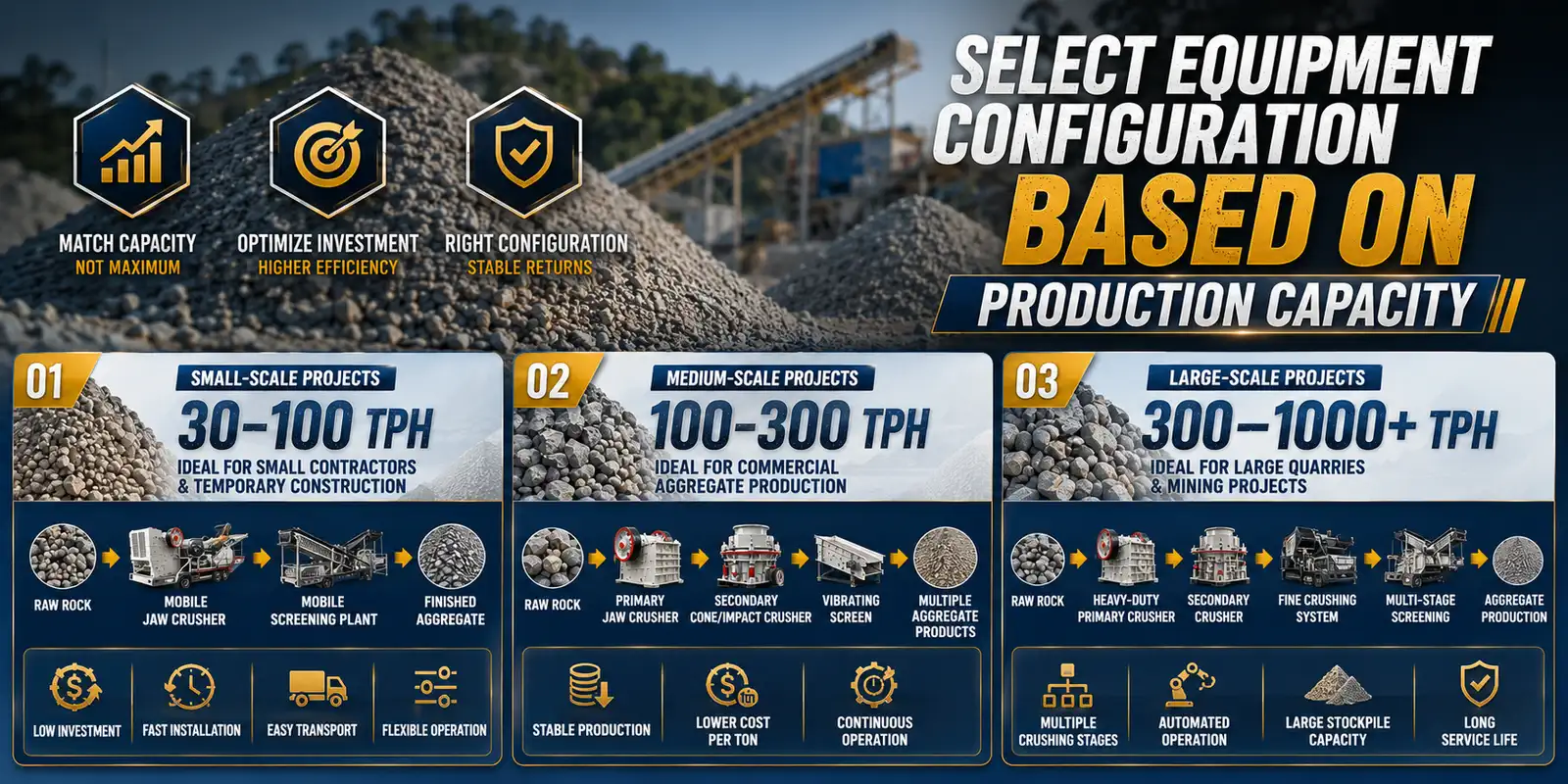
Production capacity directly determines the scale and investment level of a crushing project. A common mistake is selecting equipment only according to maximum capacity. A better approach is to calculate based on: Required daily output, Annual production target, Working hours per day, Raw material availability, and Market demand.
| Project Scale | Typical Capacity | Suitable Applications |
|---|---|---|
| Small-scale projects | 30–100 TPH | Small contractors, temporary construction |
| Medium-scale projects | 100–300 TPH | Commercial aggregate production |
| Large-scale projects | 300–1000+ TPH | Large quarries and mining projects |
Small-Scale Crushing Projects (30–100 TPH)
Small-scale projects focus on flexibility, quick deployment, and cost-effective production.
Small projects usually focus on:
- Lower initial investment
- Fast installation
- Easy transportation
- Flexible operation
Recommended Crushing Process: Raw Rock → Mobile Jaw Crusher → Mobile Screening Plant → Finished Aggregate.
Suitable Applications:
- Small quarry operations
- Local construction projects
- Short-term aggregate supply
Medium-Scale Crushing Projects (100–300 TPH)
Medium-scale projects require a balance between investment and production efficiency.
The main goals are:
- Stable production
- Lower cost per ton
- Continuous operation
Recommended Crushing Process: Raw Rock → Primary Jaw Crusher → Secondary Cone Crusher/Impact crushers → Vibrating Screen → Multiple Aggregate Products.
Suitable Applications:
- Commercial aggregate suppliers
- Ready-mix concrete supply
- Regional construction projects
Large-Scale Crushing Projects (300 TPH+)
Large projects require higher reliability and continuous production.
Typical requirements include:
- Multiple crushing stages
- Automated operation
- Large stockpile capacity
- Long service life
Recommended Crushing Process: Raw Rock → Heavy-Duty Primary Crusher → Secondary Crusher → Fine Crushing System → Multi-Stage Screening → Large-Scale Aggregate Production.
Suitable Applications:
- Large mining companies
- Industrial quarries
- National infrastructure supply projects
Choose the Processing Mode Based on Project Scenario
Indonesia’s geographical conditions make location an important factor in crushing plant selection. Because Indonesia consists of thousands of islands, transportation distance can significantly affect aggregate production costs. The best rock crusher processing mode depends on whether the project is located: Near the quarry source, Near the construction site, and In a remote area.
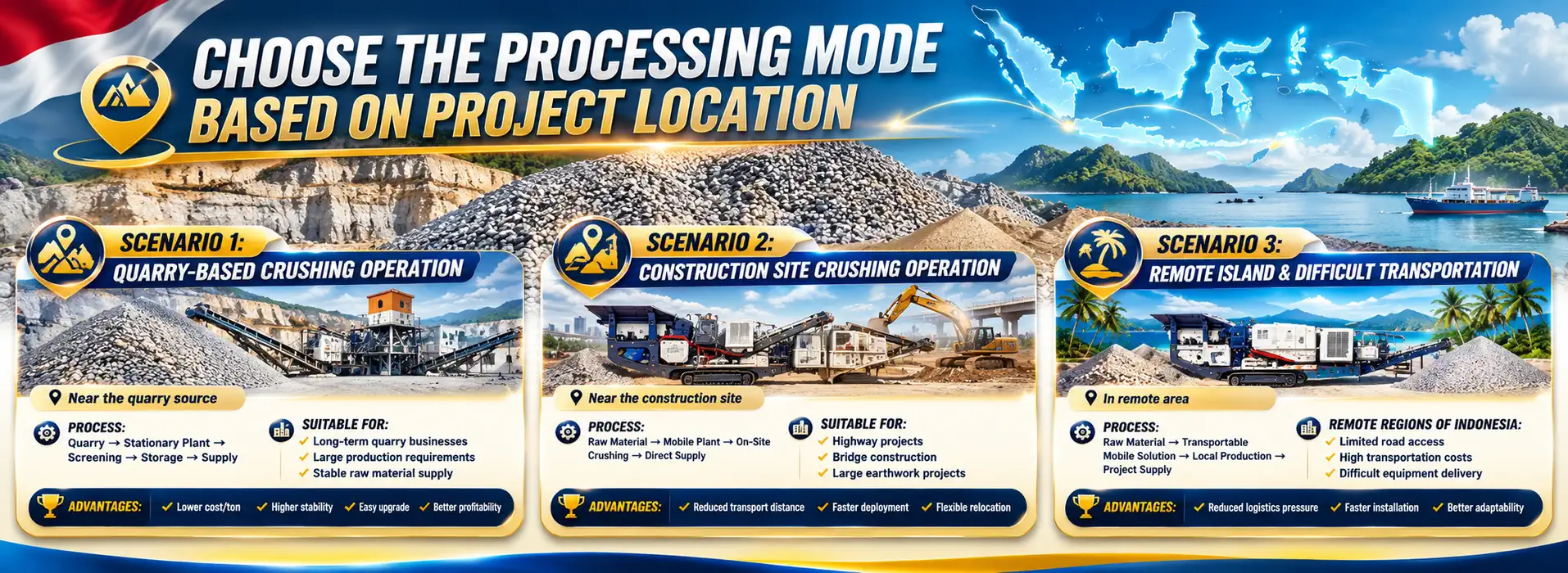
Scenario 1: Quarry-Based Crushing Operation
For projects located close to rock resources, a fixed processing system is usually more economical.
Recommended Process:
Rock Quarry → Stationary Crushing Plant → Screening System → Aggregate Storage → Market Supply.
Suitable For:
Long-term quarry businesses
Large production requirements
Stable raw material supply
Advantages:
✓ Lower production cost per ton
✓ Higher output stability
✓ Easier automation upgrade
✓ Better long-term profitability
Scenario 2: Construction Site Crushing Operation
For infrastructure projects where the working location changes frequently, mobile crushing provides greater flexibility.
Recommended Process:
Raw Material → Mobile Crushing Plant Deployment → On-Site Crushing → Direct Aggregate Supply to Construction Site.
Suitable For:
Highway projects
Bridge construction
Large earthwork projects
Advantages:
✓ Reduced aggregate transportation distance
✓ Faster project deployment
✓ Flexible relocation
Scenario 3: Remote Island and Difficult Transportation Projects
For projects in remote areas, crushing solutions should prioritize easy transportation, quick installation, and reduced logistics costs.
Remote regions in Indonesia often face:
Limited road access
High transportation costs
Difficult equipment delivery
Recommended Process:
Raw Material Source → Transportable Mobile Crushing Solution → Local Aggregate Production → Project Supply.
Advantages:
✓ Reduced logistics pressure
✓ Faster installation
✓ Better project adaptability
Select Crushing Process Based on Final Product Requirements
The final product requirement determines the crushing stages. Different industries require different aggregate sizes and particle shapes.
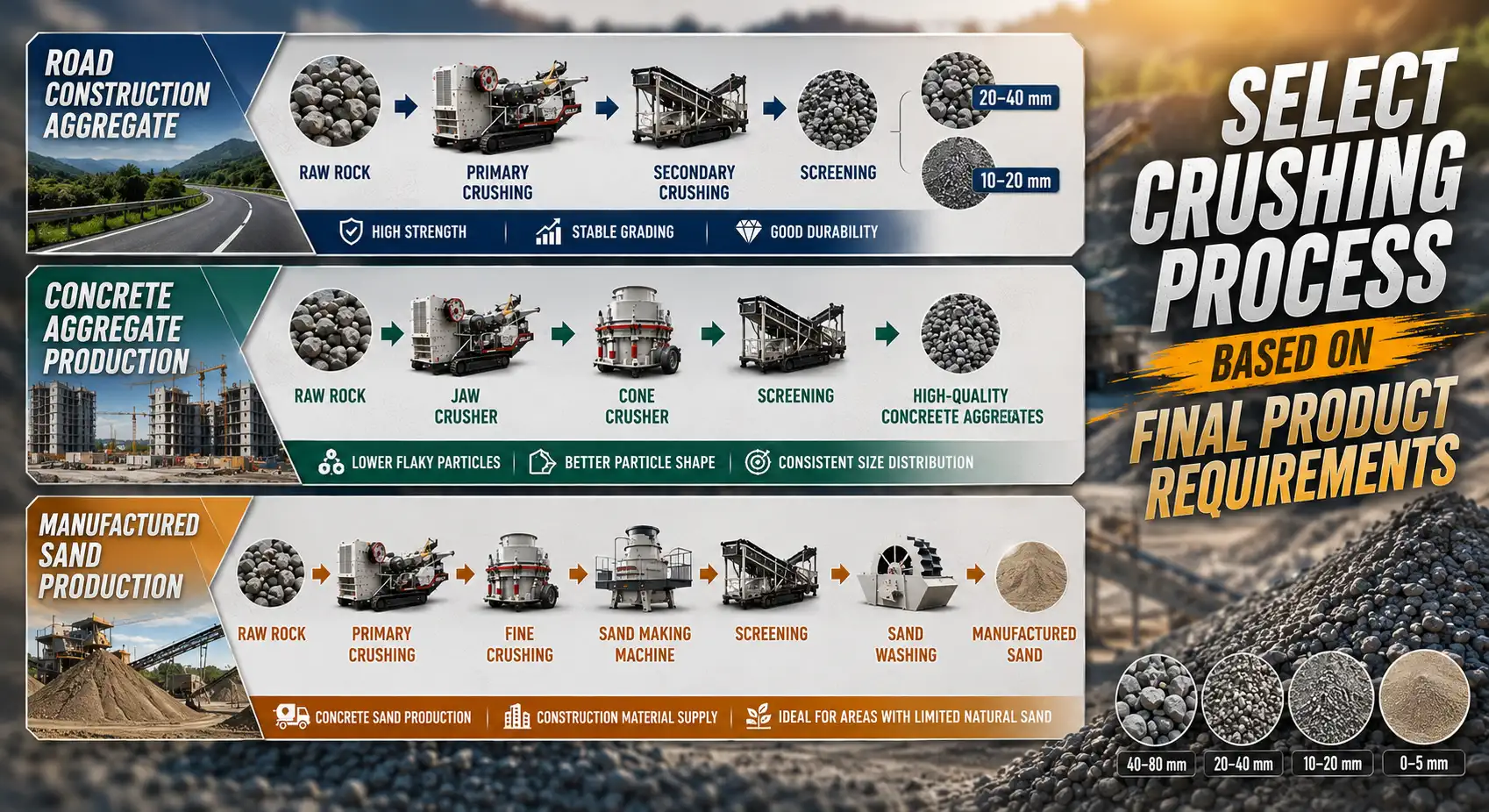
Road Construction Aggregate Production
Road projects usually require controlled aggregate sizes such as: 20–40 mm, 10–20 mm.
Recommended Process:
Raw Rock → Primary Crushing → Secondary Crushing → Screening → Road Construction Aggregates.
Key requirements:
High strength
Stable grading
Good durability
Concrete Aggregate Production
Concrete production requires better particle shape and size control.
Recommended Process:
Raw Rock → Jaw Crusher → Cone Crusher → Screening → High-Quality Concrete Aggregates.
Important quality factors:
Lower flaky particles
Better particle shape
Consistent size distribution
Manufactured Sand Production
Manufactured sand requires additional shaping and washing processes.
Recommended Process:
Raw Rock → Primary Crushing → Fine Crushing → Sand Making Machine → Screening → Sand Washing → Manufactured Sand.
Suitable for:
Concrete sand production
Construction material supply
Areas with limited natural sand resources
Choosing the right rock crusher equipment is only the beginning. The real value lies in how these solutions perform under actual project conditions. Explore the following Indonesian projects to see how different challenges are transformed into efficient and reliable rock crushing solutions.
Real Indonesian Rock Crushing Projects: From Challenges to Solutions
Rock crushing projects in Indonesia often face different challenges depending on location, rock characteristics, production requirements, and transportation conditions. From quarry operations to infrastructure and mining projects, customers need solutions that match their actual working environments. The following cases highlight how ANDAMINE analyzes project challenges and provides suitable crushing solutions for different applications across Indonesia.
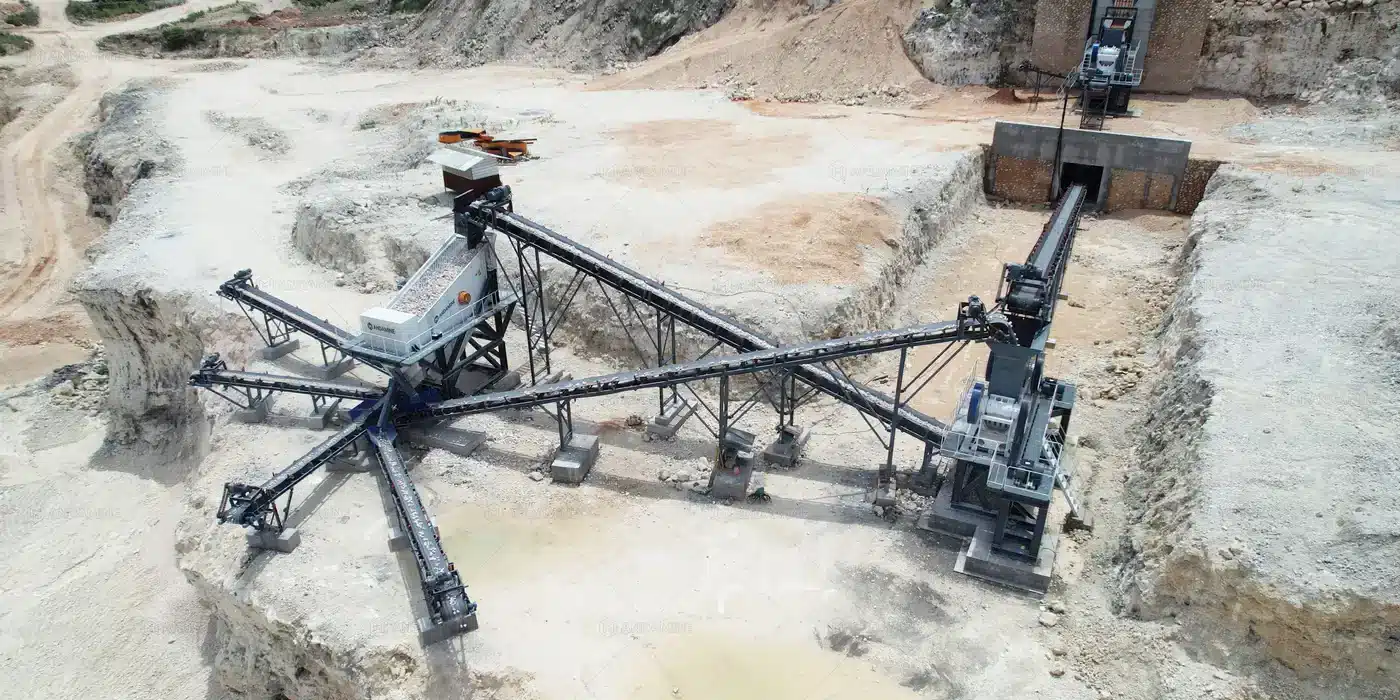
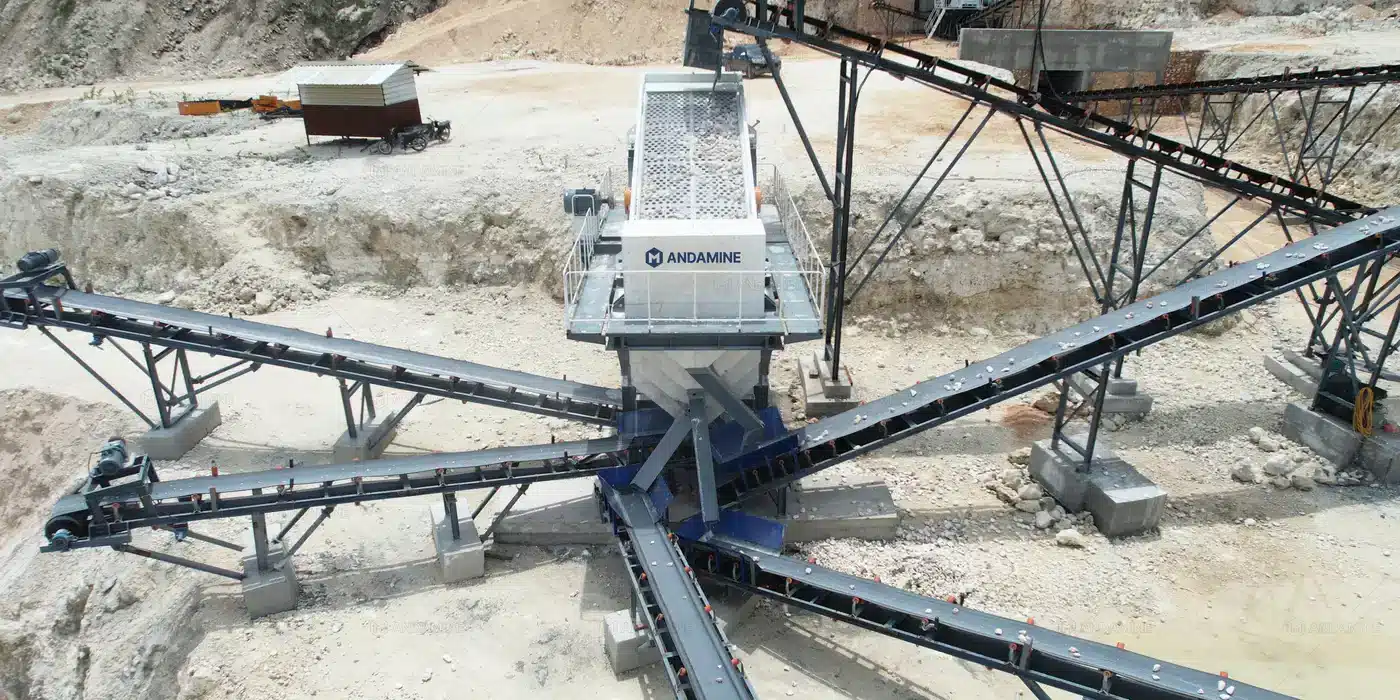
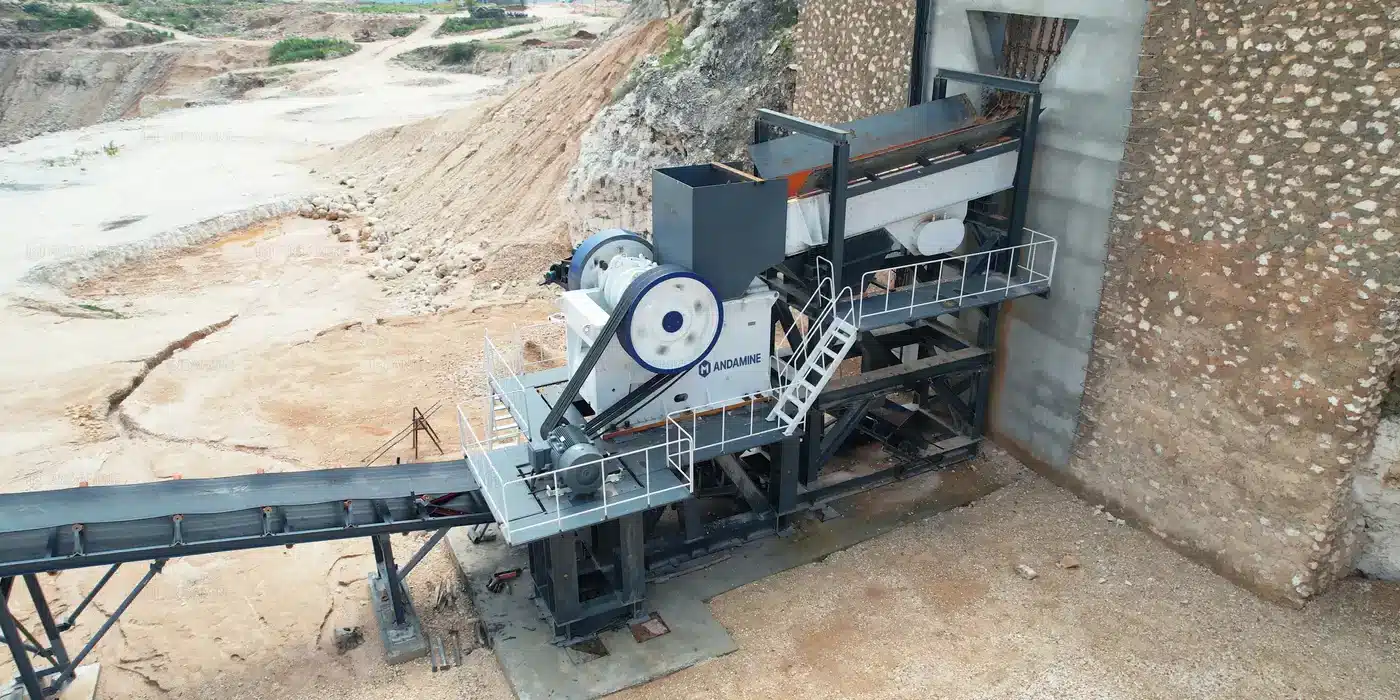
 200t/h Stationary Rock Crusher Plant for Crushing Limestone in Tuban, Indonesia
 Rock Material:Limestone
 Required Capacity:200 TPH
 Application:Paper Industry
 Location:Tuban, East Java, Indonesia
Overview:


 Equipment Configuration: APJ-6090E Jaw Crusher, APJ-1012E Jaw Crusher, APS-2160Y4 Vibrating Screen, APG-600X130 Feeder, GZD-250X120 Vibrating Feeder, Steel Structure, and Belt Conveyor Accessories.
 Results & Value Delivered: 200 TPH Limestone Processing Achieved | 4,000+ Tons Daily Production Capability | Continuous Raw Material Supply for Paper Manufacturing | Reliable Crushing Performance for Long-Term Operation.


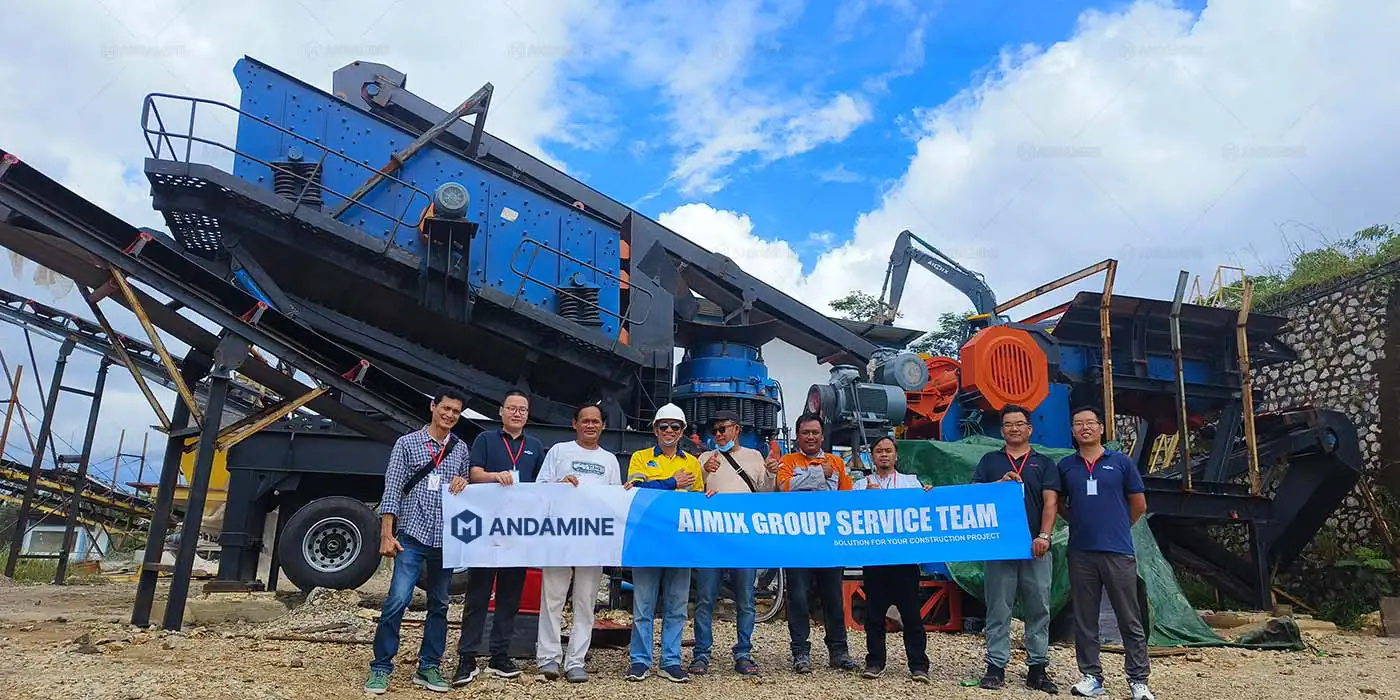
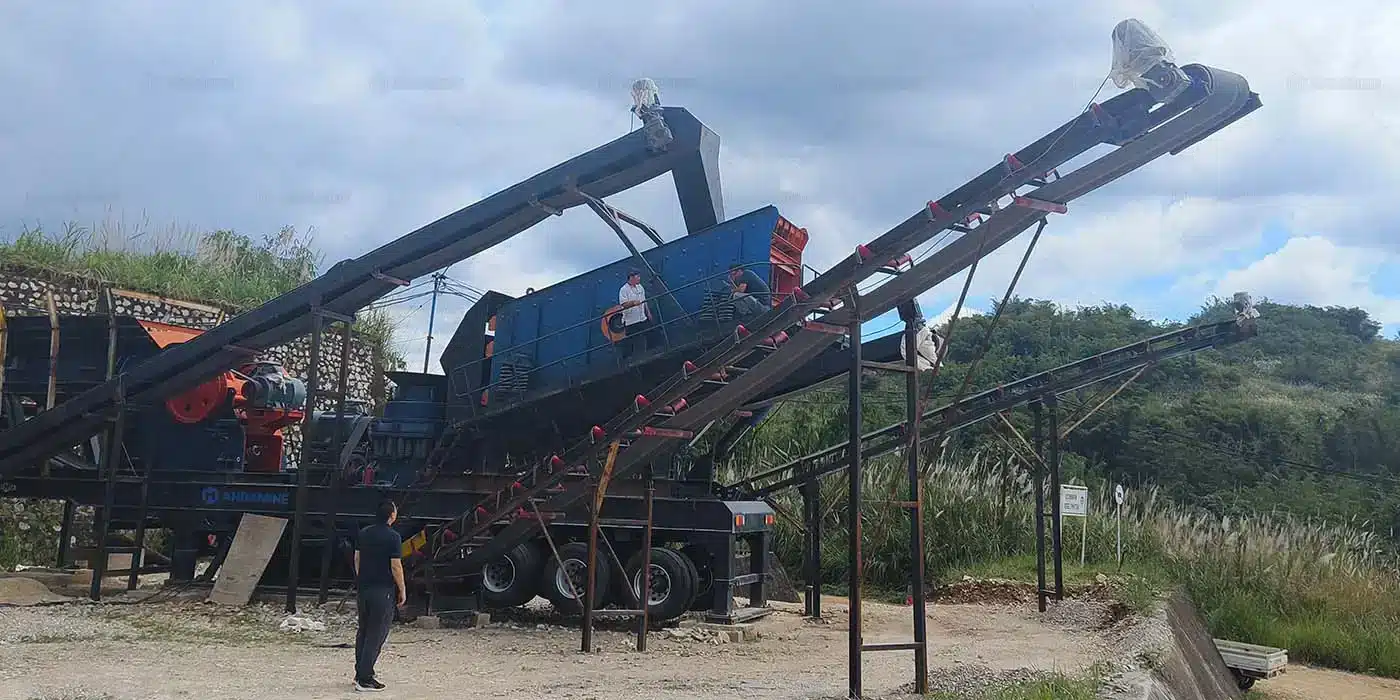
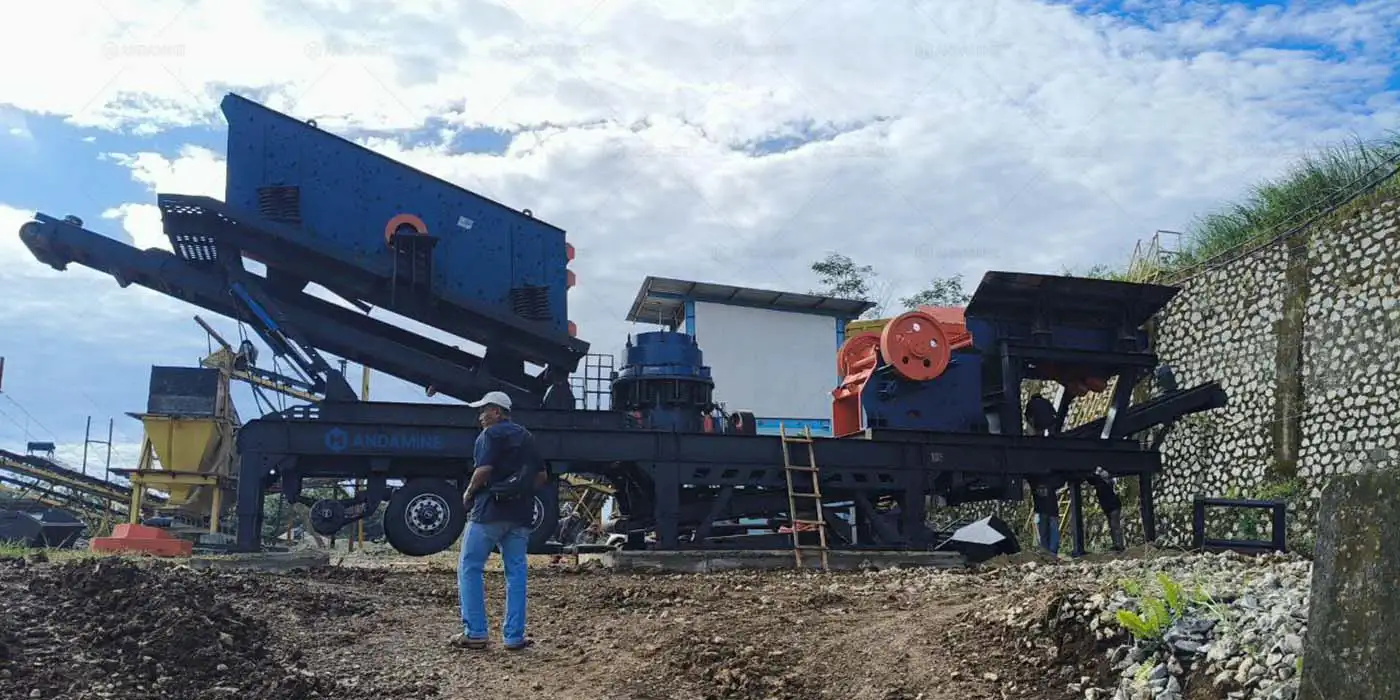
100t/h Mobile Rock Crusher Plant for Crushing Granite in Sukabumi, West Java, Indonesia
Rock Material:Limestone
Required Capacity:100 TPH
Application:Road Base Aggregate Production
Location:Sukabumi, West Java, Indonesia
Overview:
- Equipment Configuration: APY4-S Series Combined Rock Crusher Plant (JAW CRUSHER | CONE CRUSHER | VIBRATING SCREEN | VIBRATING FEEDER | PLC CONTROL BOX | Related Components ).
- Results & Value Delivered: By replacing multiple standalone machines with one 4-in-1 mobile crushing plant, the customer reduced equipment coordination and relocation costs by 30%+ while achieving 100 TPH granite aggregate production for road projects.
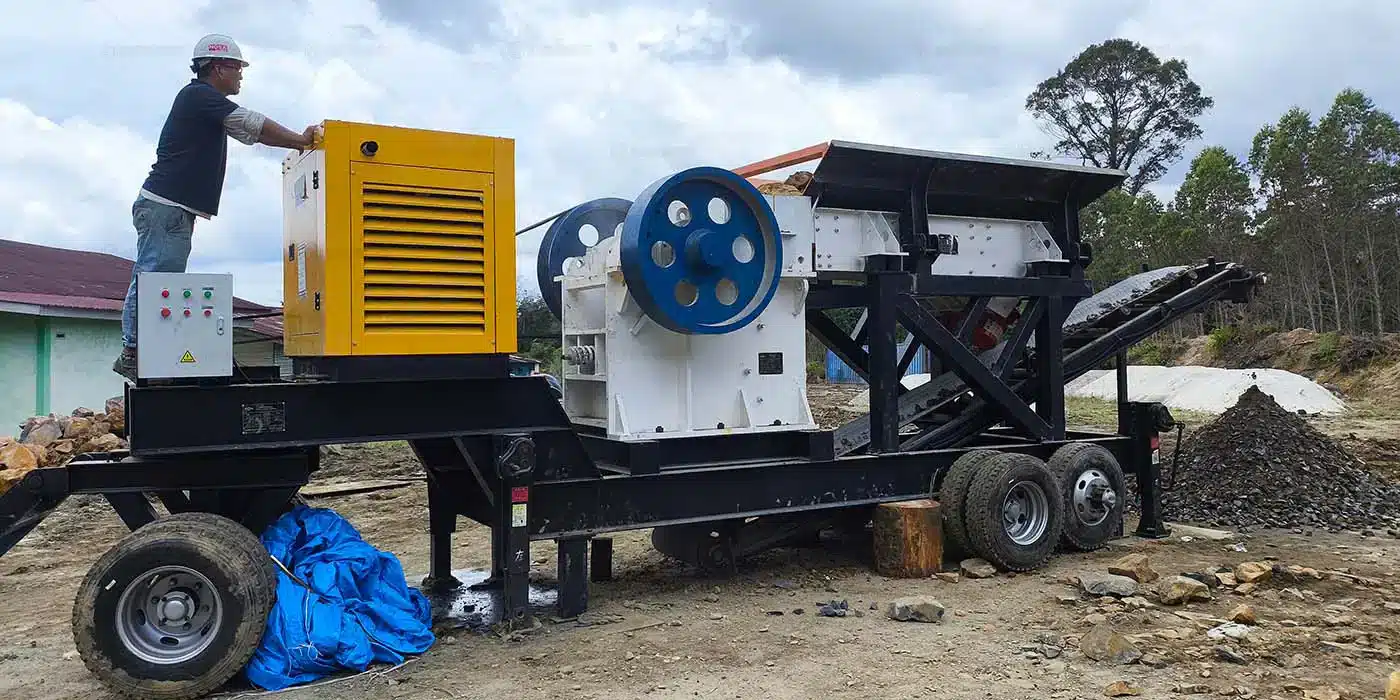
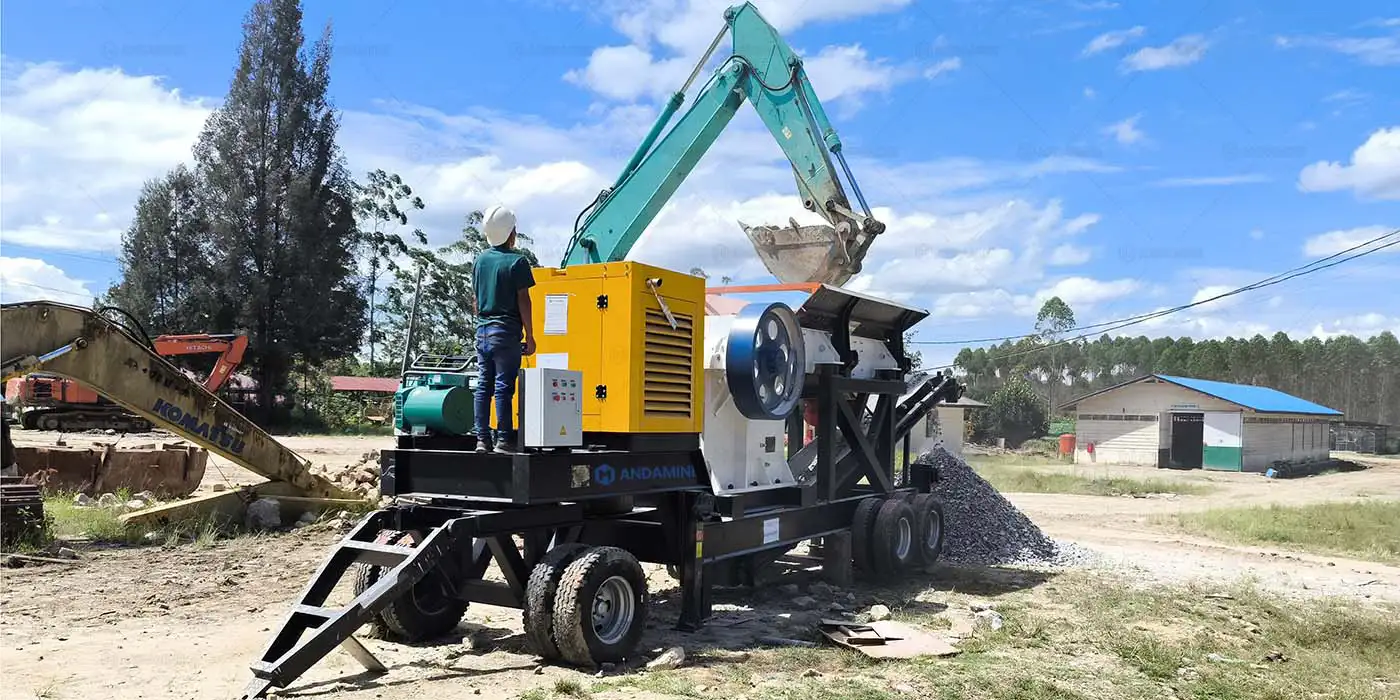
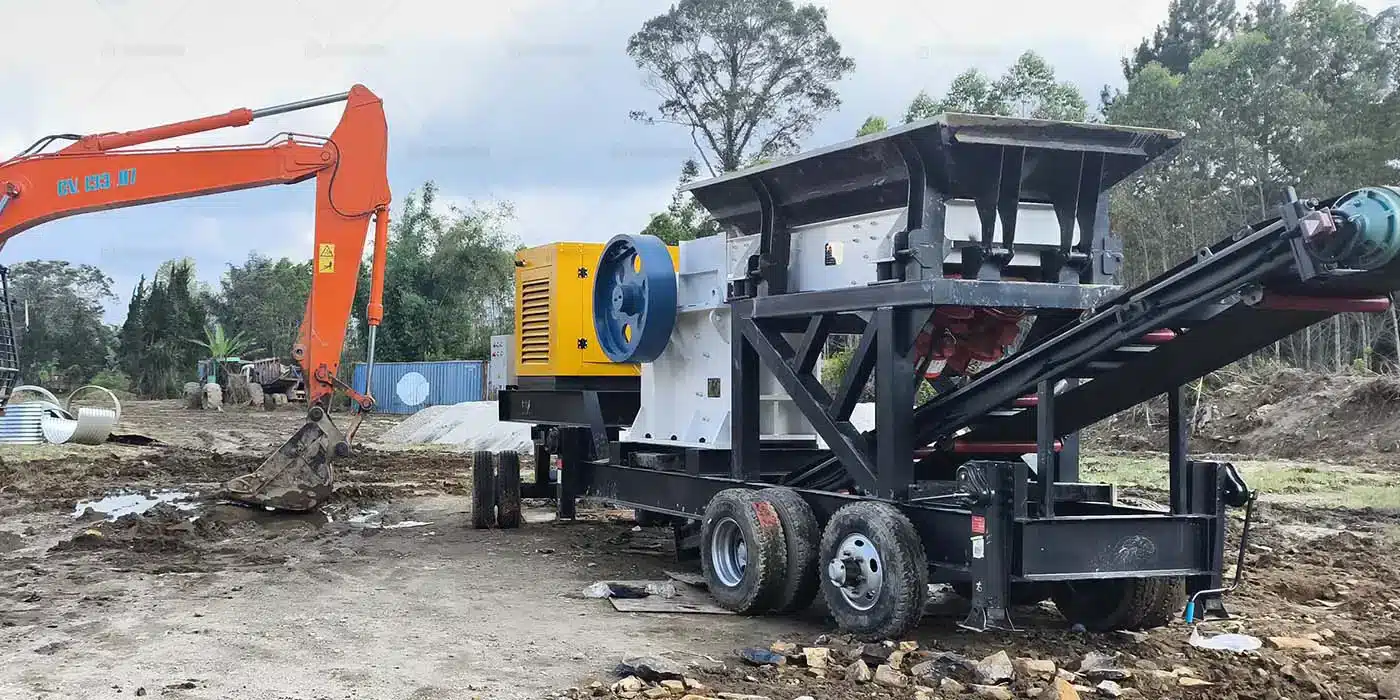
30 TPH Mini Portable Rock Jaw Crusher Plant for Crushing Andesite in Balikpapan, Indonesia
Rock Material:Andesite
Required Capacity:30 TPH
Application:Road Base Aggregate Production
Location:Balikpapan, Indonesia
Overview:
- Equipment Configuration: APYE-4060(Mobile Chassis System | Vibrating Feeder | Jaw Crusher | Belt Aggregate Conveyor).
- Results & Value Delivered: By processing andesite directly on-site, the 30 TPH mini portable jaw rock crusher plant helped reduce extra material handling and transportation requirements while delivering 240+ tons of road base aggregates per day. The flexible mobile design supported faster project execution in changing construction environments.
Real project results show what a crushing solution can achieve, but seeing the equipment in operation provides an even clearer understanding. Explore the following videos to discover how different industrial rock crusher machines perform under real working conditions across Indonesia.
Explore Rock Crusher Machine Video Youtube in Action
Watch our rock crusher machines in action through the video below. Get a closer look at how our equipment performs in real-world applications, and see the quality and efficiency for yourself. For more rock crusher videos on our crushing solutions, check out our full crushing equipment video on Youtube here.
Watching a rock crusher in action provides valuable insight, but successful project delivery depends on much more than equipment performance. Reliable local support, customized solutions, and responsive service are equally important. Discover how ANDAMINE helps customers turn crushing plans into successful projects across Indonesia.
How ANDAMINE Supports Rock Crushing Projects in Indonesia
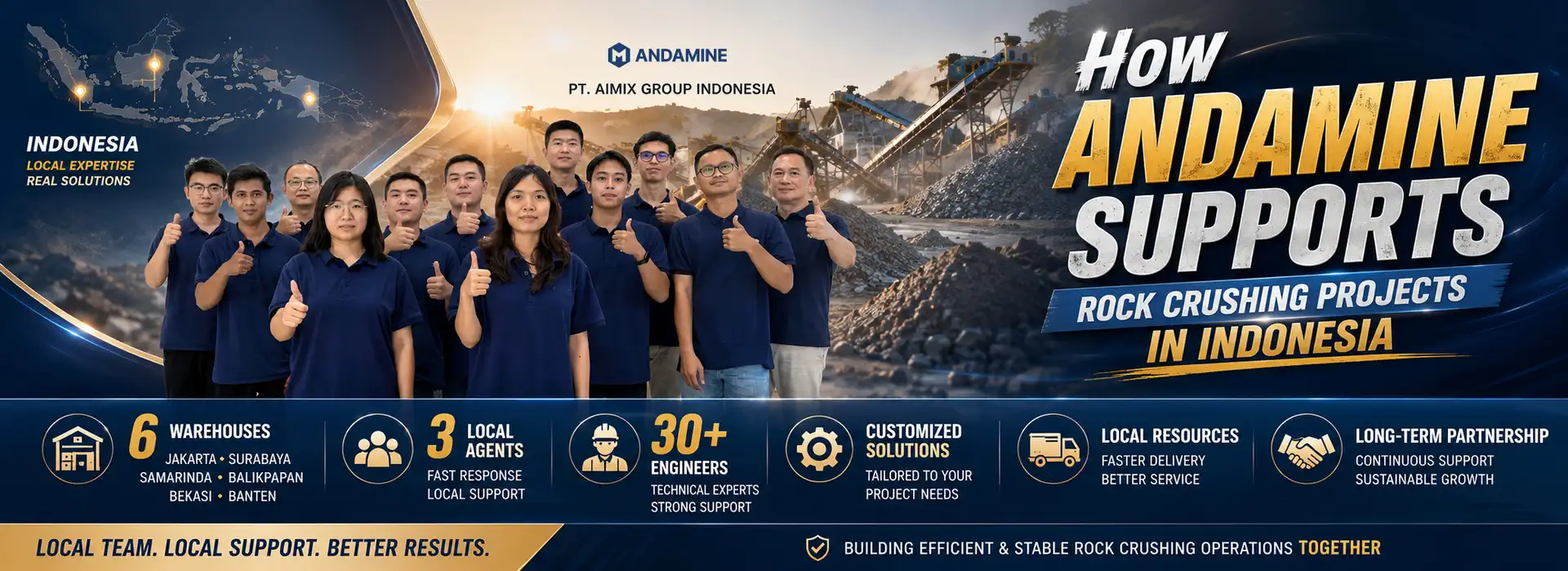
Indonesia’s rock processing projects face different challenges, including diverse rock conditions, remote locations, transportation limitations, and increasing demand for construction aggregates. A reliable crushing partner needs to understand local requirements and provide practical solutions for each project. ANDAMINE focuses on the Indonesian market by combining local project understanding, customized crushing solutions, supply resources, and technical support to help customers build efficient and stable rock processing operations.
Understand Indonesia’s Specific Rock Processing Conditions
ANDAMINE develops crushing solutions based on Indonesia’s regional characteristics, material conditions, and project requirements.
- Understanding Indonesia’s quarry, construction, and aggregate production requirements;
- Considering regional differences across Java, Sumatra, Kalimantan, Sulawesi, and other project areas;
- Evaluating factors such as rock characteristics, site conditions, transportation challenges, and production targets;
- Developing crushing solutions based on actual operating environments instead of standard equipment selection.
This local understanding helps customers choose crushing solutions that better match Indonesian project conditions.
Develop Customized Crushing Solutions for Indonesian Projects
Different rock processing projects require different production strategies. ANDAMINE focuses on designing solutions according to each customer’s actual needs.
- Analyze raw materials, including hardness, feed size, and processing requirements;
- Design suitable crushing and screening processes based on output capacity and final aggregate specifications;
- Optimize plant configuration according to project scale, investment plan, and operating conditions;
- Provide crusher solutions for quarry production, infrastructure construction, aggregate supply, and manufactured sand applications.
This project-based approach helps customers achieve stable production and improve long-term operating efficiency.
Provide Crushing Solutions for Different Indonesian Applications
Indonesia’s construction and mining industries require different crushing approaches depending on project goals and working environments.
- Support quarry operations requiring continuous aggregate production;
- Provide flexible solutions for road, bridge, and infrastructure construction projects;
- Develop suitable solutions for remote areas with transportation and installation challenges;
- Support aggregate and manufactured sand production to meet growing construction demand.
This application-focused strategy helps customers select crushing systems that fit their specific project requirements.
Improve Project Delivery Through Indonesia Local Resources
Equipment availability and delivery efficiency are important factors for Indonesian customers, especially for projects with strict schedules.
ANDAMINE provides localized support resources in Indonesia, including:
- 6 warehouse locations in Jakarta, Surabaya, Samarinda, Balikpapan, Bekasi, and Banten;
- Local equipment and spare parts availability to improve response speed;
- 3 local agents supporting customer communication and project coordination;
- Local logistics support to improve equipment preparation and delivery efficiency.
These local resources help customers reduce waiting time and keep projects moving according to schedule.
Provide Technical Support for Stable Project Operation
Successful crushing projects require continuous technical support after equipment delivery. ANDAMINE provides assistance throughout different operation stages.
- Supported by 30+ engineers and technical experts for project communication and technical consultation;
- Assistance with solution confirmation, installation guidance, and commissioning;
- Operation recommendations and maintenance suggestions after plant startup;
- Support for production optimization and equipment performance improvement.
This technical capability helps Indonesian customers reduce operation risks and maintain stable crushing performance.
Build Long-Term Partnerships with Indonesian Customers
Rock crushing projects usually require long-term operation, making continuous support an important factor when choosing a supplier.
ANDAMINE works with Indonesian customers through:
- Continuous technical communication after project completion;
- Support for spare parts requirements and equipment maintenance;
- Assistance with production improvement and future project expansion;
- Long-term cooperation with quarry owners, contractors, and aggregate producers in Indonesia.
This long-term partnership approach helps customers achieve sustainable and reliable rock processing operations.
Reliable local support helps keep your rock crushing project running smoothly. But beyond equipment and service, every investment should deliver measurable returns. Next, explore the economic benefits and profitability of rock crushing projects in Indonesia.
Economic Benefit Analysis of a Rock Crushing Project in Indonesia
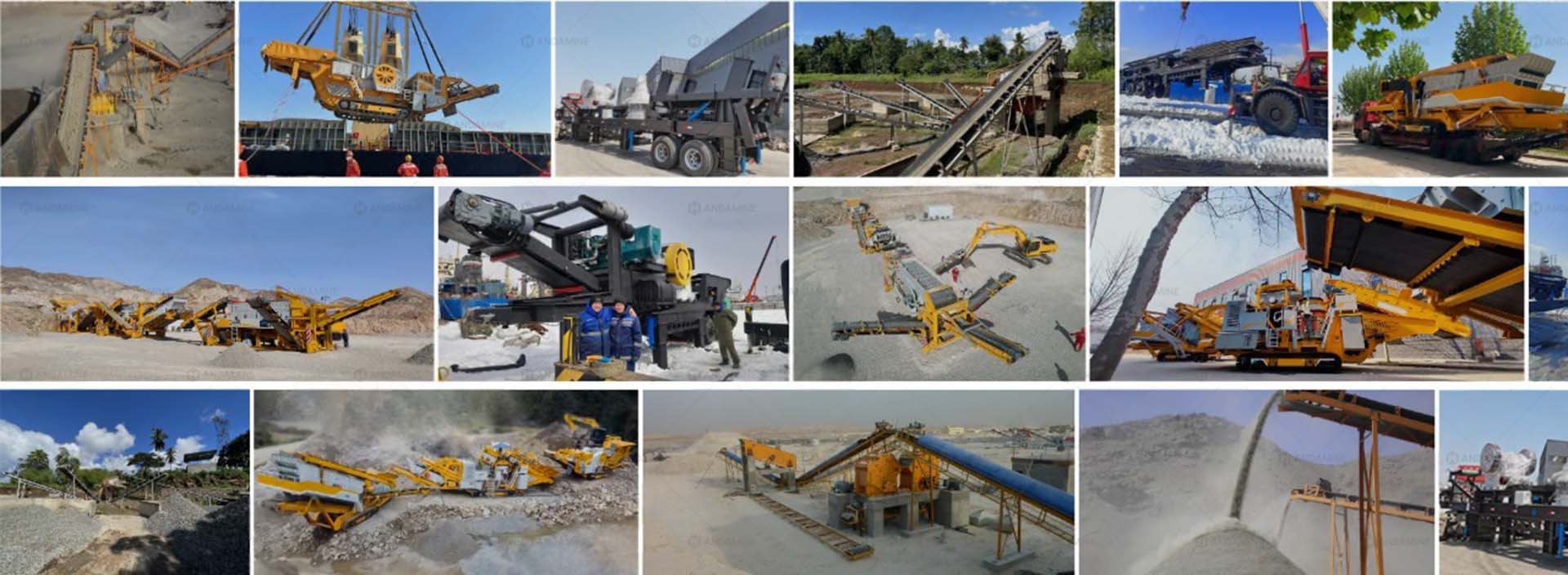
A rock crushing project generates economic value by converting natural rock resources into commercial aggregates for construction markets. The profitability of the project depends on production capacity, aggregate demand, operating costs, and transportation advantages. The following example demonstrates the potential economic performance of a medium-scale granite crushing project in Indonesia. A local quarry operator in Indonesia plans to process granite resources into construction aggregates for road projects, concrete production, and regional infrastructure development. The project adopts a 200 TPH crushing system to produce multiple aggregate sizes and supply nearby construction markets.
 Production Capacity and Annual Output
The project is designed with:
- Crushing capacity: 200 tons per hour
- Working time: 8 hours per day
- Operating days: 300 days per year
- Equipment utilization rate: 75%
- The estimated annual production is: 200 TPH × 8 hours × 300 days × 75% = 360,000 tons of aggregates per year
This production volume allows the project to continuously supply local construction material demand.
 Revenue Potential from Aggregate Sales
After crushing and screening, the granite resources are converted into different aggregate products, including:
- Coarse aggregates for road construction;
- Medium-sized aggregates for concrete production;
- Manufactured sand for construction applications.
- Assuming an average selling price of USD 8 per ton: 360,000 tons × USD 8/ton = USD 2.88 million annual sales revenue.
The actual revenue depends on local aggregate prices, product quality, and market demand.
 Operating Cost Analysis
The main operating costs of a rock crushing project include:
- Energy Consumption: Fuel or electricity is required for crushing equipment, conveyors, and supporting systems.
- Labor Cost: Operators and maintenance personnel are needed for daily production management.
- Maintenance Cost: Regular replacement of wearing parts and equipment maintenance directly affect production stability.
- Transportation Cost: The distance between the quarry, crushing plant, and customers has a significant impact on final material costs.
- Assuming the average production cost is USD 3.50 per ton: 360,000 tons × USD 3.50/ton = USD 1.26 million annual operating cost.
 Profitability Estimation
The basic economic calculation is:
Sales Revenue – Operating Cost = Operating Profit.
Based on the example:
- Annual sales revenue: USD 2.88 million
- Annual operating cost: USD 1.26 million
- Estimated annual operating profit: USD 1.62 million
This demonstrates that production scale, market demand, and cost control are key factors affecting project profitability.
 Transportation Cost Reduction Benefits
For Indonesia, transportation is an important factor affecting aggregate prices because many construction materials need to be transported over long distances between islands or regions.
A local crushing project can reduce dependence on external aggregate suppliers. For example:
If local production reduces transportation costs by USD 2 per ton: 360,000 tons × USD 2/ton = USD 720,000 potential annual transportation savings.
This advantage is especially important for projects located far from existing aggregate supply areas.
Long-Term Investment Value
Beyond direct sales revenue, a rock crushing project creates long-term business value by:
- Increasing the commercial value of local rock resources;
- Building a stable aggregate supply capability;
- Supporting infrastructure and construction demand;
- Reducing dependence on external material sources.
For Indonesian projects, selecting suitable crushing capacity, optimizing production costs, and matching market demand are the key factors determining long-term investment returns.
A successful rock crushing project is not only about choosing the right equipment, but also about maximizing value throughout the operation. To help you make better decisions, let’s answer the most common questions about rock crusher machines in Indonesia.
FAQ About Rock Crusher Machine In Indonesia
How Can A Rock Crusher Plant Reduce Aggregate Transportation Costs In Indonesia?
Establishing a crushing plant closer to the quarry source or project site can help:
- Reduce long-distance aggregate transportation.
- Improve material supply stability.
- Support remote construction and mining projects.
How Much Does A Rock Crushing Plant Cost In Indonesia?
- Small rock crushing plants (50–100 TPH): Approximately USD 50,000–200,000, usually suitable for small aggregate production and local construction supply.
- Medium crushing plants (100–300 TPH): Approximately USD 200,000–600,000, commonly used for commercial quarry operations and regional aggregate supply.
- Large crushing plants (300–500+ TPH): Approximately USD 600,000–1.5 million+, suitable for large infrastructure projects, mining support, and long-term quarry businesses.
The final investment may also include: Primary crusher and secondary crusher, Vibrating screens, Belt conveyors, Feeding system, Electrical control system, Installation and commissioning, and Spare parts package.
For Indonesian projects, transportation distance, port conditions, and site accessibility may also affect the total project cost.
How Long Does It Take To Install A Rock Crushing Plant In Indonesia?
- Mobile crushing plant: Around 7–20 days for installation and commissioning after equipment arrival.
- Small fixed crushing plant: Around 30–60 days, including equipment assembly and testing.
- Complete multi-stage crushing plant: Around 60–120 days, depending on foundation work, electrical installation, and commissioning requirements.
For remote Indonesian areas, transportation from ports to project sites may require additional preparation time.
What Equipment Is Included In A Complete Rock Crushing Plant?
- Feeder: Controls raw material feeding into the crusher.
- Primary crusher: Reduces large rocks, often from around 300–700 mm feed size.
- Secondary crusher: Further processes materials to achieve better size control.
- Vibrating screen: Separates aggregates into required sizes.
- Belt conveyors: Transfer materials between processing stages.
The final configuration depends on production capacity, material conditions, and required products.
What Information Is Needed To Design A Rock Crushing Solution In Indonesia?
- Raw material information
- Maximum feed size (commonly 300–700 mm before primary crushing)
- Required production capacity (TPH)
- Final aggregate requirements
- Project location
- Expected operating period
This information helps determine equipment configuration, crushing stages, and plant layout.
Can A Rock Crushing Plant Be Used In Remote Areas Of Indonesia?
- Equipment transportation routes
- Site preparation conditions
- Local power availability
- Spare parts supply
- Technical support response
For projects in areas such as Kalimantan, Sulawesi, and Papua, a suitable crushing solution can help reduce dependence on transported aggregates.
How Long Can A Rock Crushing Plant Operate For Quarry Production In Indonesia?
Typical business planning:
- Short-term projects: Around 6–24 months
- Medium-term operations: Around 3–5 years
- Long-term quarry businesses: Usually 5–10 years or longer
For long-term aggregate production, investors usually focus on equipment durability, maintenance costs, and future expansion possibilities.
What Are The Main Operating Costs Of A Rock Crusher Plant In Indonesia?
- Fuel or electricity consumption
- Wear parts replacement
- Routine maintenance
- Labor costs
- Material transportation
For hard and abrasive materials, wear part consumption and maintenance planning can significantly affect long-term operating efficiency.
How Can I Choose A Reliable Rock Crusher Supplier For My Indonesian Project?
- Crushing process design
- Equipment configuration recommendations
- Installation guidance
- Operator training
- Spare parts supply
- Long-term technical support
For Indonesian projects, experience with local transportation conditions and project environments is also an important consideration.
Turn Your Rock Resources into Long-Term Value
Successful rock crushing projects are not only about choosing equipment, but about creating the right processing strategy. From material analysis and process design to equipment selection and technical support, ANDAMINE helps Indonesian customers build efficient and sustainable aggregate production solutions. Share your project details with ANDAMINE today, and let our experts help you develop the right crushing solution for your next project.


