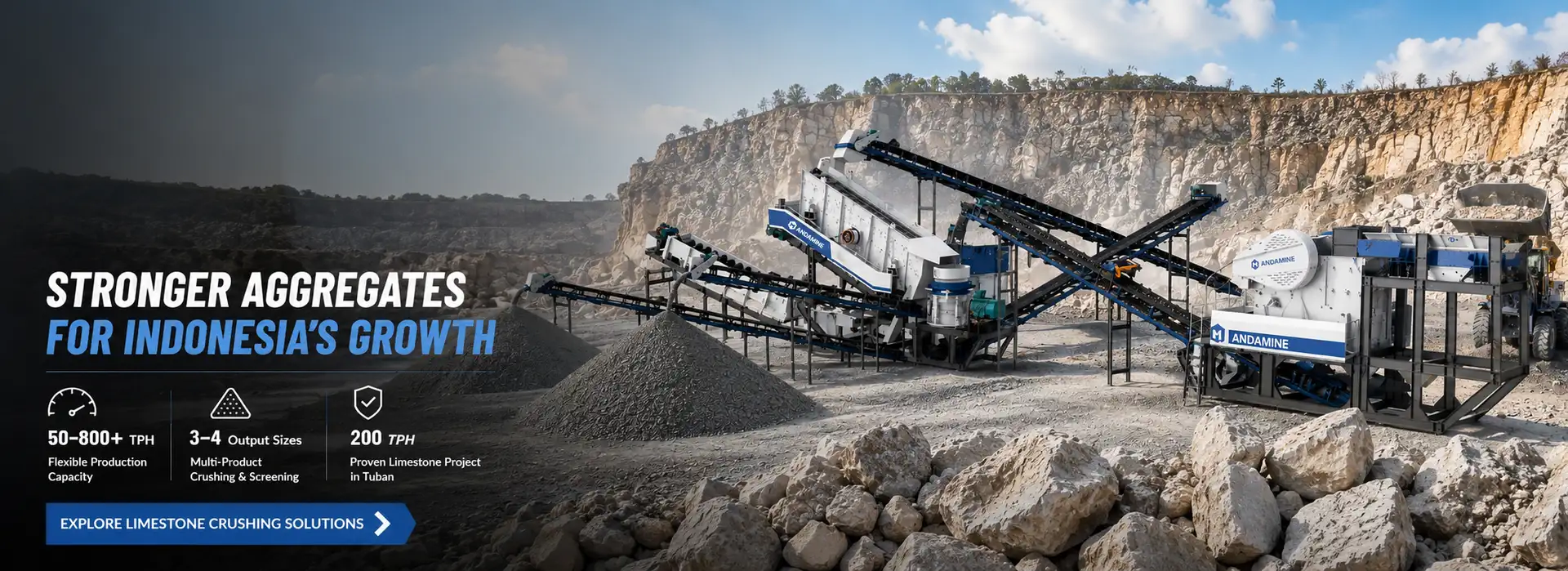
Limestone crushing is a key stage in Indonesia’s limestone supply chain, connecting quarrying with the aggregate, cement, asphalt, lime and other industries that depend on processed limestone. A suitable limestone crusher plant must do more than reduce rock size—it needs to match the quarry’s feed conditions, required production capacity, target product sizes and the needs of downstream applications. From crushing and screening to finished product supply, this guide explores practical limestone crushing solutions for different Indonesian projects.
 0–40+ mm: Flexible Finished Product Sizes
 Complete Line: Crushing + Screening + Conveying
 Quarry, Aggregate & Cement Solutions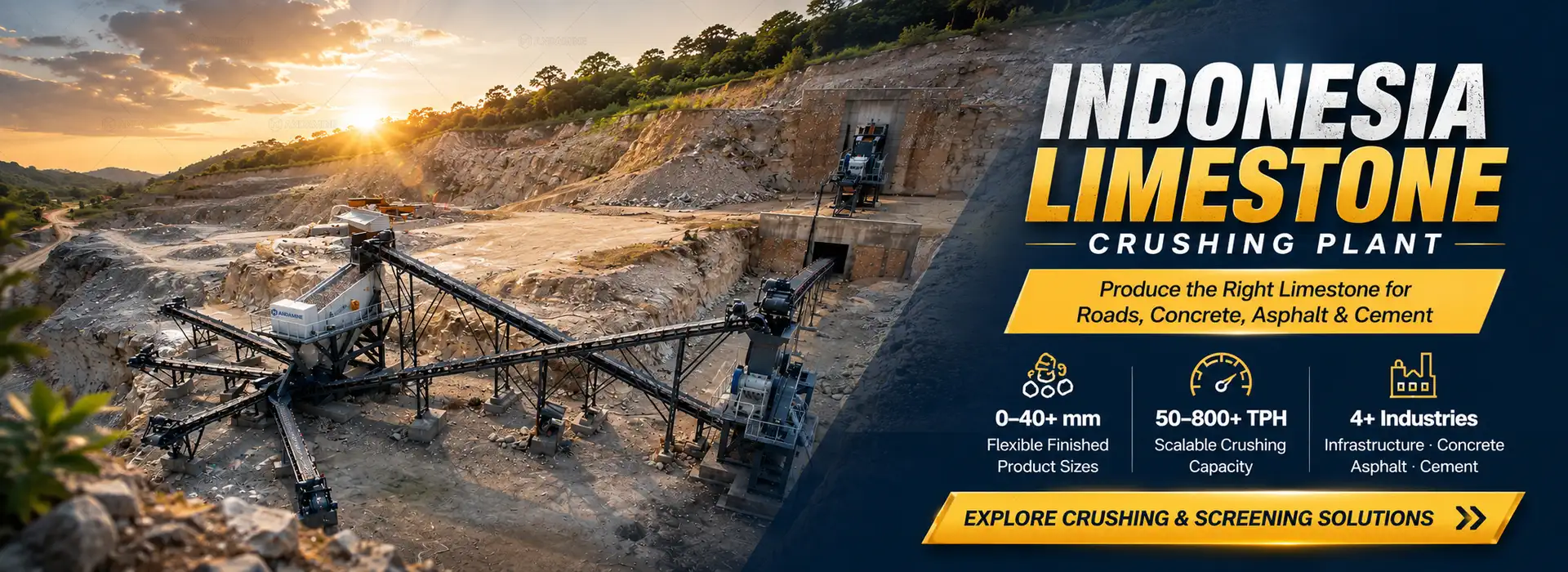
How To Choose Right Limestone Crushing Plant For Indonesian Project?
Limestone quarries in Indonesia often face clay-contaminated feed, sticky material during the rainy season, AMDAL requirements, SNI aggregate standards, and RKAB production limits. Site conditions also vary across Java, Sumatra, Sulawesi, and Kalimantan. The right crushing plant should therefore be selected based on quarry location, limestone characteristics, required capacity, and final product specifications.
Scenario 1: Large-Scale Limestone Quarry for Cement Production in Java
Typical Conditions: A long-term fixed quarry with stable grid power, sufficient RKAB production quota, and high, consistent output demand. The limestone is mainly used for cement raw meal and SNI-compliant road aggregate, with only minor surface clay and little need for plant relocation.
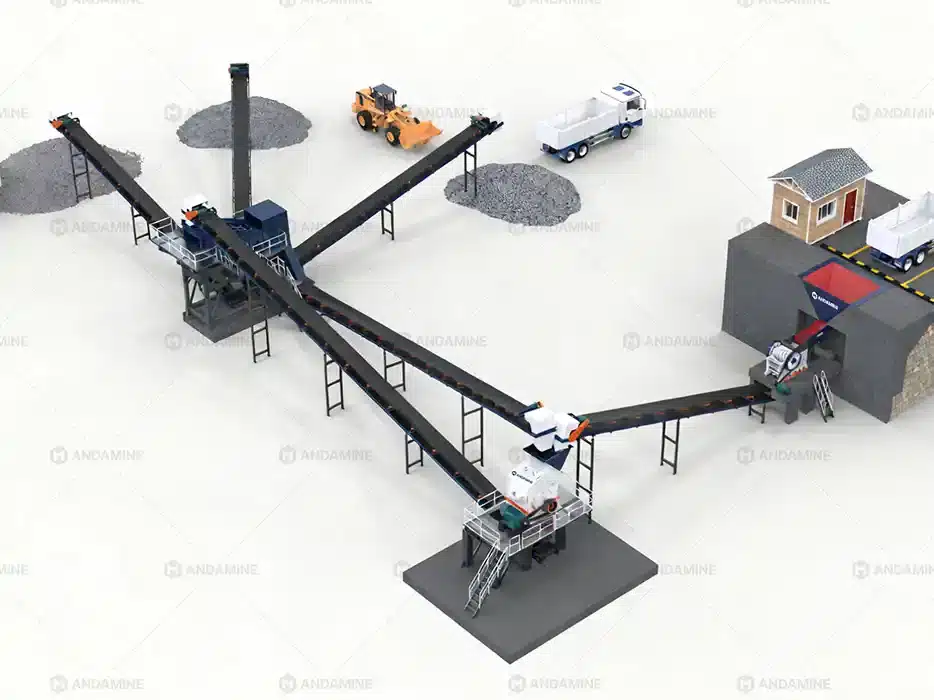
Option 1 — Fixed Stationary Limestone Crushing Plant
- Full configuration: APJ‑E Jaw Primary Crusher + APF‑H Hydraulic Impact Secondary Crusher, matched with vibrating feeder, multi‑deck vibrating screen and belt conveyor system
- Nominal capacity: 50‑550 T/H
- Max feed size: Up to 1000 mm blasted limestone rock
- Output: Cement raw material, 5‑10, 10‑20, 20‑40 mm road aggregate
Why choose this for your limestone project:
- Hydraulic impact crusher is perfectly matched for medium‑soft limestone, producing cubic‑shaped aggregate that meets Indonesian SNI standard.
- Pre‑screen module can be added to separate surface clay ahead of crushing chamber, effectively reduce equipment blockage in rainy season.
- Stationary line delivers stable large throughput for mining operation, easy for maintenance management inside cement‑support quarry.
Option 2 — Alternative: APY Tyre‑type Mobile Combination (Avoid heavy civil construction work)
Combined Line Key Configuration: APY2‑J + APY3‑F + APY‑S Mobile Limestone Crushing Production Line
- Combined working capacity: 50‑320 T/H
- Feed limit: Max 720 mm blasted limestone, requires stable grid power and hardened haul road
- Full‑range outputs: 0‑40 mm multi‑spec SNI‑compliant aggregate, also cement raw material
- Combined advantages: No heavy civil foundation; quick commissioning; independent screening reduces rainy‑season clogging; flexible relocation if quarry boundary changes.
- Limitation: Not suitable for muddy outer‑island sites without firm roads.

APY2‑J (Tyre‑type Mobile Jaw Limestone Crusher | Primary crushing)
- Capacity: 50‑400 T/H
- Max feed size: <720 mm
- Output size: 10‑20 mm, 20‑40 mm, 40‑60 mm, custom sizes
- Why select this unit: It handles large blasted limestone blocks. As front‑end primary crusher, it reduces big rock into medium‑size material suitable for secondary crushing. Tyre chassis relies on trailer towing, fits Java quarries with hardened access road, saves concrete foundation investment.

APY3‑F (Tyre‑type Mobile Impact Limestone Crusher | Secondary shaping crushing)
- Capacity: 50‑350 T/H
- Max feed size: <600 mm
- Output size: 0‑5 mm, 5‑10 mm, 10‑20 mm, 20‑40 mm
- Why select this unit: European high‑cavity impact crusher optimised for medium‑soft limestone. It improves aggregate particle shape to satisfy SNI requirement. Can also process mixed construction waste if your site has leftover concrete debris.

APY‑S (Tyre‑type Mobile Limestone Screening Plant | Independent grading)
- Capacity: 65‑400 T/H
- Max feed size: ≤100 mm
- Output size: 0‑10 mm,10‑20 mm,20‑30 mm
- Main configuration: 2‑3 deck vibrating screen, folding belt conveyors, remote‑control system
- Why select this unit: Matches tyre-type crushing lines for Java limestone quarries. The multi-deck screen accurately produces SNI-standard aggregates and separates clay-containing wet materials, effectively preventing clogging during Indonesia’s rainy season.
Scenario 2: Medium-Sized Quarry for Road & Concrete Aggregates
Typical Conditions: Medium-sized quarries often supply limestone aggregates for local road projects and concrete batching plants. In Java and Sumatra, access is generally easier, while some outer-island sites may have muddy ground, limited access, or unstable power. Choose a tyre-type or tracked mobile crushing plant according to your site conditions, mobility needs, and production target.

2‑A Java / Sumatra Quarry with hardened site road
Site condition: Hardened access road available, reliable grid power supply. Mainly produce SNI‑standard road & concrete aggregate.
Solution: All‑in‑one APY4‑S Mobile Jaw and Cone Crusher Plant
- Capacity: 30‑200 T/H
- Max feed size: <500 mm
- Output size: 5‑10 mm, 10‑20 mm, 20‑40 mm
- Main configuration: Frequency‑conversion remote‑control vibrating feeder + jaw crusher + cone crusher + vibrating screen integrated on one chassis
Why choose APY4‑S for your limestone quarry: APY4-S integrates all functions on one trailer for quick setup, reduces blockage risks with wet limestone, and saves space for faster ROI on medium-small quarries.
2‑B Outer‑island Sites (Sumatra, Sulawesi, Kalimantan; muddy ground, no hardened road, unstable power grid)
Site condition: Poor site road, muddy quarry face, limited or unstable grid power. Frequent working‑face movement is common for outer‑island limestone operation. Crawler tracked mobile plant is the preferred solution here.
Recommended tracked full‑set solution: APYL2‑J Tracked Crawler Mobile Jaw Crusher + APYL3‑F Tracked Crawler Mobile Impact Crusher,
- Combined working capacity: 80‑260 T/H
- Feed limit: Max 700 mm blasted limestone; supports electric / diesel‑electric dual‑power
- Full‑range outputs: 5‑40 mm SNI‑qualified construction aggregates
- Combined advantages: Self‑driving crawlers adapt to muddy, road‑less quarry sites; no concrete foundation; easy frequent working‑face shift; works well under unstable grid conditions.
- Limitation: Higher equipment investment compared with tyre‑type sets for well‑paved sites.
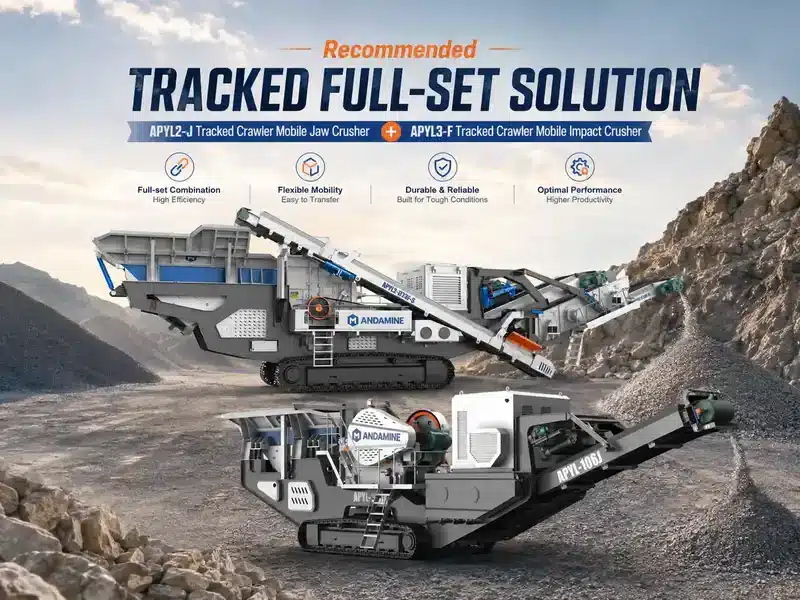

APYL2‑J (Tracked Crawler Mobile Jaw Crusher | Primary crushing)
- Capacity: 80‑415 T/H
- Max feed size: <700 mm
- Output size: 20‑30 mm, 30‑40 mm, customisable
- Why select this unit: Self‑propelled tracked chassis can directly drive onto muddy limestone quarry face. No trailer or heavy civil foundation required. Optional diesel‑electric power solves power‑shortage pain point for outer‑island quarries without stable grid supply. Wear‑resistant components handle clay‑bearing limestone under heavy‑duty working conditions.

APYL3‑F (Tracked Crawler Mobile Impact Crusher | Secondary crushing & screening)
- Capacity: 80‑300 T/H
- Max feed size: <600 mm
- Output size: 5‑10 mm, 10‑20 mm, 20‑30 mm, 30‑40 mm, customisable
- Why select this unit: 3‑in‑one integrated auto feeding‑crushing‑screening function. After secondary crushing, finished SNI‑standard limestone aggregate can be produced directly without extra separate screening station. Track mobility supports frequent working‑face relocation in remote outer‑island mines.
Special note: APYL3‑F comes with built‑in 3‑in‑1 feeding‑crushing‑screening function. Add extra APYL‑S (Tracked Mobile Screening Plant) only when you need more aggregate fractions and higher screening throughput. APYL‑S parameters: Capacity 120‑450 T/H, max feed ≤100 mm, 3‑deck screen, self‑propelled tracked chassis with optional diesel‑electric power for remote outer‑island quarry.
Scenario 3: Limestone for PCC Filler and Fine Material
Typical Conditions: The quarry needs to produce both construction aggregates and fine 0–4.75 mm limestone material for PCC applications. During Indonesia’s rainy season, higher clay content can affect the quality of fine products. A crushing and screening line with controlled fine-material production and dual-output capability is therefore preferred.

APY2‑V (Tyre‑type Mobile Sand‑making Plant)
- Capacity: 60‑400 T/H
- Max feed size: 30‑55 mm
- Output size: 0‑4.75 mm ~ 30 mm
- Main configuration: VSI sand‑making crusher, vibrating screen, PLC control cabinet
- Why select this unit: Specially designed to produce 0‑4.75 mm fine limestone material for Indonesian PCC filler production. It connects behind jaw‑impact main crushing line, one complete production line outputs aggregate and industrial filler at same time.
- Java island full production line: APY2‑J (Tyre‑type Mobile Jaw Crusher) + APY3‑F (Tyre‑type Mobile Impact Crusher) + APY2‑V (Tyre‑type Mobile Sand‑making Plant) + APY‑S (Tyre‑type Mobile Screening Plant)
- Outer‑island full production line: APYL2‑J (Tracked Mobile Jaw Crusher) + APYL3‑F (Tracked 3‑in‑1 Impact Crusher) + APY2‑V (Tyre‑type Mobile Sand‑making Plant) + APYL‑S (Tracked Mobile Screening Plant)
Scenario 4: Short-Term Small-Scale Quarry or Equipment Rental
Typical Conditions: Projects with short concession periods or frequently changing quarry sites need fast deployment, easy transportation, and quick commissioning. Equipment rental operators also benefit from mobile crushing plants with minimal civil work, allowing machines to be moved and put into operation with lower setup costs and less downtime.

Java quarry with hardened access road: Choose APY4‑S all‑in‑one tyre‑type plant
- Key parameters: 30‑200 T/H, max feed <500 mm, output 5‑40 mm multi‑spec aggregate.
- Customer benefit: Delivered as complete unit, minimal installation work. Ready‑to‑run after arriving quarry site, ideal for short‑term project and rental fleet.
Muddy outer‑island quarry without good road: Choose APYL3‑F tracked 3‑in‑1 impact plant
- Key parameters: 80‑300 T/H, max feed <600 mm, custom finished aggregate sizes.
- Customer benefit: Self‑driving tracked chassis, one unit covers feeding‑crushing‑screening. Avoid investment of multiple separate machines for temporary mining work.
ANDAMINE Mobile Series Quick Overview For Limestone Crushing Plant
Below is key‑parameter reference for mobile units applied to Indonesian limestone crushing projects. Optimized for local limestone characteristics: clay‑contained raw rock, rainy‑season wet material, SNI aggregate standard, Java hardened roads and outer‑island muddy terrain with unstable power supply.
| Model | Equipment Type | Capacity(T/H) | Max Feed(mm) | Typical Output Size | Power & Site Condition | Application For Limestone Crushing |
|---|---|---|---|---|---|---|
| APY2‑J | Tyre‑type Mobile Jaw Crusher | 50‑400 | <720 | 10‑60 mm | Electric only, hardened road required | Primary crushing stage for large‑scale limestone crushing plant in Java, process clay‑bearing limestone rock |
| APY3‑F | Tyre‑type Mobile Impact Crusher | 50‑350 | <600 | 0‑40 mm | Electric only, hardened road required | Secondary shaping for limestone crushing line, produce cubic aggregate meeting SNI standard, handle wet sticky material in rainy season |
| APY‑S | Tyre‑type Mobile Screening Plant | 65‑400 | ≤100 | Multi‑fractions grading | Electric only, hardened road required | Independent screening for tyre‑type limestone crushing plant, reduce wet material blockage during rainy months |
| APY4‑S | Tyre‑type All‑in‑one Crushing & Screening | 30‑200 | <500 | 5‑40 mm | Electric only, easy relocation | Compact complete limestone crushing plant, fit small quarry and rental business for short‑term mining operation |
| APYL2‑J | Tracked Mobile Jaw Crusher | 80‑415 | <700 | 20‑40 mm | Electric / Diesel‑electric, adapt to muddy ground | Primary unit for outer‑island limestone crushing plant (Kalimantan, Sulawesi), no concrete foundation needed |
| APYL3‑F | Tracked 3‑in‑1 Impact Crusher | 80‑300 | <600 | 5‑40 mm | Electric / Diesel‑electric, adapt to muddy ground | Integrated limestone crushing plant with feeding‑crushing‑screening, support frequent working‑face movement in remote mines |
| APYL‑S | Tracked Mobile Screening Plant | 120‑450 | ≤100 | Multi‑fractions grading | Electric / Diesel‑electric, adapt to muddy ground | Auxiliary screening for tracked limestone crushing plant, achieve precise grading to satisfy SNI aggregate requirements |
| APY2‑V | Tyre‑type Mobile Sand‑making Plant | 60‑400 | 30‑55 | 0‑4.75 mm ~30 mm | Electric only, hardened road required | Fine‑processing module for limestone crushing plant, produce 0‑4.75mm fine limestone for local PCC filler industry |
Key Limestone‑oriented Tips for Indonesian Customer
Limestone belongs to medium‑soft rock: impact crusher is preferred for secondary crushing. Cone crusher is only required when large volume of hard rock interlayers exist inside limestone deposit.
Most Indonesian limestone carries surface clay. Variable‑frequency feeder and pre‑screen function help reduce rainy‑season blockage. APY4‑S is factory‑fitted with remote variable‑frequency feeding system.
Location‑based selection rule: Java with hardened road → APY tyre‑type mobile or fixed plant; outer‑island muddy quarry → APYL tracked crawler series.
For outer‑island limestone projects, evaluate diesel‑electric dual‑power configuration to handle unstable grid supply.
Your whole crushing solution must comply with AMDAL permit, SNI aggregate standard and RKAB production quota requirements.
For full‑spec technical datasheet including weight, motor power and dimension, please visit our mobile crusher product list page.
Get Custom Solution For Your Limestone Quarry
Please share below information for ANDAMINE local Indonesia engineer:
- Limestone raw‑material condition: clay content, max feed block size
- Target hourly capacity (T/H)
- Final product purpose: cement raw material / road aggregate / PCC industrial filler
- Project location: Java or outer islands
- On‑site power‑supply situation

Limestone Crushing in Indonesia: Local Market & Project Demand
Indonesia has a substantial limestone quarrying market. In 2024, Indonesia produced about 12.98 million m³ of limestone, and BPS recorded 3,430 limestone quarrying businesses nationwide. Limestone was also one of the major quarrying commodities alongside sand, stone/andesite and gravel. For a limestone crushing project, however, the important question is not only how much limestone is available. It is where the quarry is, who will use the material, and what market the project is serving.
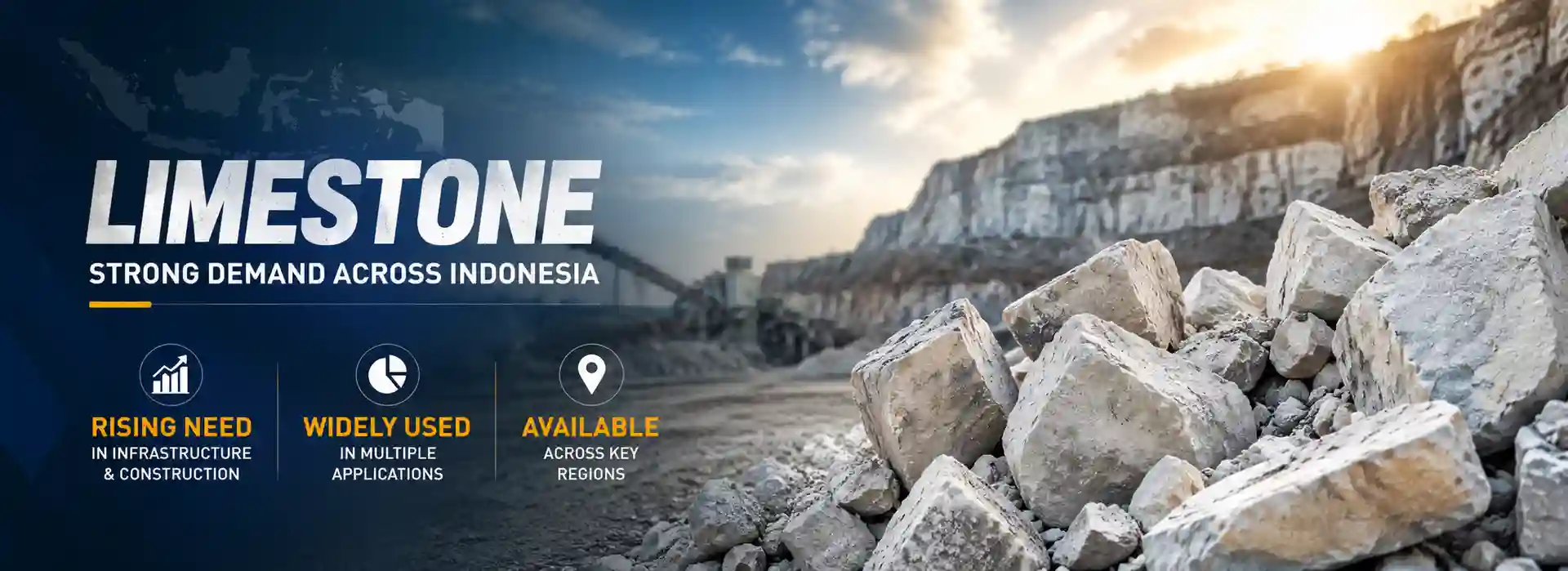
Why Is Limestone Crushing Important in Indonesia?
Limestone demand in Indonesia is strongly connected with several downstream markets:
Cement manufacturing: SIG used 36.65 million tonnes of limestone, compared with 40.74 million tonnes in 2023, for its clinker production.
Construction and infrastructure: Limestone is supplied as crushed material for roads, concrete, asphalt and other projects.
Lime and industrial minerals: Limestone can also become feedstock for further processing and higher-value mineral products in Indonesia.
This creates different project needs. A quarry supplying a cement plant may prioritize stable large-volume supply, while an aggregate producer may focus on consistent marketable materials for local construction demand.
Where Is Limestone Crushing Demand Concentrated?
Limestone quarrying and downstream demand are distributed across Indonesia, with particularly important activity in Java and Sulawesi.
The regional pattern matters because a quarry located near a cement plant has different market priorities from one supplying aggregate to dispersed construction projects.
How Does Local Market Demand Vary Across Indonesian Limestone Projects?
Different regions show different downstream patterns:
Tuban, East Java
limestone is closely connected with cement production; SIG’s published data lists the 752-hectare Temandang limestone quarry in Tuban.
Rembang, Central Java
a local PCC project planned to use about 42,000 tonnes/year of limestone to produce 27,000 tonnes/year of PCC, targeting paper, polymers, paints and rubber.
Pangkep, South Sulawesi
the cement industry produced 5.6 million tonnes of cement and 4.9 million tonnes of clinker, creating significant regional demand for limestone raw material.
So an Indonesian limestone crushing project should start with four practical questions:
Distance to the cement plant, construction market or other customer affects the supply model.
Cement plants, aggregate buyers, asphalt suppliers and industrial processors have different requirements.
The end use determines the value and specification of the finished material.
The crushing capacity should be matched with realistic market demand rather than simply choosing the largest available plant.
Indonesia’s limestone demand is only part of the picture. What enters the lime stone crusher determines what comes out of it—from feed size and material condition to clay content and moisture. So, before choosing a limestone crusher machine, let’s look at the limestone actually found in Indonesian quarries and what it means for crushing performance.
What Limestone Characteristics Affect Crushing in Indonesian Quarries?
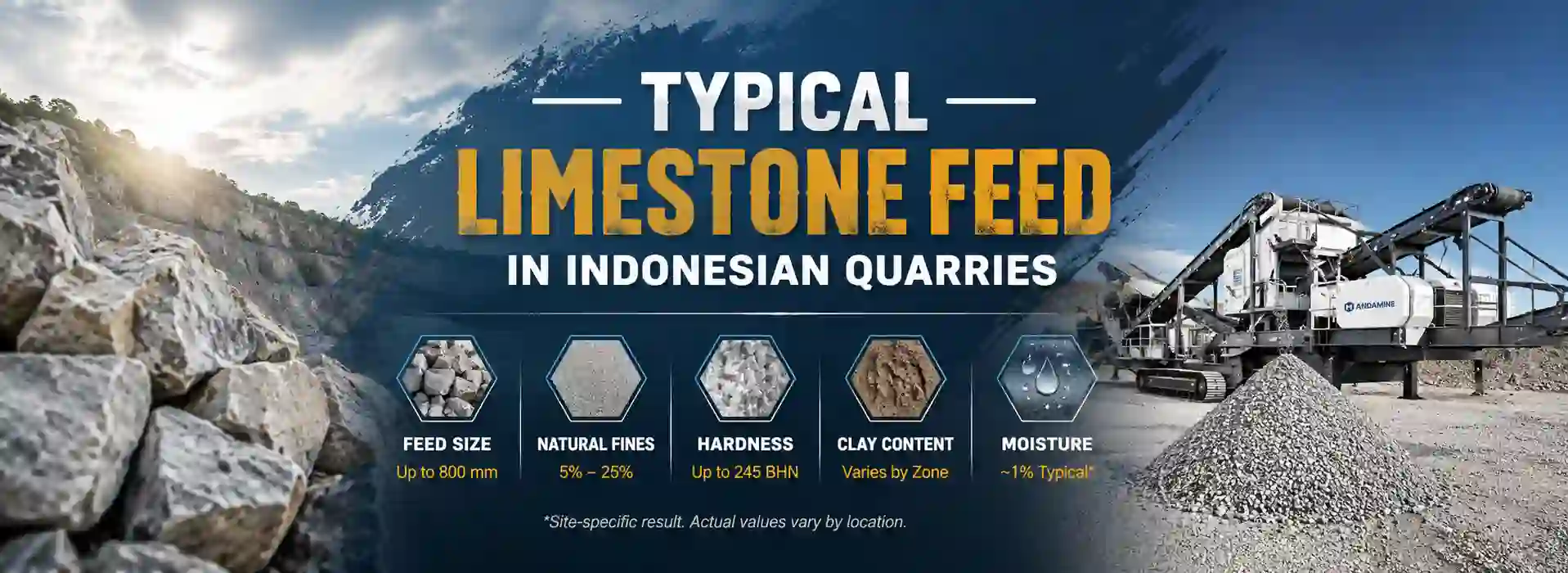
Limestone entering a crushing plant is not the same at every Indonesian quarry. Feed size, hardness, abrasion, moisture, clay and natural fines can all affect how the rock should be crushed and screened. Understanding these characteristics helps determine the right crushing process, equipment configuration and operating approach for the actual quarry.
Physical Particle Gradation Characteristics
Particle gradation is a critical limestone physical property that not only reflects raw material composition but also directly affects crusher operation, screening efficiency and final aggregate quality in Indonesian quarry crushing plants:
- Variable maximum feed size: Indonesian limestone feed size ranges 300–1000 mm. Oversized stones easily cause crusher bridging and overloads, leading to unplanned downtime and reduced continuous production capacity.
- Unbalanced particle distribution: Irregular blasting produces excessive oversized fragments, which increases crushing energy consumption and accelerates abrasion of crusher wear parts on site.
- Fluctuating natural fines content: Natural fine particles account for 5%–18% of raw materials. Excess fines cause screen blinding, reduce screening efficiency by 10%–20% and leave unqualified powder impurities.
- Unstable feed gradation consistency: Particle gradation differs by over 10% between fresh and weathered layers. Fixed crusher gaps fail to adapt to changes, resulting in inconsistent aggregate particle size and high rejection rates.
Mechanical Hardness, Strength and Wear Resistance Properties
Variable mechanical properties of Indonesian limestone determine crushing difficulty, energy consumption and particle quality:
- Variable rock hardness: Local limestone hardness reaches up to 245 BHN. Harder rock requires greater crushing force, increasing wear part loss by 25%–35% and raising daily equipment maintenance costs.
- Differentiated compressive strength: Limestone compressive strength ranges 30–80 MPa. High-strength limestone cannot be fully shaped by conventional hammer crushing, producing flaky particles that degrade finished aggregate quality.
- Regional abrasion difference: Silicate-bearing limestone in Kalimantan and Sulawesi has strong abrasiveness. It shortens the service life of crusher vulnerable parts and increases long-term operational investment.
- Unstable fracture characteristics: Tough limestone produces irregular fragments after crushing. This raises product rework rates, reduces qualified aggregate yield and affects overall production efficiency.
Moisture and Clay Impurity Content
Seasonal moisture and clay impurities are major causes of equipment blockage and unstable crushing in Indonesian quarries:
- Stable low moisture in fresh bedrock: Fresh limestone maintains a steady moisture content of 1.01%. It causes no material adhesion or equipment blockage, ensuring stable dry crushing operation.
- High seasonal moisture in weathered layers: Weathered limestone moisture rises to 4%–9% in rainy seasons. Sticky wet fines clog crusher cavities and screens, cutting production capacity by 15%–20% and triggering frequent shutdowns.
- Low clay content in fresh rock layers: Fresh limestone contains 1%–3% clay impurities. Low clay content matches standard dry crushing systems and avoids on-site equipment blockage risks.
- Excessive clay in weathered mixed layers: Weathered limestone contains 5%–8% clay impurities. High clay content blocks screening devices, requiring supporting washing processes for continuous crushing production.
Weathering Heterogeneity and Ore Layer Stability
Tropical differential weathering creates layered limestone heterogeneity, severely affecting crushing stability and product consistency:
- Dual-layer material property differentiation: Surface weathered limestone is soft and impurity-rich and easily causes equipment clogging, while dense fresh rock needs higher crushing force for qualified fragmentation.
- Intra-quarry raw material fluctuation: Rock properties vary sharply in a single quarry. Mixed mining of soft weathered and hard fresh rock leads to unstable crushing load.
- Fixed parameter adaptation failure: Conventional fixed crusher settings cannot adapt to variable rock properties, causing fluctuating output and uneven aggregate particle size.
- Mandatory customized process design: Universal standard crushing processes are inapplicable. On-site testing and flexible layouts are essential to stabilize yield and product quality.
Knowing the limestone feed is only the starting point. The real value comes from turning that raw quarry material into consistent, saleable products. So, how does limestone move from the quarry face through crushing and screening to the final aggregate? Let’s follow the limestone crushing process step by step.
How Does Limestone Crushing Work from Quarry to Finished Products?
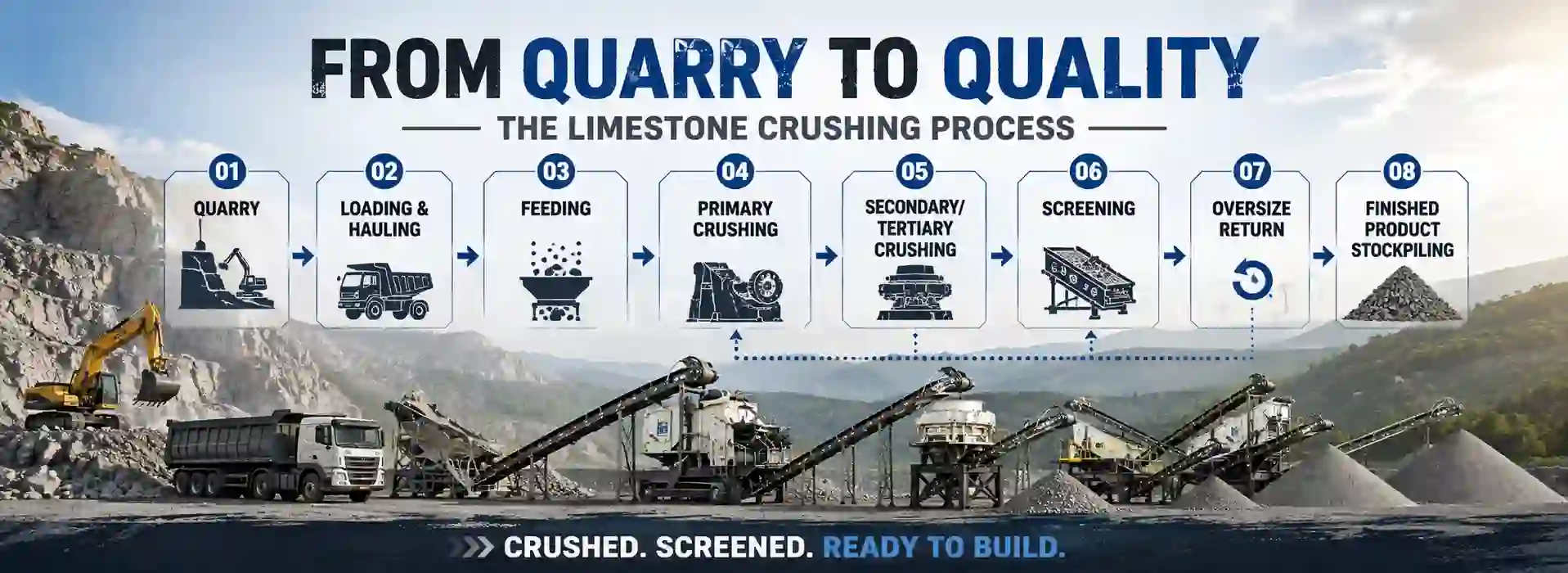
Limestone crushing is a continuous chain rather than a single crushing step. In a typical quarry operation, material moves from quarry extraction → feeding → primary crushing → secondary/tertiary crushing → screening → oversize return → stockpiling. The exact number of crushing stages depends on the feed size and the products required.
Excavation, Loading and Hauling to the Crushing Site
Typical flow: Quarry face → Excavator/Loader → Haul Truck → Feed Hopper.
The main purpose of this stage is to deliver a stable supply of quarry-run limestone to the plant.
- Excavation: Remove limestone from the quarry.
- Loading: Load blasted rock onto trucks or into the feeding area.
- Hauling: Transport the raw material to the stone crushing plant.
Feeding and Primary Limestone Crushing
- Typical flow: Feed Hopper → Vibrating Feeder → Primary Crusher.
- Feeding: Control the amount of limestone entering the crusher.
- Primary crushing: Reduce the largest rocks to a manageable size.
- Output: Produce material suitable for secondary crushing or screening.
Secondary and Tertiary Limestone Crushing
- Typical flow: Primary Crusher → Secondary Crusher → Tertiary Crusher.
- Secondary crushing: Further reduce the material.
- Tertiary crushing: Produce finer and more controlled material when required.
- Optional VSI stage: Further process material when fine aggregate or manufactured sand is needed.
Not every project requires all three stages. The crushing stages depend on the feed size and target products.
Screening and Aggregate Size Separation
Typical flow: Crushed Limestone → Vibrating Screen → Different Size Fractions.
The screen separates the material into the required grades, for example:
- Coarse aggregate
- Medium aggregate
- Fine aggregate
- Oversize material
This allows one crushing line to produce several marketable limestone sizes.
Closed-Circuit Crushing for Oversize Return
Typical flow: Crusher → Screen → Oversize → Return Conveyor → Crusher.
This closed circuit keeps oversized material in the crushing system until it reaches the required size, helping maintain a more controlled product output.
Conveying and Finished Product Stockpiling
Typical flow: Screened Products → Belt Conveyors → Separate Stockpiles.
Different product sizes can be stored separately for later:
- Road construction
- Concrete production
- Asphalt production
- Further limestone processing
Typical Limestone Crushing and Screening Flow
- A complete limestone crushing line can be summarized as: Quarry → Loading & Hauling → Feeding → Primary Crushing → Secondary/Tertiary Crushing → Screening → Oversize Return → Finished Product Stockpiling.
- For a simpler project: Quarry → Primary Crushing → Screening → Finished Products.
- For a higher-capacity or multi-product project: Quarry → Primary Crushing → Secondary Crushing → Screening → Tertiary/VSI Crushing → Final Screening → Multiple Finished Products.
Understanding the crushing process is one thing. Knowing what you can produce from that process is what matters commercially. From road aggregates to concrete and asphalt materials, the final product sizes determine where your crushed limestone can go—and what value it can create.
What Limestone Products Can a Crushing Plant Produce?
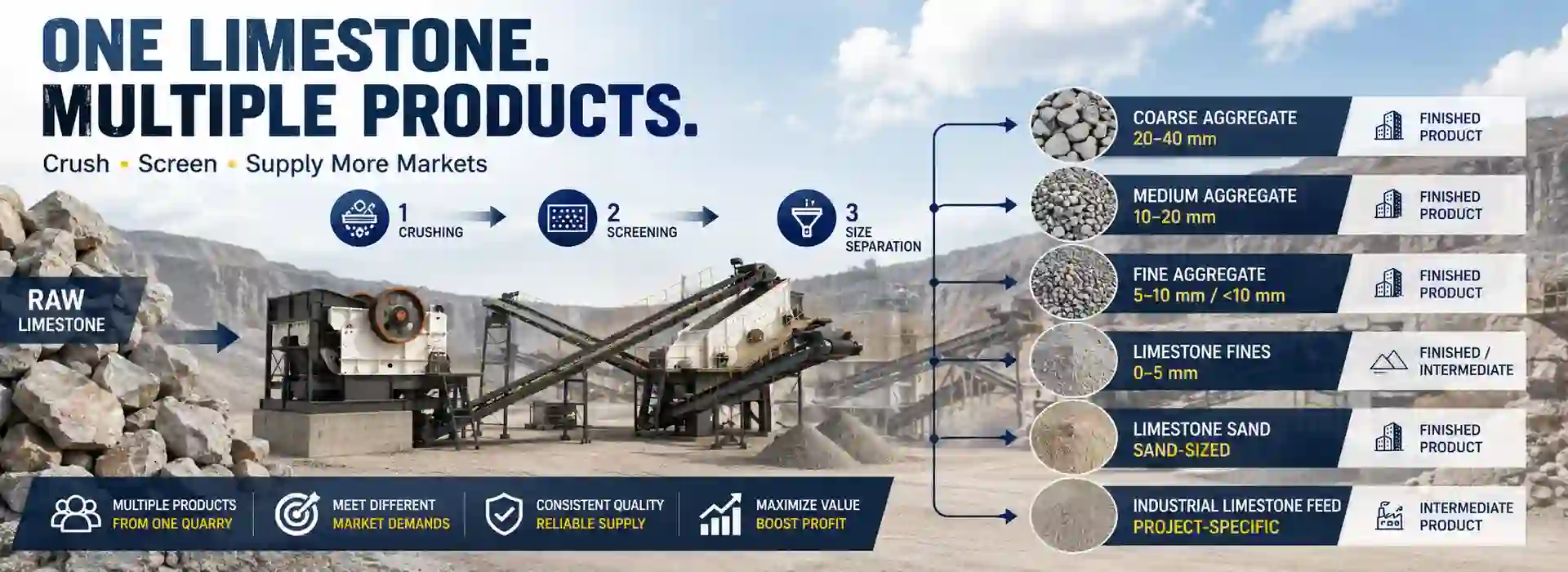
A limestone crushing plant can produce more than a single aggregate size. Through crushing and screening, one quarry may supply coarse aggregate, medium and fine aggregate, limestone fines, or sand-sized material for different markets. The exact product mix is not fixed: it depends on the raw limestone, local customer demand and required specifications. The crush plant can therefore be configured to produce one commercial grade or several products from the same crushing line, rather than following a standard size combination.
| Product Type | Typical Size Examples* | Key Characteristics | Product Status |
|---|---|---|---|
| Coarse Limestone Aggregate | 20–40 mm, 20–30 mm, etc. | Large, clean and well-graded crushed stone | Finished Product |
| Medium Limestone Aggregate | 10–20 mm, 10–15 mm, etc. | Controlled intermediate aggregate | Finished Product |
| Fine Limestone Aggregate | 5–10 mm, <10 mm | Smaller aggregate with tighter grading | Finished Product |
| Limestone Fines / Screenings | 0–5 mm or similar | Fine crushed material and natural fines | Finished / Intermediate |
| Limestone Sand / Manufactured Sand | Generally sand-sized | More controlled grading and particle shape | Finished Product |
| Industrial Limestone Feed | Project-specific | Controlled size for further processing | Intermediate Product |
The right limestone products are only valuable when they meet a real market need. From crushed aggregate to road base and construction materials, each product has a destination. Let’s see where Indonesian crushed limestone goes after leaving the crushing plant—and why those markets matter.
Where Does Crushed Limestone Go Next After Crushing?
After quarrying, limestone can follow different routes depending on the required product, grading and final application. Crushing and screening may produce aggregate for direct construction use or prepare limestone for cement, lime, manufactured sand, grinding and other processing. The main idea is: Quarry Limestone → Crushing & Screening → Limestone Product → Downstream Use → Final Product.
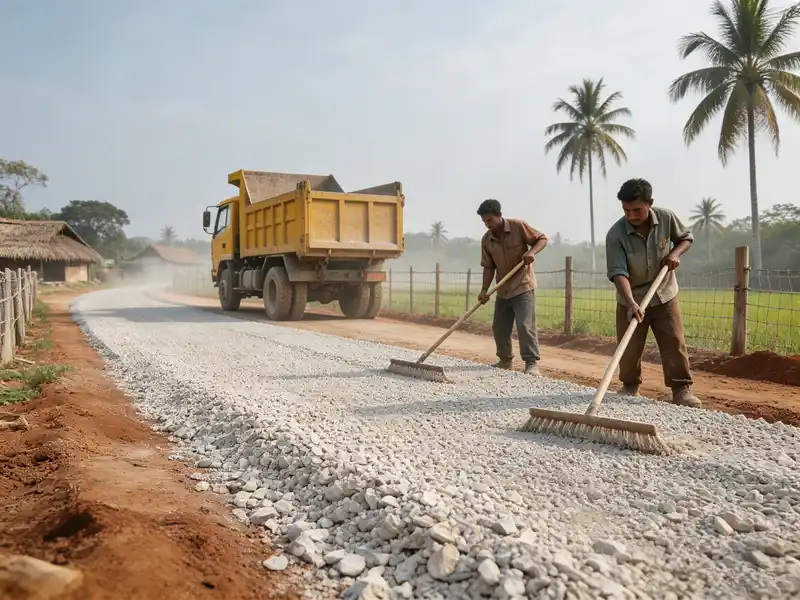
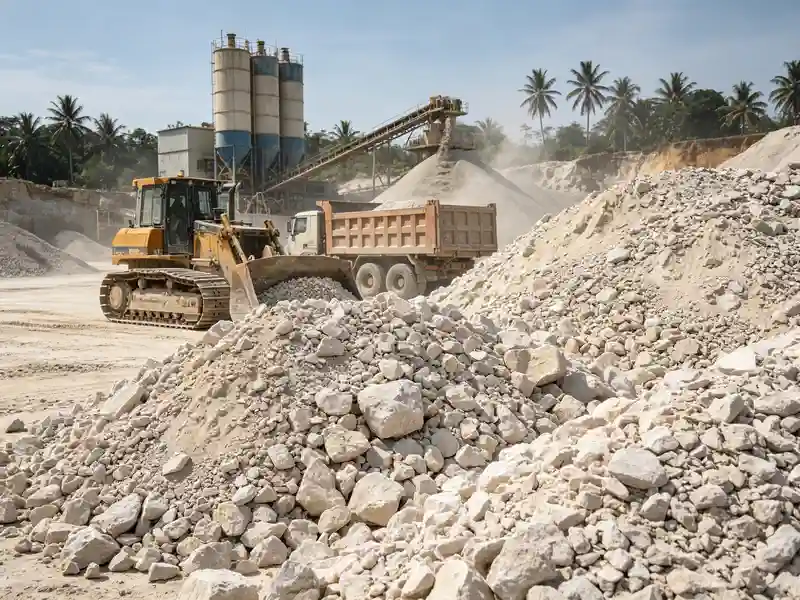
Limestone Aggregate for Road Base and Sub-Base
Quarry Limestone → Primary Crushing → Secondary Crushing → Screening → Sized Limestone Aggregate → Stockpiling → Hauling → Road Base / Sub-Base → Road Construction
Crushed limestone can be supplied for road base, sub-base and other pavement layers.
- Primary and secondary crushing reduce quarry rock to usable aggregate sizes.
- Screening separates the material into the required fractions.
- Typical products may include 20–40 mm, 10–20 mm, 5–10 mm and finer fractions, depending on the project specification.
- Separate stockpiles keep different sizes available for construction.
- The finished aggregate is then transported to the road project for placement and compaction.
The main value of crushing here is to turn quarry limestone into graded aggregate suitable for a specific road application.
Limestone Aggregate for Concrete Production
Quarry Limestone → Primary Crushing → Secondary Crushing → Screening → Coarse / Fine Aggregate → Separate Stockpiles → Concrete Batching Plant → Concrete
Limestone can become coarse and fine aggregate for concrete production.
- Crushing reduces the quarry rock into manageable sizes.
- Screening separates the aggregate into different commercial fractions.
- Stockpiling keeps the required sizes available for continuous supply.
- The finished limestone aggregate is then delivered to a concrete batching plant.
- The aggregate becomes part of the concrete mixture together with cement, water and other materials.
For this market, the limestone processing equipment needs to provide consistent aggregate fractions, rather than simply producing the highest possible tonnage.
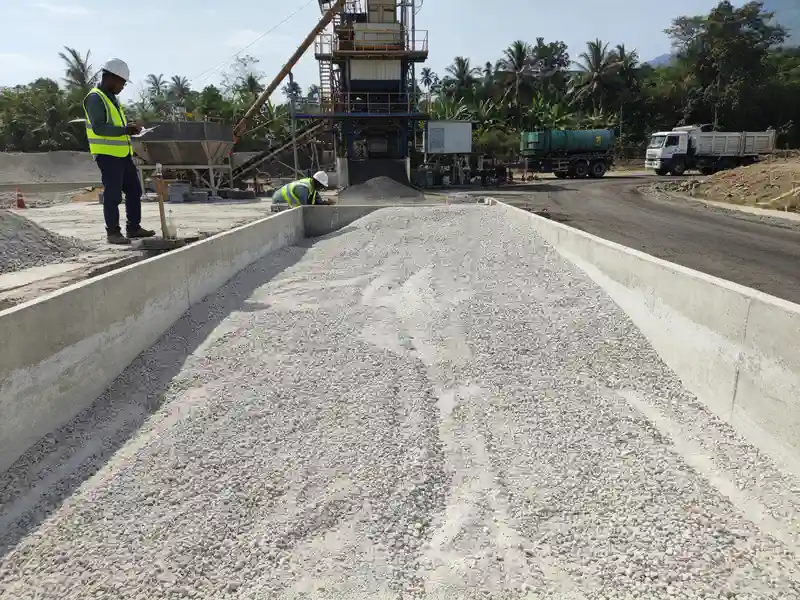
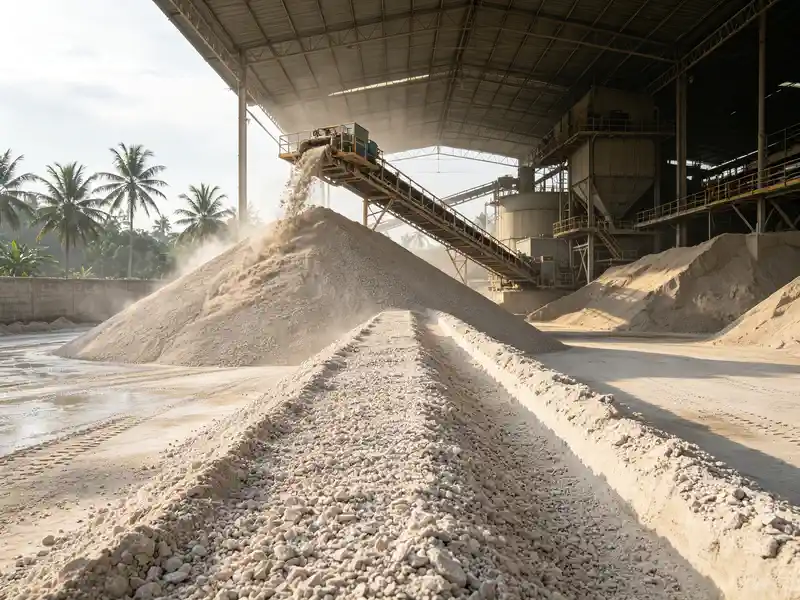
Limestone Aggregate for Asphalt Production
Quarry Limestone → Primary / Secondary Crushing → Screening → Graded Aggregate → Stockpiling → Asphalt Mixing Plant → Asphalt Mixture → Pavement
Crushed limestone can also be used as aggregate for asphalt production.
- Crushing and screening produce the aggregate fractions required by the asphalt mix.
- Different sizes can be stored separately before use.
- The material is supplied to the asphalt mixing plant as part of the mineral aggregate blend.
- Limestone may be combined with other aggregates and mineral filler before mixing with bitumen.
- The final asphalt mixture is then transported for paving.
The crushing objective is to provide stable aggregate sizes and suitable grading for the intended asphalt mixture.
Crushed Limestone for Cement Raw Material Preparation
Quarry Limestone → Primary Crushing → Secondary Crushing → Controlled Limestone Feed → Storage / Blending → Raw Material Preparation → Raw Mill → Kiln → Clinker → Cement
Cement production is a different downstream route. Here, limestone becomes a raw material for clinker production, rather than a finished aggregate.
- Crushing reduces large quarry limestone to a manageable feed.
- Storage and blending can help maintain a more consistent raw-material supply.
- The limestone is combined with other raw materials during preparation.
- The prepared raw meal enters the raw mill and kiln system.
- The final downstream products are clinker and cement.
For this application, the crushing stage mainly provides a stable and suitable limestone feed for continuous cement production.
Controlled-Size Limestone for Lime Production
Quarry Limestone → Crushing → Screening → Controlled-Size Limestone → Stockpiling / Feed System → Lime Kiln → Lime
Limestone can also be processed into lime rather than sold as aggregate.
- Crushing reduces large quarry rock.
- Screening separates limestone within the required feed-size range.
- The selected material can be stored before entering the lime-production system.
- The limestone then enters a lime kiln for calcination.
- The final product is lime rather than crushed aggregate.
The important output from the crushing stage is therefore controlled-size limestone feed for the next processing step.
Limestone for Manufactured Sand and Fine Aggregate
Quarry Limestone → Primary / Secondary Crushing → Fine Crushing / VSI → Fine Screening → Limestone Sand / Fine Aggregate → Construction Use
Suitable limestone can be processed further when the target market requires a finer product.
- Initial crushing reduces the quarry rock to smaller sizes.
- Fine crushing or VSI shaping can further reduce and shape the particles.
- Fine screening separates the required sand-sized fraction.
- Washing or classification may be added where the final specification requires tighter control of fine particles.
- The finished material can then be supplied as limestone sand or fine aggregate.
A 0–5 mm fraction is not automatically manufactured sand; the final material still needs suitable grading and particle characteristics.
Fine Limestone for Grinding and Powder Production
Quarry Limestone → Crushing → Screening / Feed Preparation → Controlled Feed → Grinding → Classification → Limestone Powder
Some limestone continues beyond crushing because the final market requires a finer material.
- Crushing first prepares a manageable and consistent feed for the next stage.
- A grinding mill performs the main fine size reduction.
- A classifier separates material according to the required fineness.
- A dust collection system handles the fine powder generated during processing.
- The final material can become limestone powder or another processed limestone product.
Here, crushing is the initial size-reduction stage, while grinding and classification determine the final fine product.
Other Industrial Limestone Processing Routes
Quarry Limestone → Crushing → Screening / Size Control → Controlled Limestone Feed → Further Processing → Industrial Product
Some limestone enters more specialized industrial processing instead of conventional aggregate markets.
Depending on the application, the downstream process may include:
- Fine crushing and screening for more controlled feed material.
- Grinding and classification for finer mineral products.
- Separation or purification where the downstream process requires cleaner material.
- Other specialized mineral-processing stages depending on the final product.
For example, a proposed PCC project in Sale, Rembang, Central Java, identifies local limestone as feedstock for products serving industries such as paper, polymers, paints and rubber.
How Downstream Markets Change the Crushing Objective
Different downstream markets require different limestone products and material conditions. As a result, the crushing and screening plant may need to prioritize product grading, feed consistency, particle shape, fines control or further size reduction depending on where the limestone will go next.
| Downstream Market | Limestone Output | Downstream Route | Key Material Requirement | Crushing & Screening Objective |
|---|---|---|---|---|
| Road construction | Graded limestone aggregate | Stockpile → Road construction | Stable grading, suitable fines | Produce the required aggregate fractions consistently |
| Concrete batching | Coarse + fine aggregate | Aggregate bins → Concrete batching plant | Consistent grading, separated sizes | Produce and separate multiple aggregate fractions reliably |
| Asphalt mixing | Controlled aggregate fractions | Cold feed bins → Asphalt mixing plant | Grading, particle characteristics, fines control | Maintain stable fractions and add shaping/fine crushing where required |
| Cement production | Limestone raw-material feed | Storage / blending → Raw mill → Kiln | Suitable feed size, consistency, continuous supply | Reduce quarry rock to a stable feed for raw-material preparation |
| Lime production | Controlled-size limestone feed | Screening → Lime kiln | Suitable feed range, controlled oversize and fines | Prepare limestone within the required kiln-feed range |
| Manufactured sand | Fine aggregate / limestone sand | Fine crushing / VSI → Fine screening | Grading, particle shape, fines control | Further reduce and shape fine material to the required specification |
| Grinding / powder | Limestone grinding feed | Grinding mill → Classifier | Consistent feed size, manageable top size | Prepare stable feed for the downstream grinding stage |
| Industrial processing | Selected limestone feed | Further mineral processing | Size, consistency, cleanliness, material quality | Provide controlled feed suited to the specific processing route |
Knowing where crushed limestone goes is only part of the picture. Producing it efficiently in Indonesia means working with local quarry conditions, logistics, climate and project requirements. So, what makes limestone crushing here different from a typical quarry operation? Let’s take a closer look.
What Makes Limestone Crushing Projects in Indonesia Different?
Limestone crushing projects in Indonesia are influenced by more than the limestone itself. Quarry location, transport distance, rainfall, site infrastructure, maintenance access, environmental requirements and mining plans can all affect how a project is developed and operated. For this reason, an Indonesian limestone crushing solution needs to fit the actual quarry environment and operating conditions, rather than simply selecting a limestone crusher based on its capacity.
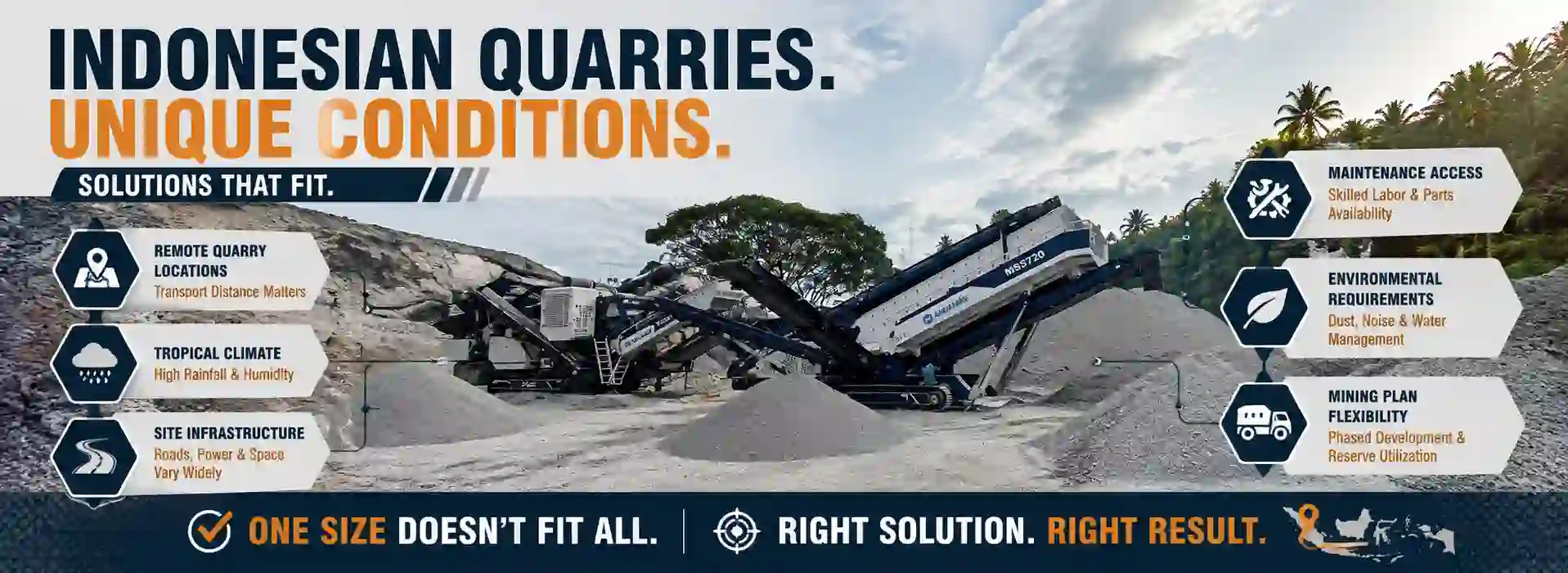
Quarry Locations and Long Haulage Distances Can Shape Project Planning
- Cement-linked quarries can have relatively direct connections with nearby industrial plants.
- Aggregate quarries may supply multiple construction and infrastructure projects.
- Remote quarries can face longer distances between the quarry, crushing site, stockpiles and customers.
- Longer haulage can increase the importance of plant positioning, stockpile planning and transportation efficiency.
For Indonesian projects, the practical question is not only where to quarry limestone, but also where and how the finished material will be supplied.
Heavy Rainfall Can Affect Quarry Access and Production Continuity
- Quarry roads can become difficult for heavy trucks and mobile equipment.
- Drainage around the crushing and stockpile areas needs to handle heavy runoff.
- Extended rainfall can affect material movement and site accessibility.
- Stockpile areas may need better water management and layout planning.
- Maintenance activities can also become more difficult when access to the site is limited.
The important issue is therefore not simply wet limestone. It is whether the quarry and crushing site can maintain stable material movement and production during wet periods.
Remote Quarry Sites Can Have Limited Power and Infrastructure
Typical considerations include:
- Grid power availability or the need for generators
- Diesel fuel supply and storage
- Water availability for site operations
- Heavy-truck and equipment access
- Space for plant installation, maintenance and stockpiling
- Local facilities for operators and technicians
A crushing plant designed for a well-developed industrial site may therefore require adjustments when deployed at a remote Indonesian quarry.
Remote Locations Can Make Maintenance and Spare Parts More Challenging
A limestone crushing project may need to prepare:
- Critical spare parts before operation starts
- Crusher wear parts based on expected operating conditions
- Preventive maintenance schedules
- Remote troubleshooting and technical support
- Local or regional engineer response
- Clear replacement procedures for critical components
For a complete limestone crusher for sale, one unavailable critical component can interrupt the entire production chain, not just one machine. Local parts and service support can therefore have a direct impact on long-term production availability.
Dust, Noise and Nearby Communities Can Add Site Constraints
A project may therefore need to consider:
- Dust around crushers, screens and stockpiles
- Water management for dust suppression where appropriate
- Truck routes and traffic movement
- Noise from continuous plant operation
- Distance between the plant and nearby communities
- Site layout and operating practices
Indonesia’s ESDM identifies environmental protection, safety, community involvement, reclamation and transparency as important elements of Good Mining Practice. The limestone crushers should therefore be planned as part of the whole quarry site, rather than as an isolated equipment package.
Limestone Quarries Must Account for Environmental and Reclamation Requirements
For a limestone quarry, this can affect:
- Land disturbed by quarrying and supporting facilities
- Water and drainage management
- Dust and other environmental impacts
- Progressive reclamation where applicable
- Post-mining land rehabilitation
- Monitoring and reporting requirements
This means the crushing area, access roads, stockpiles and other supporting facilities need to fit into the broader quarry development and reclamation plan.
Production Plans Must Align With Indonesia’s Mining Requirements
For a limestone crushing project, this means the planned:
- Annual production
- Crushing capacity
- Mine development schedule
- Environmental measures
- Safety arrangements
- Supporting infrastructure
should be considered together rather than treating the crusher capacity as an isolated number.
Understanding Indonesia’s unique limestone conditions is one thing—seeing how they are handled in a real project is another. Let’s move from local challenges to a proven solution and see how a limestone crushing plant performs in practice.
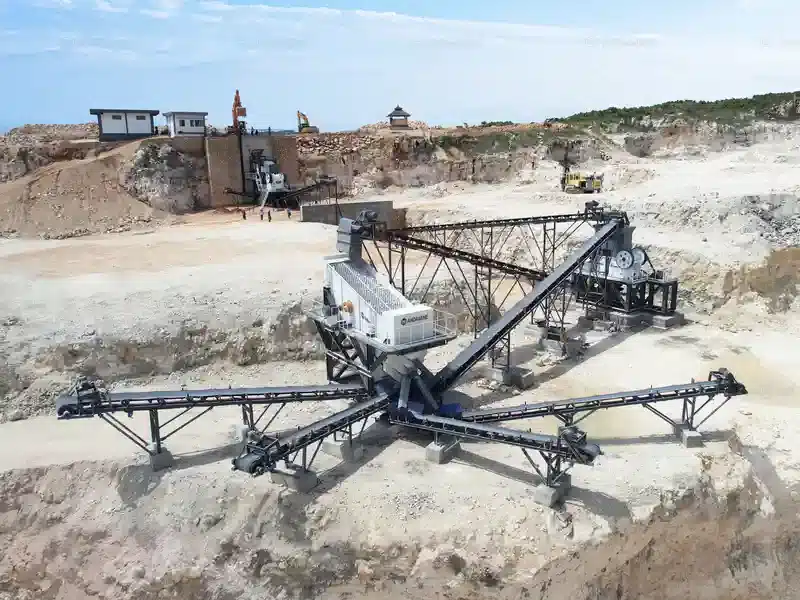
200 TPH Stationary Limestone Crushing Plant in Tuban, Indonesia
A limestone-processing customer in Tuban, East Java needed to expand its aggregate production while handling limestone feed of up to 500 mm. The project required a 200 TPH stationary crushing solution capable of producing 0–5 mm and 5–20 mm materials for both internal use and external sales. Based on these requirements, ANDAMINE supplied a complete crushing and screening line for the Indonesian site.
Project Snapshot
- Capacity: 200 TPH
- Feed Size: ≤500 mm
- Final Products: 0–5 mm & 5–20 mm
- Application: Limestone aggregate production
- Customer Need: Increase limestone aggregate production for both internal use and external sales.
- Our Solution: A 200 TPH stationary crushing and screening plant with jaw crushers, feeders, vibrating screen and belt conveyors.
- Process Flow: Limestone → Crushing → Screening → 0–5 mm / 5–20 mm → Stockpiling
- Results: The new crushing line expanded customer’s limestone aggregate production, supporting both internal material requirements and external aggregate sales.
A real project shows what today’s limestone crushing solutions can achieve. But the industry is moving forward—bringing smarter control, greater flexibility and more efficient material handling to Indonesian quarries. Let’s see how new crushing technology is changing the way limestone is processed.
How Limestone Crushing Technology Is Changing Indonesian Quarries?
Limestone crushing in Indonesia is becoming more focused on production efficiency, material handling, product consistency and operating flexibility. Modern crushing solutions are no longer measured only by crusher capacity—the real value comes from how much usable limestone can be produced with less downtime, unnecessary haulage and manual intervention.
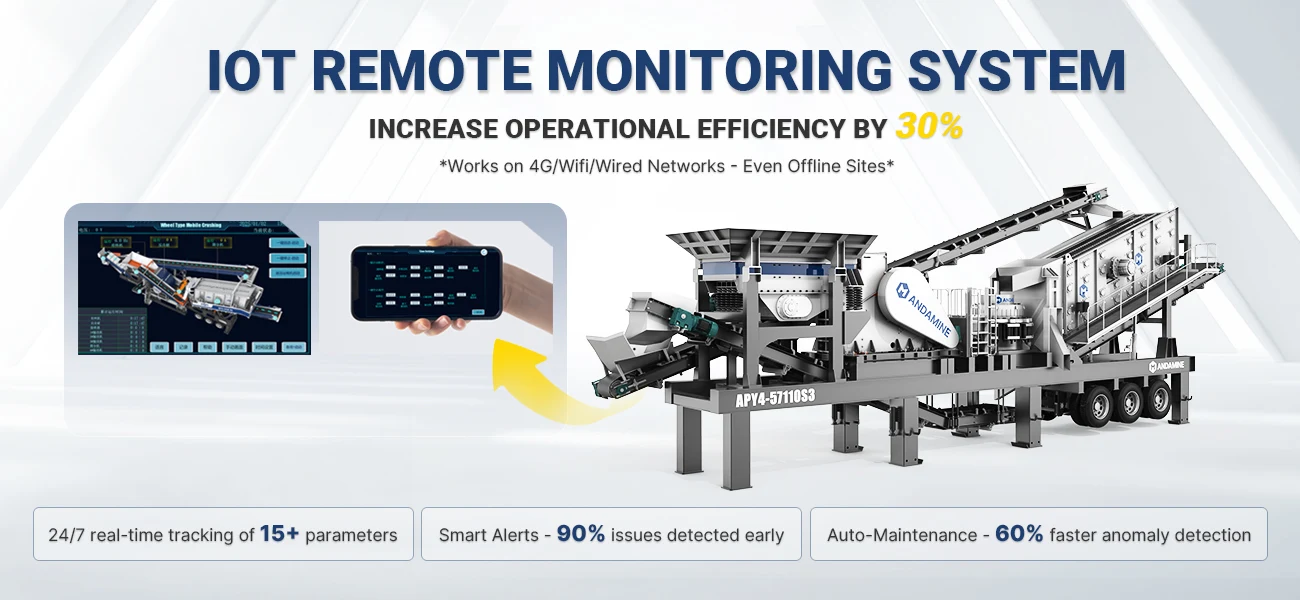
Smarter Control for More Stable Limestone Production
- Up to +15% Higher Efficiency — Intelligent process control can improve overall production efficiency under suitable operating conditions.
- Real-Time Monitoring — Key operating data helps identify abnormal feeding, crushing or screening conditions earlier.
- Less Unplanned Downtime — Early warnings allow operators to address problems before they become major production interruptions.
- More Consistent Output — Stable feeding and process control help maintain limestone product grading.
Mobile Crushing Can Cut Unnecessary Limestone Haulage
- Up to 30% Less Internal Haulage — A shorter distance between extraction and crushing can reduce unnecessary raw-limestone transport, depending on quarry layout.
- Less Double Handling — Limestone can be processed closer to where it is extracted.
- Faster Relocation — Mobile equipment can follow changing quarry areas instead of rebuilding a fixed crushing point.
- Better Remote-Site Flexibility — Particularly valuable where quarry access and infrastructure are limited.
Better Crushing and Screening Can Increase Saleable Output
- More Controlled Product Grading — Screening helps separate limestone into consistent commercial sizes.
- Lower Recirculation — Proper crusher-screen matching can reduce unnecessary return material.
- Multiple Finished Products — One crushing line can supply several aggregate fractions.
- Less Product Loss — Better process control can reduce excessive fines and unwanted oversize.
Smarter Plant Design Can Lower Operating Costs
- Up to 20% Lower Operating Cost — Process optimization and reduced material handling can lower operating costs in suitable project conditions.
- Lower Energy Waste — Better-matched equipment avoids unnecessary crushing and material transfer.
- Reduced Wear-Part Consumption — Stable feeding and correct operating conditions can help extend component life.
- Lower Material Handling Cost — Shorter internal haulage and better plant layout reduce unnecessary movement.
Technology is changing what limestone crushing plants can achieve—but the right technology still depends on how your quarry operates. From stable, long-term production to remote or changing extraction areas, the next step is choosing the limestone crusher plant that fits your Indonesian limestone project.
When to Choose a Stationary or Mobile Limestone Crushing Plant?
Indonesia’s limestone quarries range from established operations near major markets to remote sites across Java, Sumatra, Kalimantan and other islands. Quarry access, internal haulage, extraction patterns, rainfall, available infrastructure and project duration can all affect how a limestone processing plant should be deployed. The right choice is therefore not only about capacity, but also about how the limestone quarry operates in its local environment.

Choose a Stationary Limestone Crushing Plant When…
A stationary limestone crusher plant is generally more suitable for an established limestone quarry with a stable extraction area and long-term production plan.
- Stable Quarry Location — The main limestone extraction area is expected to remain in the same location.
- Long-Term Production — The plant will operate continuously for many years.
- High Production Demand — Large and consistent volumes of limestone aggregate are required.
- Multiple Product Requirements — A permanent crushing and screening line can produce several aggregate sizes for different markets.
- Permanent Site Infrastructure — The quarry has sufficient space and suitable conditions for a fixed plant, stockpiles and material handling.
- Future Expansion — The plant layout can allow additional crushing, screening or conveying capacity later.
Typical fit: established Indonesian limestone quarries supplying continuous aggregate for road construction, concrete, asphalt and other local markets.
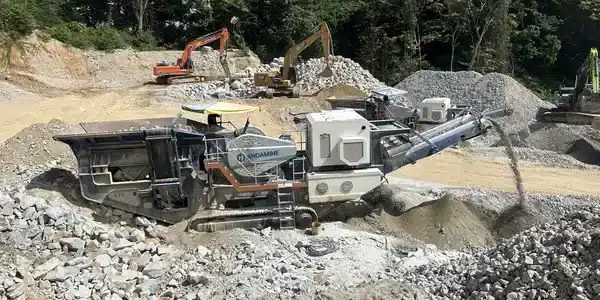
Choose a Mobile Limestone Crushing Plant When…
Mobile crushing becomes more practical when the limestone working area changes, the quarry is remote or the crushing location needs to be relocated during the project.
- Changing Extraction Areas — The mesin penghancur batu kapur needs to move as limestone extraction progresses.
- Remote Quarry Locations — Greater flexibility is needed where permanent infrastructure is limited.
- Long Internal Haulage — Crushing closer to the extraction area can reduce the distance for transporting raw limestone.
- Phased Quarry Development — Different limestone areas may be developed at different stages.
- Relocation Is Part of the Plan — The plant needs to move without building a new permanent crushing base each time.
- Flexible Production — Crushing and screening can be configured around changing production or product requirements.
Typical fit: mobile crusher plant is suitable for remote Indonesian limestone quarries, changing working areas and phased or flexible quarry operations.
The right crusher batu kapur gives a project a strong start, but the right partner turns that setup into a working solution. From understanding Indonesian quarry conditions to delivering practical support throughout the project, here’s how ANDAMINE can help you move from equipment selection to reliable limestone production.
Why Choose ANDAMINE for Limestone Crushing in Indonesia?
ANDAMINE is a specialized crushing and screening brand focused on complete quarry solutions. Instead of offering a standard crusher package, we help you develop the right limestone crushing plant around your material, site, products, and production target. Our support covers process design, equipment selection, plant manufacturing, commissioning, and technical assistance, helping turn your project requirements into a workable production solution.
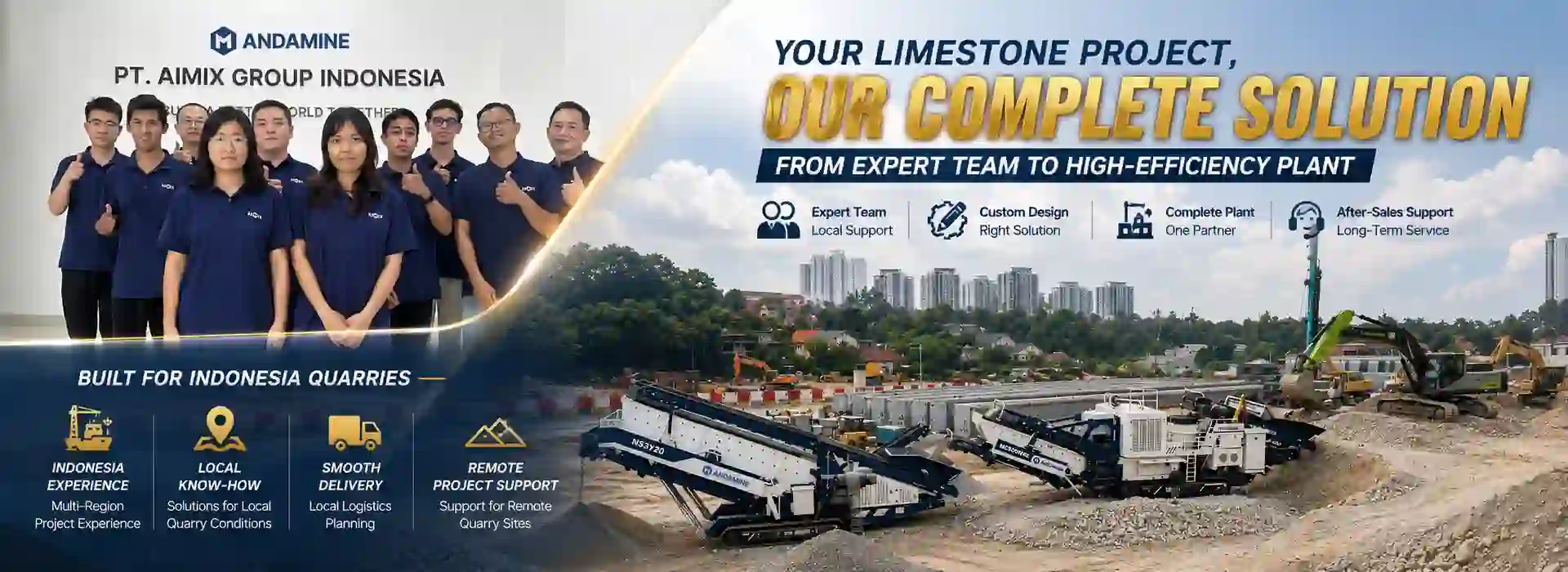
The Right Crushing Solution for Your Limestone
- 1-to-1 Project Assessment — Review your material, site, products, and production goals.
- Multiple Configuration Options — Compare different crushing and screening setups.
- Customized Process Design — Develop the flow around your actual project.
- Dedicated Technical Team — Help turn your requirements into a workable solution.
One Complete Plant Instead of Separate Equipment
- Complete Line Integration — Coordinate feeding, crushing, screening, and conveying.
- Multiple Equipment Series — Select suitable equipment for each production stage.
- End-to-End Plant Design — Cover process flow, layout, and equipment matching.
- One Project Contact — Reduce coordination between different equipment suppliers.
Indonesian Know-How for Local Quarry Projects
- Indonesia-Focused Solutions — Develop solutions for local quarry conditions.
- Multi-Region Project Experience — Support quarry projects across different Indonesian regions.
- Local Logistics Planning — Consider port access, transport, and site delivery.
- Remote Project Support — Help address installation challenges in hard-to-reach areas.
Engineering and Manufacturing Behind Every Solution
- Engineering + Manufacturing — Connect process design with equipment production.
- Full Plant Engineering — From process flow to equipment layout.
- Factory-Backed Equipment — The solution comes from actual manufacturing capability.
- Pre-Delivery Inspection — Check equipment before shipment to the project.
From Equipment Delivery to a Plant Ready for Production
- Installation Support — Guide equipment setup and line connection.
- Commissioning Support — Check the complete system before production.
- Operator Training — Train the team on operation and routine maintenance.
- Production Follow-Up — Help resolve issues after initial startup.
Local Support When Need Parts or Technical Help
- Spare Parts Support — Help identify and supply required replacement parts.
- Technical Assistance — Provide support when equipment issues occur.
- Maintenance Guidance — Help reduce unnecessary production interruptions.
- Long-Term Service — Continue technical support throughout the equipment lifecycle.
Let’s Plan Your Limestone Crushing Project in Indonesia
Have a limestone quarry project in Indonesia? Send us your requirements or leave a message with your limestone feed size, required capacity, final products and project location. The ANDAMINE team will help you evaluate the project and develop a suitable limestone crushing solution.


