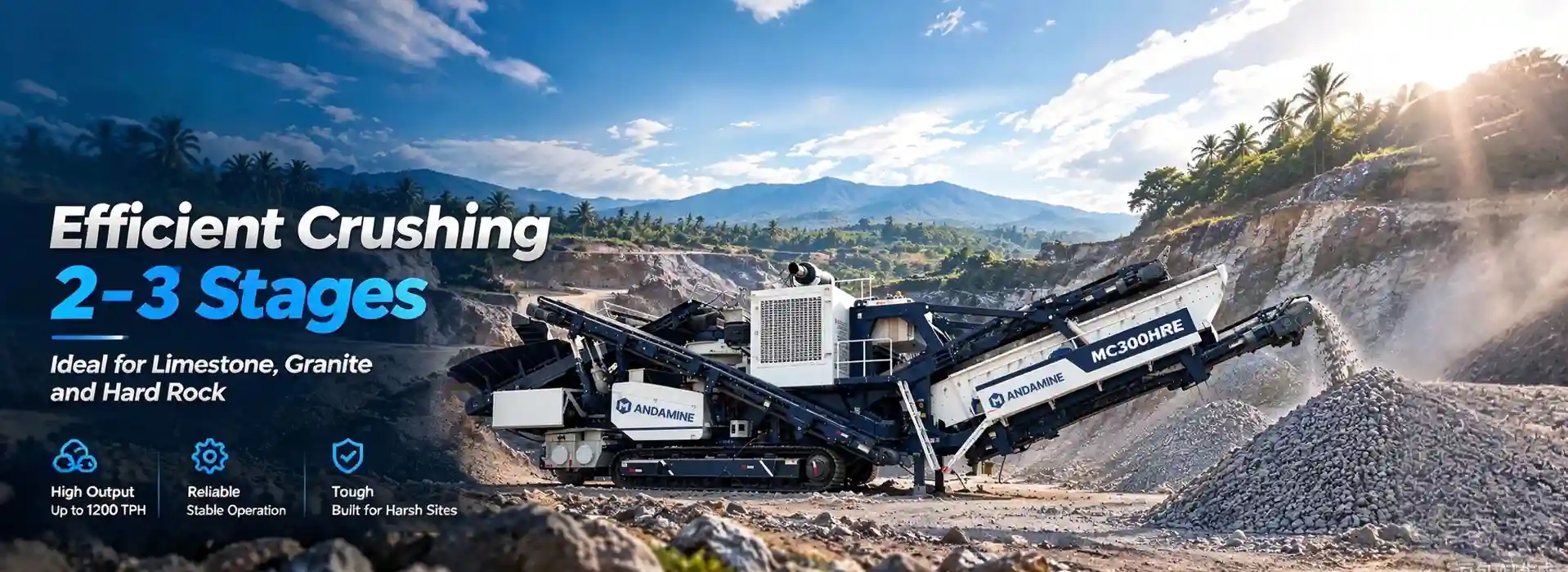
Cone crusher is a crushing machine used for secondary and fine crushing, reducing hard rock into smaller and more uniform aggregate sizes. It is normally installed after a primary crusher in quarrying, mining, and aggregate production. ANDAMINE provides stationary and mobile cone crusher solutions in Indonesia for different rock types, production capacities, feed conditions, and final aggregate requirements.
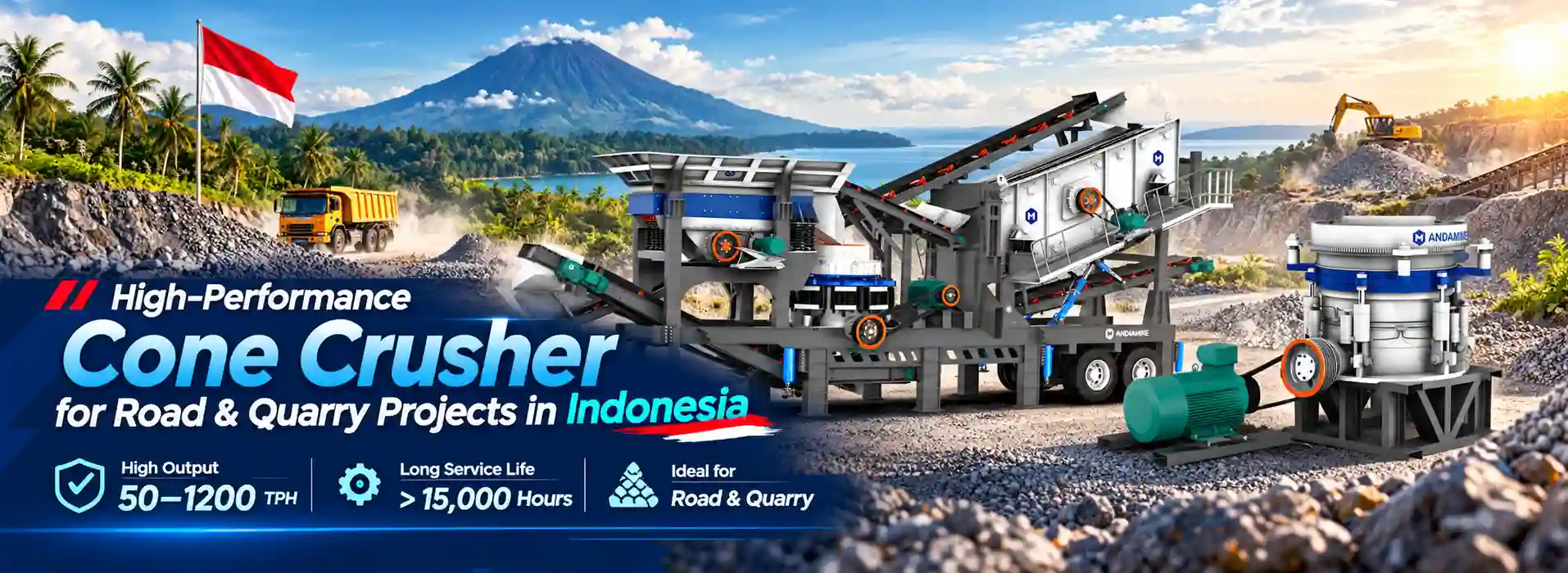
| Item | Specification |
|---|---|
| Cone Crusher Series | APC-M, APC-D, APC-Y, and APC-C |
| Cone Crusher Types | Multi-cylinder hydraulic, single-cylinder hydraulic, spring, and compound cone crushers |
| Individual Crusher Capacity | 18–1,200 t/h, depending on the model and crushing chamber |
| Maximum Feed Size | Up to 353 mm, depending on the model |
| Output Size | As low as 3 mm, depending on the model and crushing chamber |
| Mobile Cone Crusher | APY2-C wheel-type and APYL-C crawler-type mobile configurations |
| Mobile Capacity | 50–590 t/h for wheel-type configurations; 100–310 t/h for crawler-type configurations |
| Typical Materials in Indonesia | Andesite, granite, limestone, river stone, basalt, and other suitable hard rock |
| Typical Applications | Quarrying, mining, aggregate production, road construction, concrete aggregate, and asphalt aggregate production |
What Types of Cone Crushers Are Available in Indonesia?
ANDAMINE’s stone cone crusher range includes multi-cylinder hydraulic, single-cylinder hydraulic, spring, and compound cone crushers. The suitable type depends on the material entering the crusher cone, required capacity, feed size, final aggregate size, and the role of the cone crusher within the complete crushing line.
Multi-cylinder Hydraulic Cone Crusher
The APC-M multi-cylinder hydraulic cone crusher is designed for secondary and fine crushing of medium- and high-hardness materials. It is suitable for Indonesian quarry and aggregate projects processing materials such as andesite, granite, basalt, river stone, and other suitable hard rock.

Product Specifications
- Series: APC-M
- Capacity: 90–1,200 t/h
- Inlet Size: 20–353 mm
- Minimum Output Size: 6 mm
What It Offers
- High-capacity crushing: APC-M models cover large production requirements for quarry and aggregate operations.
- Hydraulic control: The hydraulic system supports crusher adjustment and protection during cone crusher operation.
- Multiple cavity options: Different crushing chambers can be selected according to feed conditions and required product size.
- Hard-rock applications: The series is suitable for materials such as andesite, granite, basalt, and river stone when matched to the actual material conditions.
Single-cylinder Hydraulic Cone Crusher
The APC-D single-cylinder hydraulic cone crusher is designed for secondary and fine crushing of medium- and high-hardness rock. Its hydraulic adjustment and protection system makes it suitable for quarrying, mining, and aggregate production where feed size and final product size need to be controlled.

Product Specifications
- Series: APC-D
- Capacity: 48–500 t/h
- Maximum Inlet Size: 270 mm
- Minimum Output Size: 6 mm
What It Offers
- Hydraulic adjustment: The discharge setting can be adjusted hydraulically to match the required crushing and product-size conditions.
- Overload protection: The hydraulic system helps protect the crusher when uncrushable material enters the crushing chamber.
- Flexible crushing chambers: Different cavity configurations allow the crusher to accommodate different feed and output requirements.
- Medium- and high-hardness materials: The crusher can process suitable materials such as granite, basalt, chrome ore, and other hard rock.
Spring Cone Crusher
The APC-Y spring cone crusher uses a spring-based overload protection system for secondary and fine crushing. It is suitable for Indonesian quarry and aggregate projects processing granite, limestone, river stone, and other suitable rock materials.

Product Specifications
- Series: APC-Y
- Capacity: 18–650 t/h
- Maximum Inlet Size: 267 mm
- Output Size: 3–60 mm
What It Offers
- Wide capacity range: APC-Y models cover 18–650 t/h for different secondary and fine crushing requirements.
- Spring overload protection: The spring system provides protection when uncrushable material enters the crushing chamber.
- Flexible product sizing: Different crushing chamber configurations support different feed and output requirements.
- Suitable quarry materials: The series can process suitable andesite, granite, basalt, limestone, river stone, and other rock materials.
Compound Cone Crusher
The APC-C compound cone crusher combines spring and hydraulic components for secondary and fine crushing. It is suitable for aggregate and construction projects processing limestone, granite, river stone, and other suitable rock materials.

Product Specifications
- Series: APC-C
- Capacity: 18–655 t/h
- Maximum Inlet Size: 267 mm
- Output Size: 6–64 mm
What It Offers
- Combined crushing structure: Spring and hydraulic components work together for crushing and overload protection.
- Flexible product sizing: Different cavity options can be matched to different feed and output requirements.
- Secondary and fine crushing: The crusher can be used after primary crushing to prepare material for screening and downstream applications.
- Construction aggregate production: Suitable applications include road construction, concrete aggregate, and other construction-material production.
Compare the Four Cone Crusher Types
The four cone crusher series differ mainly in crushing structure, capacity range, feed conditions, and adjustment or protection systems. The comparison below provides a quick reference when narrowing down a model for an Indonesian crushing project.
| Cone Crusher Type | Capacity | Max. Feed Size | Output Size | Main Characteristic |
|---|---|---|---|---|
| APC-M Multi-cylinder Hydraulic |
90–1,200 t/h | 20–353 mm | From 6 mm | High-capacity hydraulic cone crusher for large-scale secondary and fine crushing. |
| APC-D Single-cylinder Hydraulic |
48–500 t/h | Up to 270 mm | From 6 mm | Hydraulic adjustment and overload protection for controlled crushing. |
| APC-Y Spring |
18–650 t/h | Up to 267 mm | 3–60 mm | Spring-based overload protection for secondary and fine crushing. |
| APC-C Compound |
18–655 t/h | Up to 267 mm | 6–64 mm | Combined spring and hydraulic structure for secondary and fine crushing. |
When Is a Mobile Cone Crusher Plant a Better Fit for Indonesian Projects?
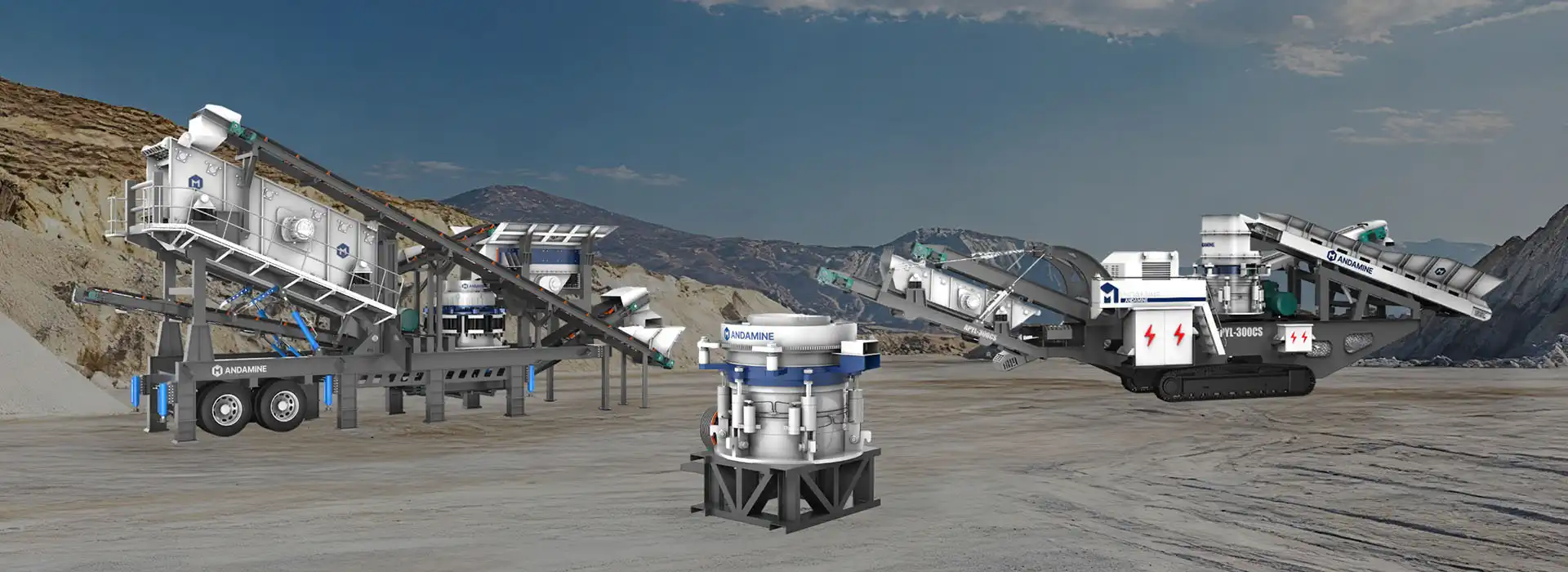
A mobile cone crusher plant is useful when the crushing location needs to change with the material source or construction progress. This can be relevant to Indonesian quarrying, road construction, infrastructure, and remote-site projects where transporting raw rock or finished aggregate over difficult routes may affect the practical plant arrangement. ANDAMINE provides wheel-mounted and crawler-type mobile cone crusher configurations. The main difference is how each configuration moves around the project site and how the crushing process is arranged around that mobility requirement.

Wheel Cone Crusher for Flexible Site Movement
The wheel-mounted type is suited to projects where the crushing plant needs to move between working areas or material sources. Its integrated configuration combines the cone crusher with supporting equipment, allowing the main crushing and screening process to be arranged as a mobile unit.

Crawler Cone Crusher for On-Site Hard Rock Crushing
The crawler type is designed for crushing sites where the plant needs to travel directly across the working area. This configuration is relevant to quarrying and hard-rock projects where the crushing position changes as material is extracted.
How to Choose a Cone Crusher in Indonesia?
The right cone crusher for sale is determined by the complete crushing requirement rather than crusher capacity alone. For an Indonesian quarry or construction project, the main factors are production target, feed material, feed size, required aggregate sizes, crushing stage, site conditions, and existing equipment.
Cone Crusher Selection by Project Condition
| Project Condition | What to Check | Selection Direction |
|---|---|---|
| High aggregate demand | Required tons per hour and complete plant capacity | Select a cone crusher whose practical operating capacity fits the required plant output. |
| Hard rock such as andesite, basalt, or granite | Material hardness, abrasiveness, feed size, and crushing stage | Match the crusher model and crushing chamber to the actual material and feed condition. |
| Multiple finished aggregate sizes | Required product fractions and screening arrangement | Plan the cone crusher together with the vibrating screen and return circuit. |
| Fixed quarry operation | Plant layout, available space, and material flow | Match the cone crusher with the complete stationary crushing line. |
| Changing crushing locations | Relocation frequency, access, and working area | Consider a mobile cone crusher configuration when mobility is an actual project requirement. |
| Existing crushing equipment | Jaw crusher discharge size, screen capacity, and conveyor capacity | Select the cone crusher as part of the existing circuit instead of sizing it independently. |
Production Demand Determines the Required Crushing Capacity
- Hourly aggregate demand: Define the required finished aggregate output before selecting the crusher.
- Complete plant capacity: The jaw crusher, cone crusher, screen, and conveyors should have compatible capacities.
- Operating conditions: Feed continuity, material characteristics, and operating schedule affect the output achieved by the complete plant.
The Feed Condition After Primary Crushing Matters
- Actual cone-crusher feed: Use the material size delivered by the primary crusher as the basis for cone crusher selection.
- Maximum feed size: The largest pieces entering the chamber must remain within the selected model’s allowable range.
- Material characteristics: Andesite, basalt, granite, limestone, and river stone can behave differently during crushing.
Finished Aggregate Sizes Shape the Crushing Arrangement
- Define the products: Identify required sizes such as 0–5 mm, 5–10 mm, 10–20 mm, or 20–40 mm before finalizing the circuit.
- Match crushing and screening: The standard cone crusher reduces size while the vibrating screen separates the required fractions.
- Consider the return circuit: Oversize material in a closed circuit needs a suitable path back to the cone crusher.
Site Conditions Determine the Suitable Plant Configuration
- Stable quarry location: A stationary crushing line is suitable when the material source and crushing area remain fixed.
- Changing work area: Mobile crushing can be considered when the crushing point needs to follow the material source or project progress.
- Road and infrastructure projects: Access, working space, relocation requirements, and material transport distances should be evaluated together.
Existing Equipment Affects Cone Crusher Selection
- Existing jaw crusher: Its discharge size and capacity provide important references for selecting the downstream cone crusher.
- Existing screening system: Screen capacity and deck arrangement must support the planned product sizes and output.
- Existing conveyors: Feed, return, and finished-product conveyors need sufficient capacity for the planned material flow.
Project Data Confirms the Final Cone Crusher Model
- Material: Specify the rock type and material characteristics.
- Feed size: Provide the maximum and typical size entering the cone crusher after primary crushing.
- Production target: State the required output in tons per hour.
- Finished products: Provide the required aggregate sizes and intended application.
- Plant configuration: Indicate whether you need a standalone crusher, mobile cone crushing plant, or complete crushing line.
- Project location: Provide the Indonesian delivery location for equipment logistics and service planning.
With these project details, the cone crusher for sale can be selected as part of a complete crushing solution instead of being chosen only by its maximum rated capacity.
What Are the Common Uses and Applications of Cone Crushers?
Cone crushers are used where rock or other suitable materials need controlled secondary or fine crushing. In Indonesia, common applications include quarry aggregate production, road construction, concrete and asphalt aggregate supply, mining, and mobile crushing projects. The suitable configuration depends on the material, production requirement, site conditions, and how the crushed material will be used.
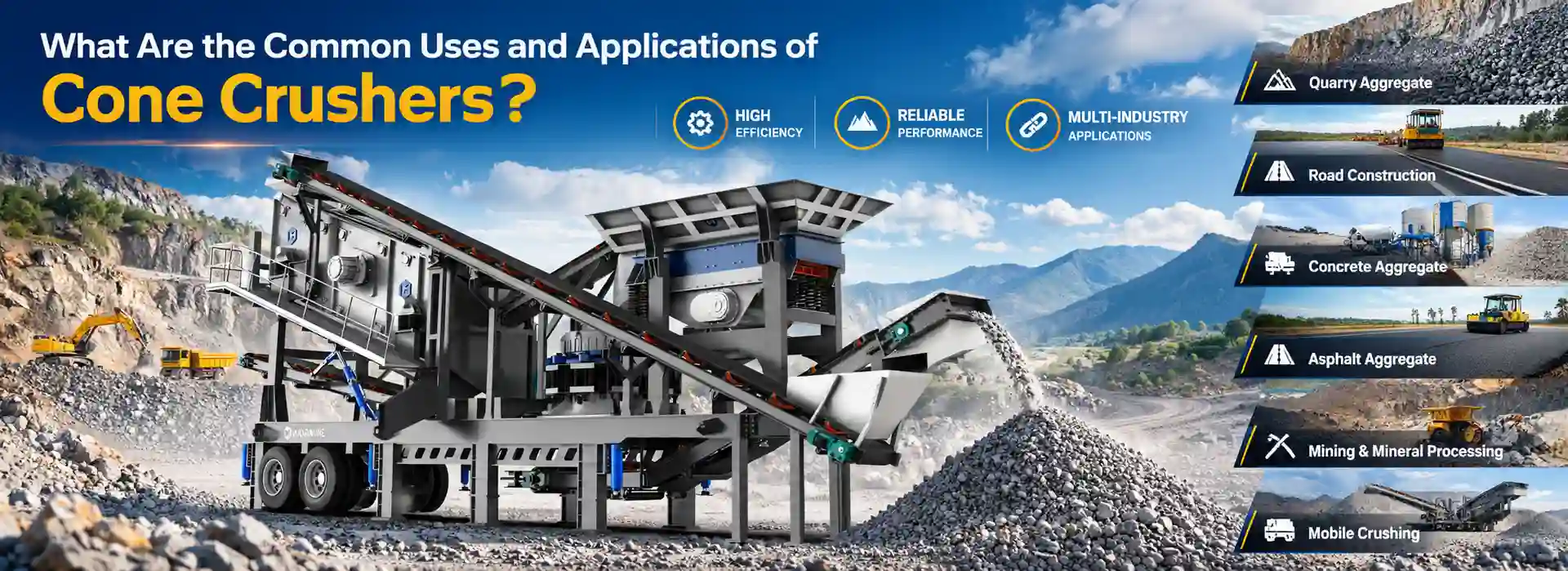
| Application | Typical Materials | Main Purpose | Suitable Configuration |
|---|---|---|---|
| Quarry Aggregate Production | Andesite, basalt, granite, limestone, river stone | Produce commercial aggregates for construction, concrete, asphalt, and other aggregate markets. | Stationary cone crusher for long-term quarry production; mobile configuration where the crushing location needs to change. |
| Road Construction | Suitable local quarry rock | Supply crushed aggregate for road base, subbase, shoulders, and other infrastructure works. | Stationary plants for fixed material sources; mobile crushing for projects with changing work areas. |
| Concrete Aggregate Production | Andesite, granite, limestone, and other suitable rock | Supply crushed stone with the required characteristics for ready-mix and precast concrete production. | Cone crusher integrated with screening and conveying equipment according to the aggregate specification. |
| Asphalt Aggregate Production | Suitable hard and durable quarry rock | Prepare aggregate for asphalt mix production and road surfacing applications. | Stationary or mobile crushing systems depending on the quarry source and project arrangement. |
| Mining and Mineral Processing | Suitable ores and mineral-bearing rock | Reduce mined material to a size suitable for screening or the next stage of mineral processing. | Cone crusher selected according to ore characteristics, feed conditions, required capacity, and downstream process requirements. |
| Mobile Crushing Projects | Suitable rock available at different project sites | Produce aggregate closer to changing work areas or material sources without establishing a permanent crushing plant at every location. | Wheel or crawler mobile cone crusher according to site access, mobility requirements, and production conditions. |
The same cone crusher may serve different applications, but the required configuration can change significantly with the material, production target, site conditions, and downstream requirements. These factors should be evaluated together when selecting the equipment.
What Is the Cone Crusher Price in Indonesia?
How much does a cone crusher cost in Indonesia? A standalone cone crusher typically ranges from $23,000 to $233,000, depending on the model, capacity, configuration, and crushing requirements. This is a machine-only reference range. The delivered cost of a complete project can be higher after transportation, installation, auxiliary equipment, electrical systems, and spare parts are included.
 Cone Crusher Machine Prices Vary by Configuration
- Standalone cone crusher: The price of cone crusher depends mainly on the selected model, capacity, feed requirements, and configuration.
- Mobile cone crusher: A mobile unit includes the crusher together with supporting equipment and a mobile chassis, so its price differs from that of an individual crusher.
- Complete crushing plant: A complete line may include primary crushing, cone crushing, vibrating screening, conveying, and other equipment, so its total cost cannot be calculated from the cone crusher price alone.
 Production Requirements Affect Equipment Cost
- Required output: Higher aggregate production requirements may require a larger cone crusher and higher-capacity supporting equipment.
- Feed condition: Feed size, material characteristics, and crushing stage affect the suitable crusher machine configuration.
- Final aggregate sizes: Multiple finished products may require additional screening equipment or a different crushing circuit.
 Indonesia Project Costs Go Beyond the Machine Price
- Transportation: Destination, shipping arrangement, and inland transportation affect delivered equipment cost.
- Installation: Installation requirements vary between an individual crusher, mobile plant, and complete crushing line.
- Supporting equipment: Feeders, vibrating screens, conveyors, electrical systems, and other auxiliary equipment may be required.
- Spare parts: Wear parts and recommended replacement parts should be included in project budget planning.
 Project Information Determines the Final Quotation
A more accurate mesin cone crusher quotation requires project-specific information rather than capacity alone. For an Indonesian project, provide:
- Material: Andesite, basalt, granite, limestone, river stone, or other rock.
- Feed size: Maximum and typical material size entering the cone crusher machine.
- Required capacity: Target production in tons per hour.
- Final products: Required aggregate sizes and intended application.
- Plant configuration: Standalone cone crusher, mobile cone crushing plant, or complete crushing line.
- Project location: Indonesian delivery destination for logistics and installation planning.
Therefore, the $23,000–$233,000 machine-only range should be treated as an initial reference rather than a final project quotation. The actual price depends on the selected equipment configuration and the requirements of the specific crushing project.
Cone Crusher Machine Projects in Indonesia and Around the World
ANDAMINE cone crusher equipment has been supplied for quarrying, aggregate production, sand making, and other crushing applications in different countries. These project examples show different equipment configurations, capacities, and operating conditions.

Peru — 50 t/h mobile cone crusher plant

Philippines — 80 t/h cone crusher

Philippines — Cone crusher plant

Uzbekistan — 100 t/h cone crusher plant for sand making

Malaysia — Cone crusher production line

Chile — Cone crusher application

Honduras — Cone crusher plant

Malaysia — Mobile compound cone crusher

Philippines — Multi-cylinder hydraulic cone crusher

Madagascar — Tire-type mobile crusher plant for sand making
How Long Do Cone Crusher Mantle and Concave Last and When Replaced?
The mantle and concave are the main replaceable wear parts inside a cone crusher. They form the crushing chamber and directly contact the material during operation. Under typical operating conditions, their service life is around 6 months, but the actual replacement interval varies with material hardness and abrasiveness, feed conditions, operating hours, feeding method, and liner wear.

Around Six Months Is a Typical Liner Service Life
- Mantle: The moving liner forms one side of the crushing chamber and is continuously exposed to material.
- Concave: The fixed liner surrounds the crushing chamber and works with the mantle during crushing.
- Typical service life: Both liners typically last around 6 months under typical operating conditions, although the actual interval can vary.
- Replacement condition: Replacement is required when the liner reaches the specified wear limit, develops damage, or can no longer maintain the required crushing setting.
Material and Feeding Conditions Affect Liner Wear
- Material hardness: Hard and abrasive rock can accelerate mantle and concave wear.
- Feed size: Oversized or unsuitable feed can increase stress on the crushing chamber.
- Moisture and fines: Wet or fine-rich material can affect material flow and cause buildup under unsuitable conditions.
- Feeding method: Uneven or excessive feeding can create localized wear, while stable distribution supports more uniform wear.
Wear Inspection Shows When Replacement Is Needed
- Liner thickness: Monitor remaining thickness during routine maintenance. According to the maintenance guidance, replacement is required when the liner has worn to approximately 2/3 of its original thickness.
- Cracks or damage: Broken sections, cracks, or other abnormal damage require inspection and may require earlier replacement.
- Discharge opening: Excessive liner wear can affect the available adjustment range and final product size.
- Uneven wear: Significant differences across the crushing chamber should be investigated because they can indicate uneven feeding or unsuitable operating conditions.
Correct Liner Replacement Restores the Crushing Chamber
- Match the crusher model: The mantle and concave must correspond to the specific crusher model and crushing chamber.
- Follow the maintenance procedure: Remove the worn liner, clean the relevant surfaces, and install the replacement according to the equipment procedure.
- Check fasteners: After initial operation, inspect and tighten relevant fasteners according to maintenance requirements. The equipment guidance specifies a check after approximately 6–8 hours of operation.
- Check the crushing chamber: Confirm that the replacement liner is correctly seated and the crusher operates within the required adjustment range.
Regular Maintenance Helps Control Liner Wear
- Control feed material: Keep material within the crusher’s specified requirements and prevent uncrushable objects from entering the chamber.
- Maintain uniform feeding: Stable and evenly distributed feeding helps reduce localized wear.
- Monitor liner condition: Inspect the mantle and concave regularly so wear can be identified before it affects normal operation.
- Prepare replacement parts: Keep the correct mantle and concave available as the liner approaches its replacement condition.
For Indonesian quarrying and aggregate projects, liner condition is especially important when processing hard and abrasive materials such as andesite, basalt, granite, and other suitable rock. Regular inspection and timely replacement help maintain the intended crushing chamber condition and support stable operation.
What Are the Cone Crusher Components?
A cone crusher consists of several main components that work together to transmit power, create the crushing movement, crush material, and support lubrication, adjustment, and protection. The main cone crusher parts include the frame, horizontal shaft, eccentric sleeve, moving cone, mantle, concave, balance wheel, lubrication system, and hydraulic system.

- Frame: The main supporting structure that holds the major cone crusher components.
- Horizontal Shaft: Transfers power from the drive system to the eccentric mechanism.
- Eccentric Sleeve: Creates the eccentric movement that drives the moving cone.
- Moving Cone: The moving crushing member that works with the fixed concave to compress and break feed material.
- Mantle: The replaceable liner mounted on the moving cone. It forms one side of the crushing chamber.
- Concave: The fixed liner surrounding the crushing chamber. It works with the mantle to crush the material.
- Balance Wheel: Helps maintain balance in the rotating drive components during operation.
- Lubrication System: Supplies lubricant to required moving and bearing components to control friction and wear.
- Hydraulic System: Supports crusher adjustment and hydraulic protection on applicable cone crusher configurations.
These components form one crushing system: the drive and eccentric mechanism create the cone movement, the mantle and concave form the crushing chamber, and the lubrication and hydraulic systems support continuous operation and adjustment.

How Does a Cone Crusher Work?
What is the cone crusher working principle? A cone crusher works by using an eccentric movement to compress material between a moving mantle and a fixed concave. The motor transfers power through the drive system to the eccentric sleeve, which causes the moving cone to gyrate inside the crushing chamber. As the gap between the mantle and concave repeatedly changes, the feed material is compressed and reduced before passing through the lower part of the crusher.

01Power Transmission
02Moving Cone Gyration
03Material Compression
04Material Discharge
The cone crusher therefore reduces rock through repeated compression between the mantle and concave. The final product size depends on the crusher setting, crushing chamber, feed material, and operating conditions. After crushing, the material is normally sent to screening or another processing stage according to the required aggregate sizes.
How ANDAMINE Cone Crushers Are Built
ANDAMINE cone crushers are manufactured through a production process covering component processing, equipment assembly, testing, and quality control. Supported by a production base of approximately 200,000 m² and established manufacturing capabilities, ANDAMINE prepares cone crusher equipment for quarrying, aggregate production, mining, and other crushing applications.

Production and quality control cover key stages from component processing and assembly to final equipment inspection. This manufacturing support allows ANDAMINE to configure cone crusher equipment according to different feed materials, capacities, crushing stages, and project requirements.
Cone Crusher FAQs
What Output Size Can a Cone Crusher Produce?
A cone crusher can produce a range of aggregate sizes by changing the crusher setting and using different crushing chambers. However, the crusher setting is not the same as the final product size. Actual output also depends on feed gradation, rock characteristics, chamber selection, and the screening process. If a project requires several controlled sizes such as 0–5 mm, 5–10 mm, 10–20 mm, and 20–40 mm, the cone crusher should be matched with a properly sized vibrating screen rather than relying on the crusher alone.
Does A Cone Crusher Need A Jaw Crusher Before It?
It depends on the feed material and its maximum size. If the quarry feed contains large rocks that exceed the cone crusher’s allowable feed size, a jaw crusher is normally installed as the primary crushing stage. The jaw crusher reduces the large material first, allowing the cone crusher to work efficiently as a secondary or tertiary crusher. If the incoming material is already within the required feed range, a jaw crusher may not be necessary.
Can One Cone Crusher Be Used For Both Secondary And Tertiary Crushing?
Yes, provided the crusher model, chamber, feed size, and required reduction ratio are suitable for the application. Secondary crushing generally receives coarser material and produces an intermediate product, while tertiary crushing uses a finer setting to produce smaller aggregates. When the same cone crusher is considered for both duties, the complete circuit should be checked to ensure the selected chamber and operating range can achieve the required feed and product sizes.
Why Does The Actual Output Differ From The Rated Capacity?
The rated capacity of a cone crusher is not necessarily the production rate you will achieve on site. Actual output can be affected by feed size distribution, material hardness and abrasiveness, moisture, crusher setting, feeding consistency, chamber selection, and the efficiency of the vibrating screen and conveyors. For this reason, a 200 t/h requirement should be used to size the complete crushing circuit, not simply matched to a crusher’s maximum published capacity.
How Can I Keep Aggregate Gradation Consistent?
Stable gradation requires more than setting the cone crusher once. The feed should be continuous and reasonably uniform, the secondary cone crusher should operate within its recommended range, and the closed-side setting should be monitored as wear changes. The vibrating screen must also have sufficient capacity and the correct deck configuration for the required products. If the feed changes significantly during production, the crusher and screening settings may need to be adjusted to maintain the target gradation.
What Information Is Needed To Configure A Cone Crushing Plant?
For a practical equipment configuration, provide the raw material, maximum feed size, required capacity in t/h, target product sizes, expected operating hours, and whether the stone crushing plant will be stationary or mobile. For a complete project, site conditions, available power, material handling distance, installation constraints, and transportation requirements are also important. These details determine not only the cone crusher model but also the feeder, primary crusher, vibrating screen, conveyors, and other supporting equipment.
Get a Cone Crusher Recommendation for Your Project
Planning a quarry, aggregate, road construction, or mining project in Indonesia? Send us your material type, feed size, required capacity, finished aggregate sizes, and project location. The ANDAMINE team can use these project details to recommend a suitable cone crusher configuration and provide the corresponding equipment information.
Contact ANDAMINE for a project-based cone crusher recommendation.


