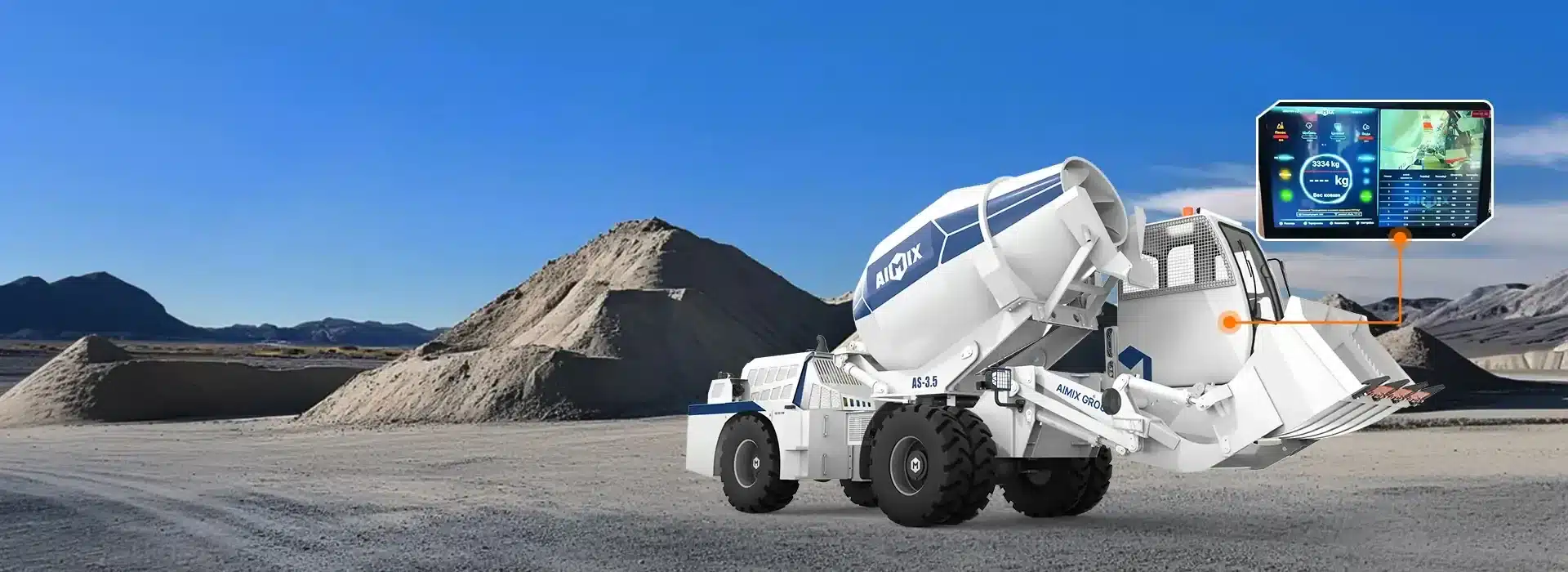
Self loading concrete mixers come in different types, and choosing the right one directly affects construction efficiency, cost, and project progress. In Indonesia, where job sites range from urban housing to remote rural areas, contractors often face one key question: which type of self loading mixer is most suitable for their project? Understanding the main types based on capacity, structure, and application is the first step to making the right decision.
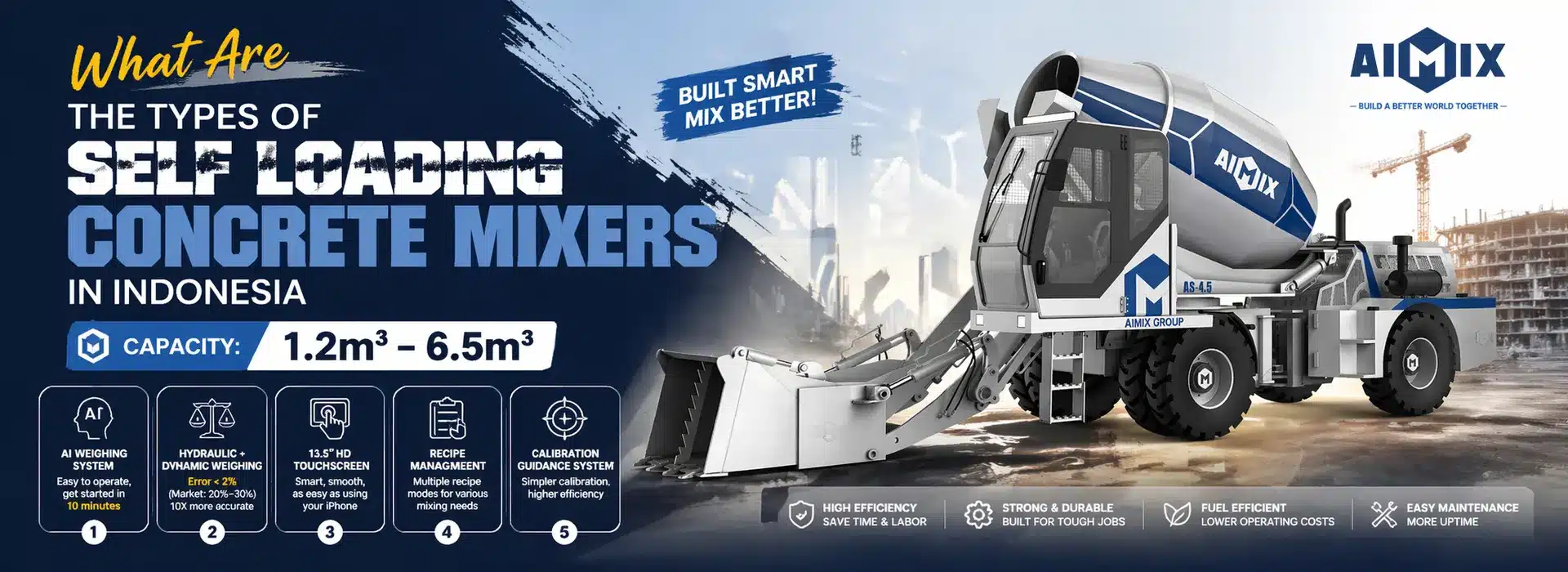
How We Classify Self Loading Concrete Mixers to Help You Choose Faster?
In Indonesia, choosing a self loading concrete mixer is not just about comparing models—it’s about solving real project constraints. Most contractors or equipment buyers are not asking “which machine is the best,” but rather:
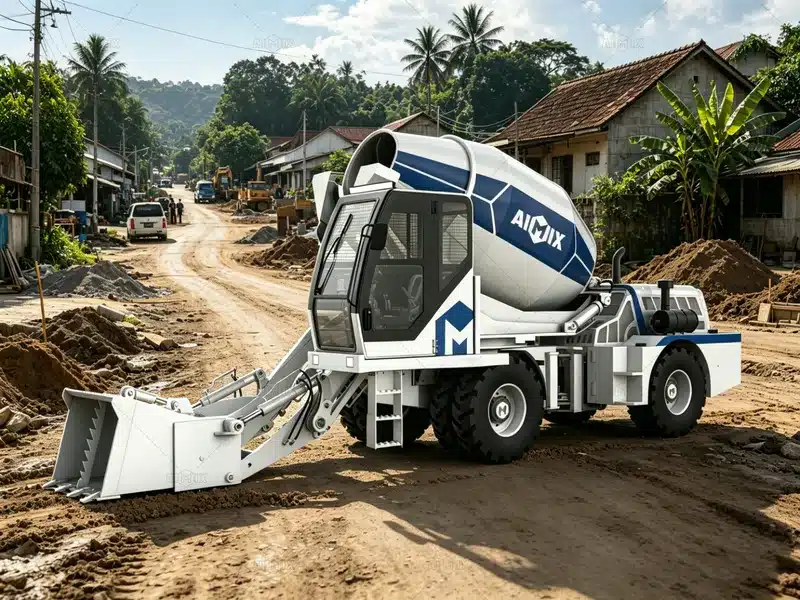
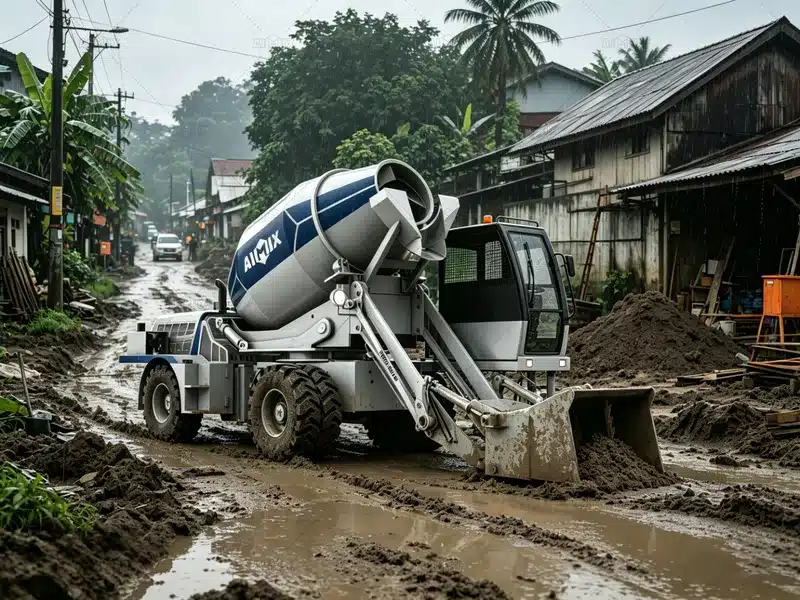
How can I produce 10–30 m³ of concrete per day with limited manpower?
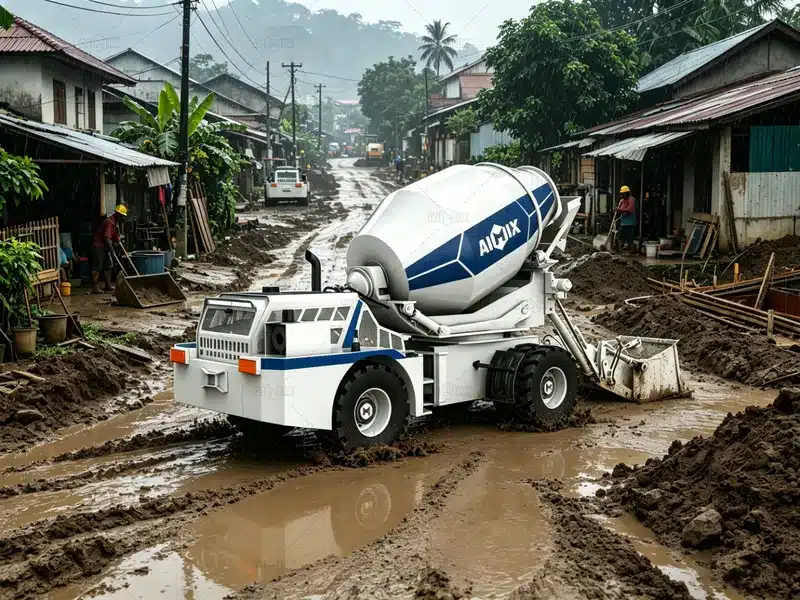
Can the machine handle narrow village roads or muddy conditions during the rainy season?
Will it still be efficient if my project is spread across multiple locations?
In many projects, transportation delays, unstable ready-mix supply, and scattered job sites can reduce efficiency by 20%–40% if the wrong equipment is selected. That’s why we don’t simply list models. Instead, we classify self loading mixers based on how projects actually operate in Indonesia. This makes it easier for you to quickly find the most suitable option.
Types of Self Loading Concrete Mixers by Capacity
When searching for a self loading concrete mixer, most buyers first ask a simple question: 👉 “What capacity do I need for my project?”. Capacity is the most practical way to compare different models because it directly affects daily output, working efficiency, and project progress. In Indonesia, construction projects are often distributed across multiple locations, site access conditions vary, and ready-mix concrete supply is not always reliable. As a result, choosing the right capacity is the key to ensuring smooth on-site production.
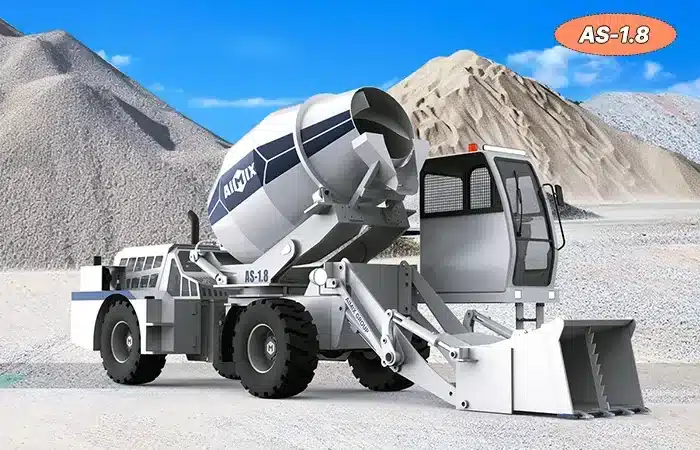
Small Capacity (1.2–1.8 m³)
👉 Compact machines designed for low-volume and restricted-access environments.
Typical characteristics:
Small drum size with flexible movement.
Suitable for narrow roads and small job sites.
Common usage in Indonesia:
Village roads
Small housing in rural or island areas.
Representative models: AS-1.2 / AS-1.8.
Key parameters:
Typical Output: 4.8/7.2 m³/h
Recommended Project Demand: 10–25 m³/day
Working Pattern: Intermittent, multi-point operation.
Get A Quote
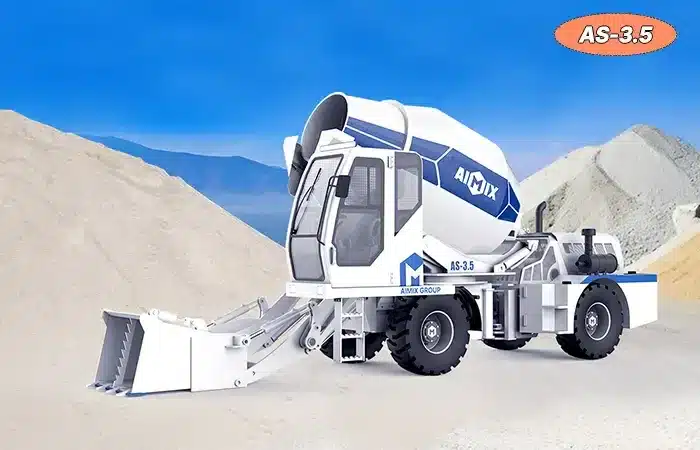
Medium Capacity (2.6–3.5 m³)
👉 Balanced solution for regular Indonesian construction projects.
Typical characteristics:
Stable output with good mobility.
Suitable for daily continuous work.
Common usage in Indonesia:
Housing construction.
Small contractors handling multiple sites.
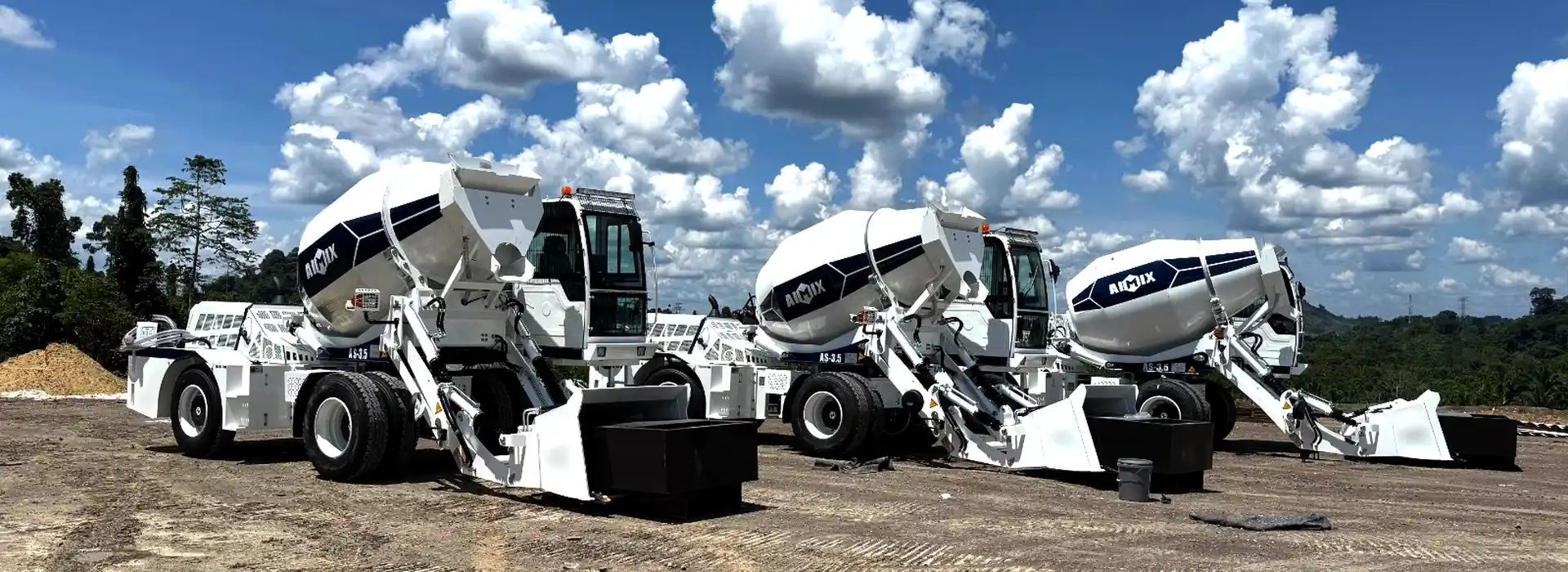
Representative models: AS-2.6 / AS-3.5
Key parameters:
Typical Output: 10.4/14 m³/h
Recommended Project Demand: 20–40 m³/day
Working Pattern: Regular daily operation.
Get A Quote
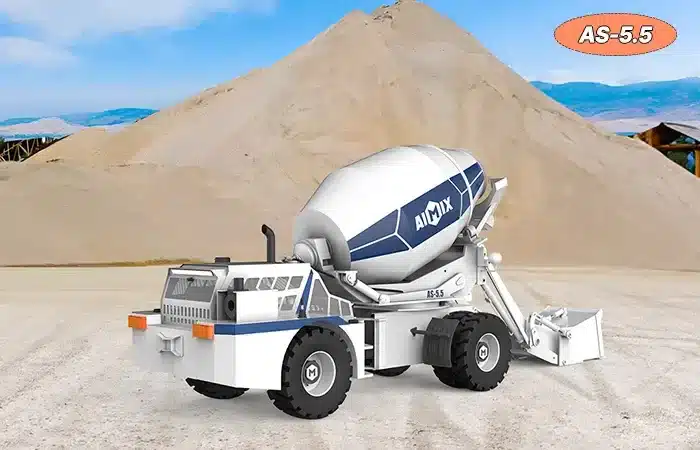
High Capacity (4.5–6.5 m³)
👉 Larger-capacity machines for higher on-site productivity under distributed conditions.
Typical characteristics:
Larger output per cycle.
Suitable for higher daily workload.
Common usage in Indonesia:
Multi-location projects
Remote areas with limited ready-mix supply.
Representative models: AS-4.5 / AS-5.5 / AS-6.5
Key parameters:
Typical Output: 18–26 m³/h (cyclic)
Recommended Project Demand: 30–60 m³/day
Working Pattern: Continuous cyclic operation.
Get A Quote
Capacity is one important way to classify self loading concrete mixers. But output is only part of the story. To choose the right machine, it’s also essential to understand how different configuration systems affect performance, operation, and jobsite adaptability.
Types of Self Loading Concrete Mixers by Configuration System
Besides capacity and application, self loading concrete mixers can also be understood from a configuration perspective. This focuses on how different systems are built into the machine, including its structural base, power transmission, and mobility setup. In Indonesia, where working conditions vary greatly across urban, rural, and remote projects, these configurations directly affect how the machine performs on-site.
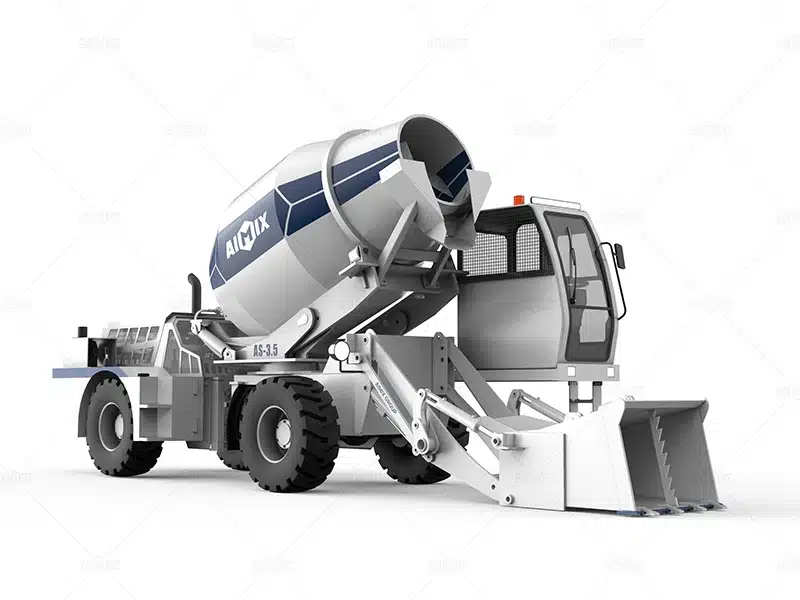
Standard Base Configuration
This is the core configuration used across most self loading concrete mixers. It integrates loading, mixing, transporting, and discharging into one machine structure, providing stable and reliable performance for general construction use.
Key characteristics:
Unified loading–mixing–transport–discharge system.
Simple and mature mechanical structure.
Compatible with all AS-A series models.
👉 Focus: basic functionality and operational stability.
Hydraulic Drive Configuration (H Series Upgrade)
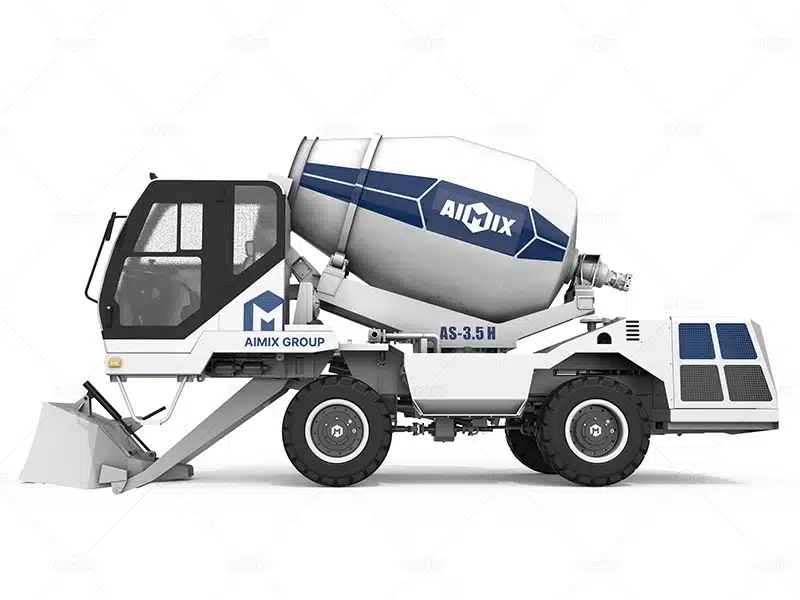
The hydraulic configuration represents an upgraded system that improves operational smoothness and efficiency. It is applied in the AS-H series, offering better control response and more stable working performance on-site.
Key characteristics:
Fully hydraulic transmission system.
Smoother operation with improved control accuracy.
Reduced mechanical wear and lower maintenance demand.
Improved efficiency in loading and discharge processes.
Representative models: AS-3.5H, Other AS-H series models
👉 Focus: efficiency, durability, and operational smoothness
4×2 Driving & Mobility Configuration
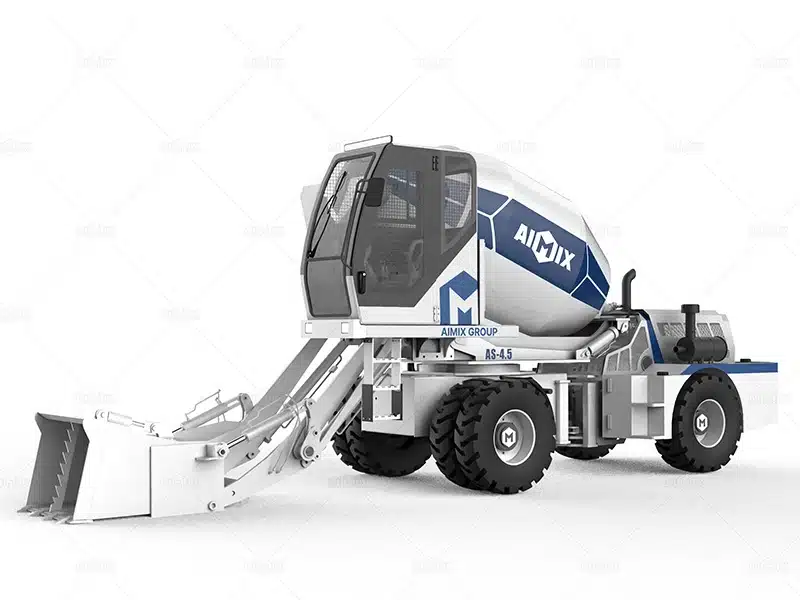
The 4×2 configuration is a mobility-focused system designed to improve traction and site accessibility. It can be integrated into different base models, depending on project requirements and working conditions.
Key characteristics:
Dual-wheel drive system designed for improved traction and stability.
Better performance on uneven, muddy, and complex construction sites.
Enhanced steering control and operational maneuverability on-site.
Typical models: AS-B / AS-C Series
👉 Focus: mobility, terrain adaptability, and site access capability
Configuration determines how a self loading concrete mixer performs on-site. But once you understand the different systems, the next step is choosing the right model. Comparing model specifications will help you see how new type of self loading concrete mixer truck differs in capacity, dimensions, and overall performance.
What Are Model Specifications for Types of Self Loading Mixers
After exploring self loading concrete mixer types by capacity, configuration, and application, the next step is to compare specific models. Each model represents a different type of self loading concrete mixer, with its own output capacity, dimensions, and performance features. Reviewing the specifications side by side makes it easier to identify which type best matches your project requirements, site conditions, and production goals.
| Model | AS-1.2 | AS-1.8 | AS-2.6 | AS-3.5 | AS-4.5 | AS-5.5 | AS-6.5 |
|---|---|---|---|---|---|---|---|
| Mixing tank capacity(m³) | 1.2 | 1.8 | 2.6 | 3.5 | 4.5 | 5.5 | 6.5 |
| Concrete output(m³/h) | 4.8 | 7.2 | 10.4 | 14 | 18 | 22 | 26 |
| Engine power (kw) | 55 | 78 | 78 | 91 | 91 | 110 | 132 |
| Mixer drum capacity (L) | 1700 | 2680 | 3580 | 4740 | 6800 | 7800 | 9000 |
| Water tank (L) | 400 | 500 | 500 | 620 | 920 | 860 | 1465 |
| Weighing method | Automatic hydraulic weighing system | Automatic hydraulic weighing system | Automatic hydraulic weighing system | Automatic hydraulic weighing system | Automatic hydraulic weighing system | Automatic hydraulic weighing system | Automatic hydraulic weighing system |
| Total weight (Kg) | 5000 | 6100 | 7100 | 7900 | 9200 | 11500 | 12520 |
| Overall size (LxWxH) | 6400x2550x3300 | 7700×2750×3350 | 7860×2750×4100 | 7830×2680×4170 | 7640×2870×4750 | 8450×3100×3640 | 8450×3050×3860 |
| Max. Speed (km/h) | 30 | 35 | 30 | 30 | 35 | 42 | 40 |
| Min. turning radius (mm) | 4700 | 3250 | 5300 | 5300 | 4800 | 6200 | 4800 |
| Drum speed (r/min) | 13 | 13 | 13 | 13-20 | 17 | 20 | 20 |
| Fuel tank (L) | 63 | 75 | 75 | 120 | 120 | 180 | 342 |
| Wheel base(mm) | 2300 | 2750 | 2800 | 2900 | 2480 | 3350 | 2850 |
| Hydraulic tank (L) | 63 | 75 | 75 | 120 | 120 | 180 | 274 |
Understanding model specifications helps you compare performance—but choosing the right self loading concrete mixer goes beyond numbers. The real question is: which type best fits your project needs? Next, explore how different types of self loading concrete mixer models perform across various construction applications in Indonesia.
What Are the Application of Different Types of Self Loading Mixers?
In Indonesia, construction projects vary not only by project type, but also by island regions and working environments. From dense urban areas in Java to remote and infrastructure-limited regions in Kalimantan and Papua, application-based classification helps explain how self loading concrete mixers are used under different real construction conditions.
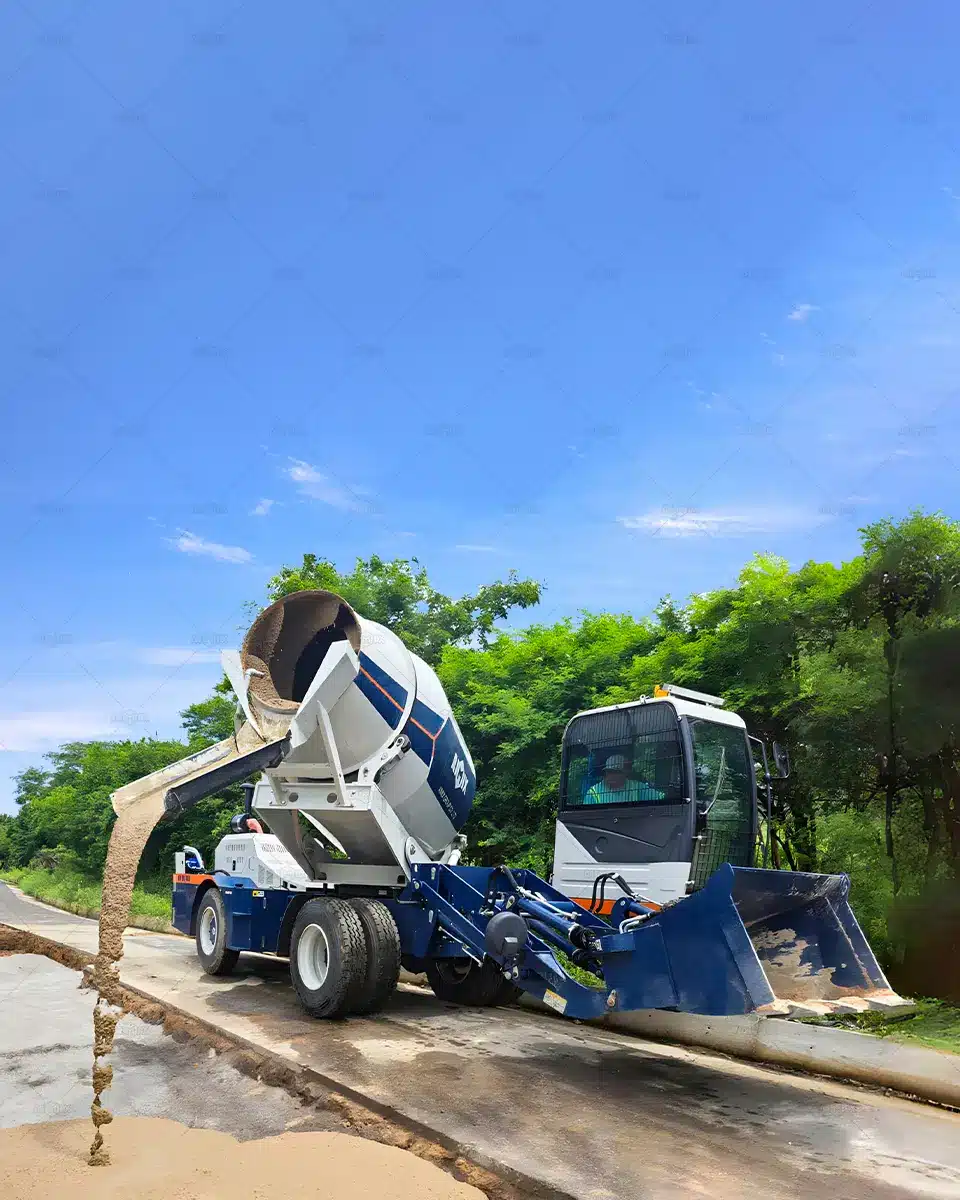
Rural & Remote Area Projects
🌍 Low infrastructure / difficult access / limited supply.
Village construction and small public works.
Island or mountainous area projects.
Sites without ready-mix concrete supply.
👉 Focus: independent on-site concrete production in low-access environments.
Urban & Residential Construction Projects
🌍 Dense urban environment / limited working space.
Housing developments and residential buildings.
Urban commercial construction.
City infrastructure with traffic constraints.
👉 Focus: efficient operation in space-restricted and fast-paced environments.
Infrastructure & Road Projects
🌍 Long-distance / linear construction / changing work zones.
Highway and bridge construction.
Drainage and road expansion projects.
Continuous relocation along project routes.
👉 Focus: stable concrete supply along long construction lines.
Industrial & Commercial Projects
🌍 Structured sites / medium-to-large scale demand.
Factories and warehouses.
Commercial complexes.
Industrial park development.
👉 Focus: consistent quality and controlled construction rhythm.
Scattered & Multi-Site Contractor Projects
🌍 Fragmented sites / flexible deployment / short-term jobs.
Small contractor operations.
Multiple short-duration projects.
Rapid relocation between job sites.
👉 Focus: flexibility and mobility across different locations.
Different projects require different car mixer types—and the best choice depends on more than just application. Factors like capacity, terrain, mobility, and jobsite conditions all matter. Next, discover how to choose the right self loading concrete mixer type for your project in Indonesia.
How to Choose the Right Self Loading Concrete Mixer Type in Indonesia?
Selecting the right self loading concrete mixer in Indonesia means matching the machine to your project scale, jobsite conditions, regional environment, and concrete demand. From urban construction in Java to remote infrastructure work in Papua, the right type can significantly improve efficiency, mobility, and cost control.
| Project Scenario in Indonesia | Typical Working Environment | Daily Concrete Demand (m³/day) | Recommended Capacity | Recommended Configuration | Recommended Models |
|---|---|---|---|---|---|
| Urban Building Construction in Java | Narrow city streets, residential and commercial sites | 10–30 m³/day | 1.8–3.5 m³ | Standard or Fully Hydraulic | AS-1.8, AS-2.6, AS-3.5H |
| Housing and Commercial Projects in Sumatra | Expanding suburban and industrial zones | 20–50 m³/day | 2.6–4.0 m³ | Standard or Dual-Wheel Drive | AS-2.6, AS-3.5, AS-4.0 |
| Plantation and Rural Construction in Kalimantan | Unpaved roads, muddy terrain, dispersed sites | 15–40 m³/day | 3.5–4.0 m³ | Dual-Wheel Drive + Enhanced Mobility | AS-3.5, AS-4.0 |
| Mining and Infrastructure Projects in Sulawesi | Hilly terrain, heavy-duty jobsite conditions | 30–80 m³/day | 4.0–5.5 m³ | Fully Hydraulic + Dual-Wheel Drive | AS-4.0H, AS-5.5H |
| Remote Road and Public Works in Papua | Mountainous areas, limited infrastructure access | 20–60 m³/day | 3.5–5.5 m³ | Fully Hydraulic + High-Mobility Configuration | AS-3.5H, AS-4.0H, AS-5.5H |
FAQs About Types of Self Loading Concrete Mixers
What Are the Main Types of the Best Self Loading Concrete Mixers?
What Is the Difference Between Standard and Hydraulic Self Loading Concrete Mixers?
What Are the Advantages of Dual-Wheel Drive Configurations?
Which Capacity of Self Loading Mixer Is Most Popular in Indonesia?
Can One Self Loading Concrete Mixer Be Used for Different Types of Projects?
Are Self Loading Concrete Mixers Suitable for Remote Areas?
What Factors Matter Most When Comparing Different Models?
Choose the Right Self Loading Concrete Mixer Type Today
Every project in Indonesia has different needs—from tight urban sites in Java to remote jobs in Kalimantan and Papua. The right type of self loading concrete mixer for sale can directly improve your efficiency, cost control, and on-site performance. 👉 Contact us to get the best recommended self loading concrete mixer type for your project in Indonesia.


